Fast Turnaround Estimating: Key Requirements at a Glance
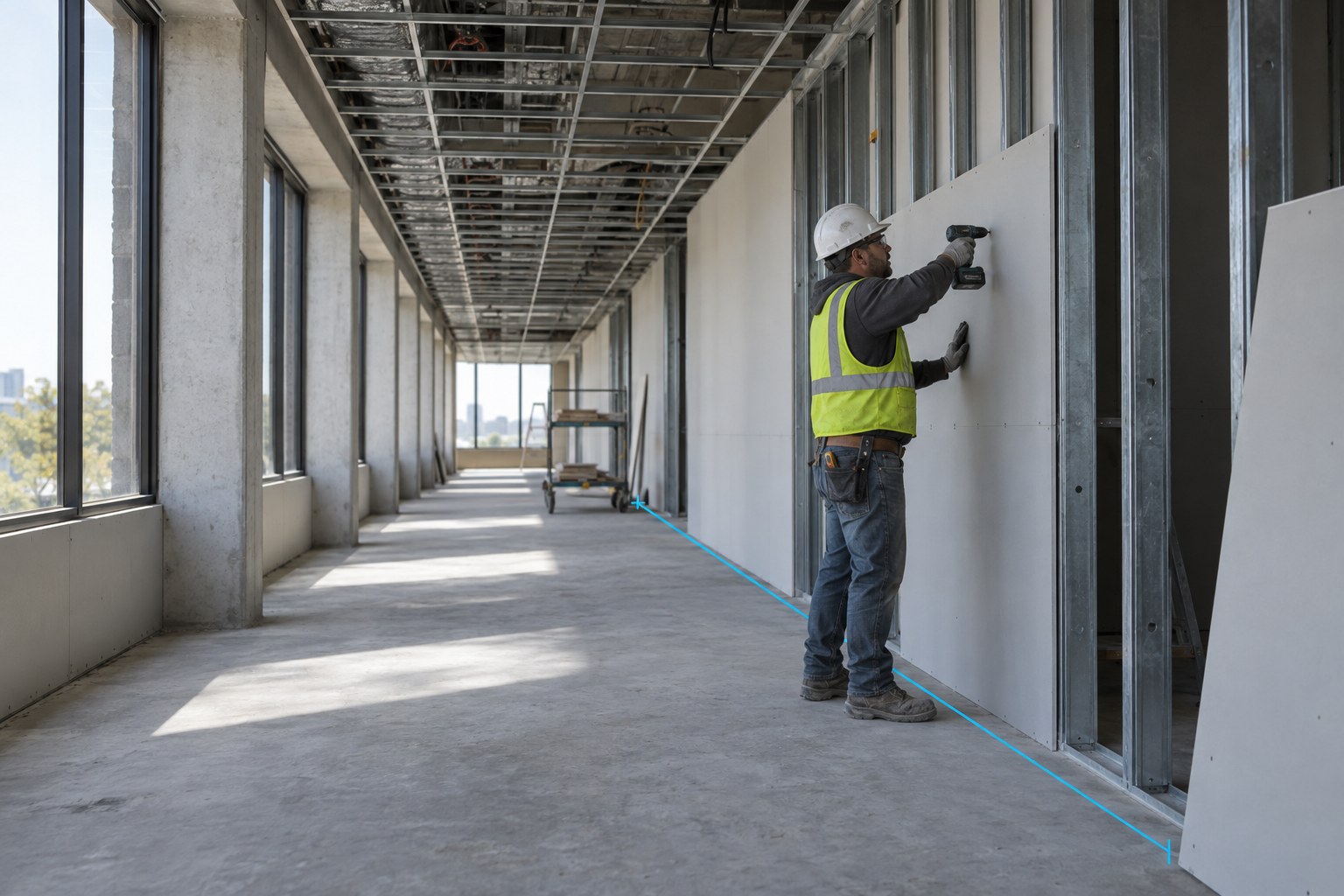
Fast turnaround estimating means delivering a defined takeoff or estimate within a compressed, agreed timeframe after the required project documents are received. This guide covers commercial flooring, drywall, ceilings, and painting scope: which windows may be feasible, what slows a bid down, and the controls that keep a quick estimate defensible.
| Question | Short answer |
|---|---|
| What does fast turnaround estimating mean? | Elapsed calendar time from receipt of complete documents to deliverable in hand, not hours spent at the desk. |
| What window is realistic? | A 24- to 48-hour window may be feasible for a clear, standard scope after document review. Large multi-trade packages need longer. |
| Does speed reduce accuracy? | Not inherently. Accuracy depends on complete documents, a defined scope, and review controls. |
| When should a contractor outsource? | When bids stack up, the scope is unfamiliar, or internal estimating capacity is limited. |
| What must the contractor supply? | Full drawing set, specifications, finish schedule, every issued addendum, bid date, and the scope split. |
What Fast Turnaround Estimating Means in Construction
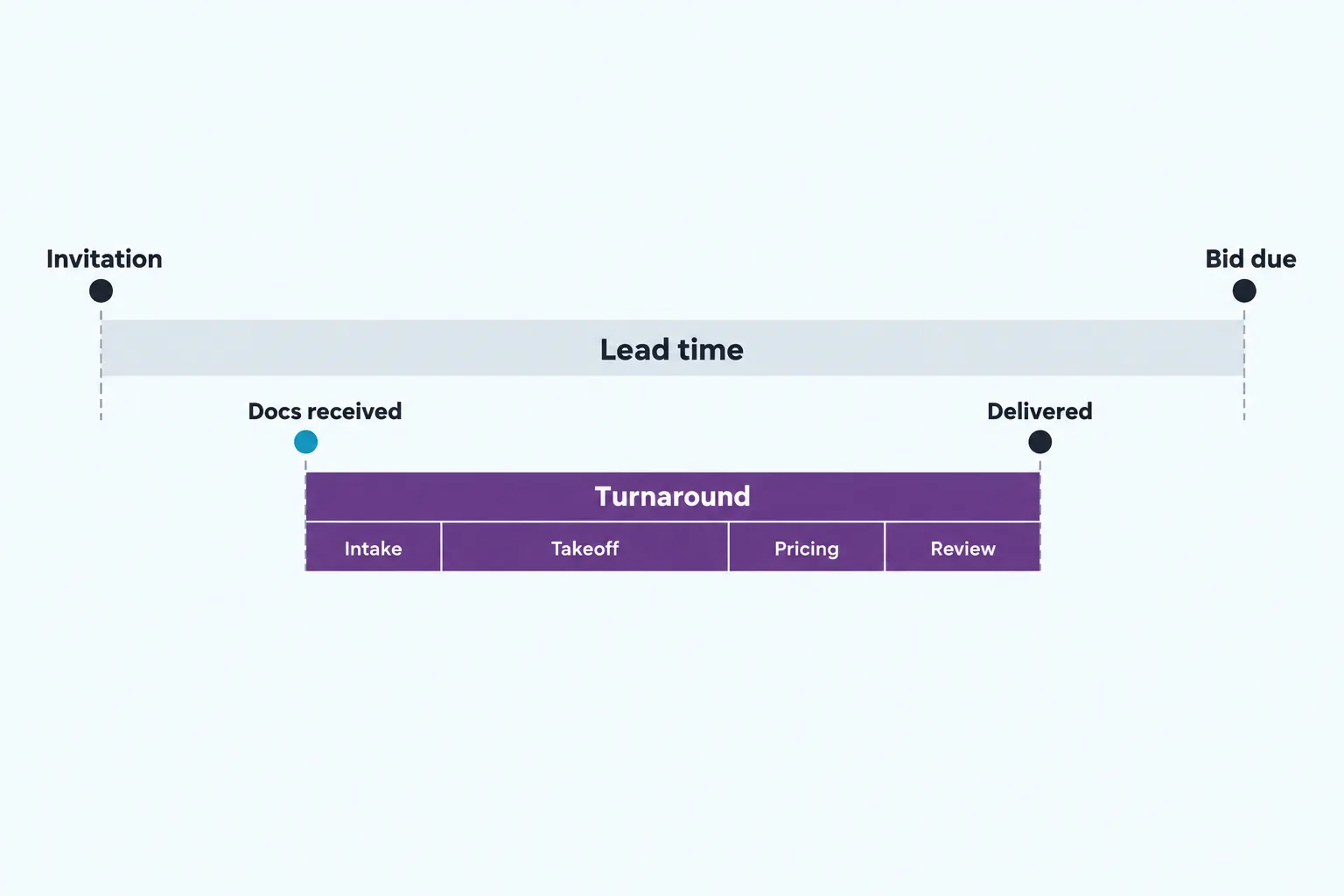
In construction estimating, turnaround time is the elapsed period between receiving the required documents and delivering the agreed takeoff or estimate. The same rule applies here. The clock starts when plans, specifications, addenda, and the finish schedule are all in hand, and it stops when the deliverable is returned. The contractor needs a clear delivery time, not simply an estimate of how many hours the estimator will work.
Three terms get mixed up during bid week. Turnaround time is the promise made to the contractor. Cycle time is the internal process length across intake, takeoff, pricing, and review. Lead time is the gap between invitation and bid due date, the only one the estimator does not control. Scope tier matters just as much: budget-level quantities, a detailed takeoff, and a full proposal package are three different products with three different windows. A clear grasp of how commercial construction estimating works prevents the wrong tier from being ordered under pressure.
What Affects Fast Construction Estimating Turnaround Time?
Some estimating providers advertise 24- to 48-hour turnaround for standard scopes, but the actual window depends on document completeness, project complexity, revisions, and available capacity. A clear, single-trade package may be suitable for a compressed window; a large, multi-trade set with active revisions may require a longer or staged delivery.
The ranges below are illustrative planning ranges, not Quantify guarantees; confirm the actual timing after the provider reviews the scope and documents.
| Project scope | Realistic window | What drives the variance |
|---|---|---|
| Single-tenant retail flooring | About 24 hours | Number of finish types, transition count, roll direction |
| Mid-rise corridor drywall and ceilings | 24 to 48 hours | Board types by rating, soffits, bulkheads, grid changes |
| School repaint package | 36 to 48 hours | Substrate variety, coats per specification, existing conditions |
| Multi-trade commercial package | Multiple days | Scope splits, addenda volume, coordination between trades |
The takeoff is usually the longest part of the process. Once quantities are measured and checked, assembling a proposal from a standard template is often shorter by comparison. A provider quoting the same window for every project should explain its scope limits, exclusions, revision policy, and review process. A rush request may affect price or availability, so ask how scope and timing affect the quote before work begins. It also helps to know what an estimate should cost before speed is negotiated. For broader construction timeline guidance, see How Long Should an Estimate Take?.
Is Your Project Ready for Fast Turnaround Estimating?
| Project status | What it means | Recommended action |
|---|---|---|
| Ready | Single-trade scope, complete documents, and no pending addenda | Request a confirmed turnaround. |
| Needs review | Missing schedule, unclear scope, or a recent addendum | Resolve the missing information before measurement begins. |
| High risk | Multi-trade package, active revisions, or unclear responsibilities | Expect a longer or staged delivery. |
The faster the intake review identifies missing information, the less likely the bid is to stall after the takeoff has started.
What Slows an Estimate Down and How to Remove It
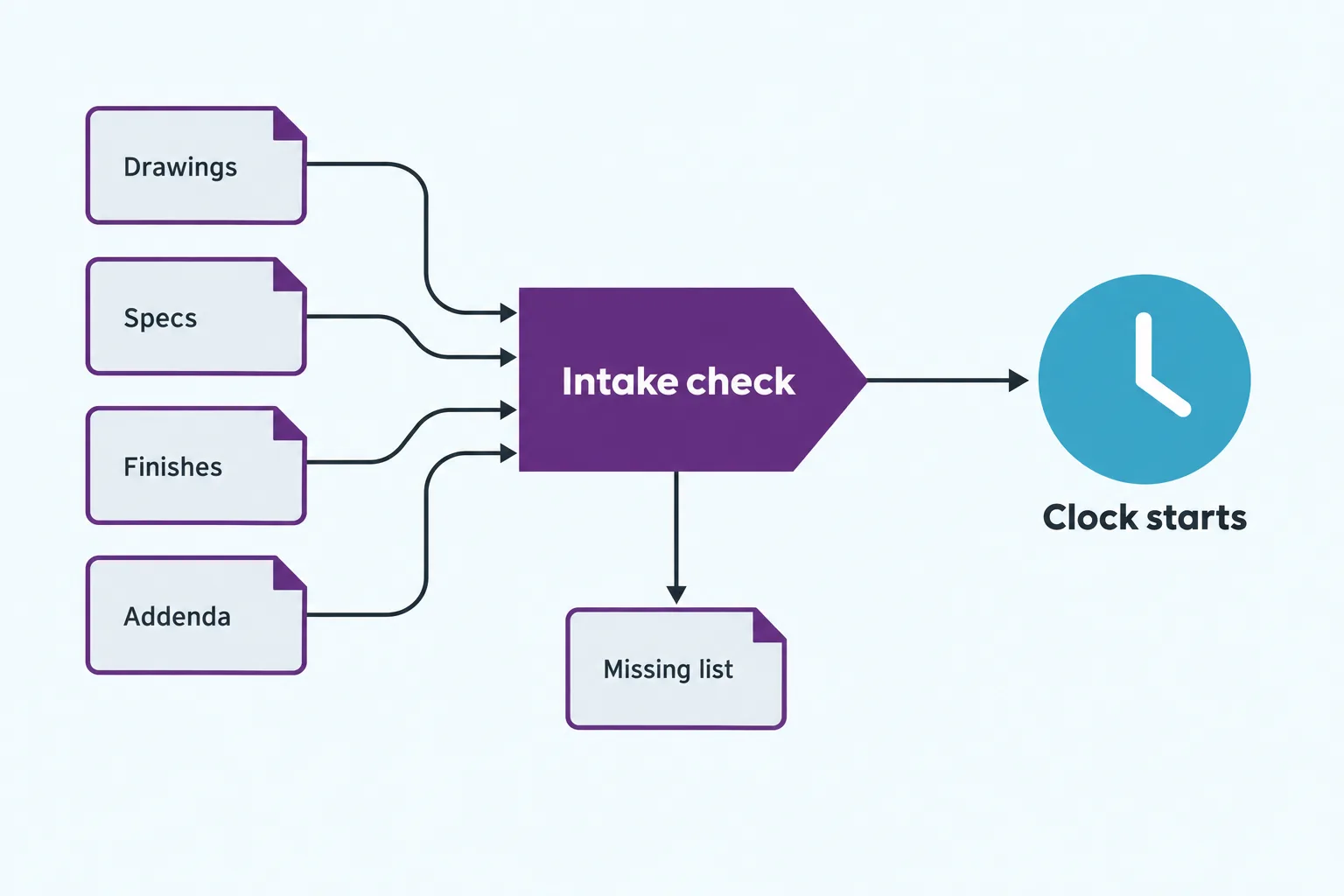
Most lost hours come from friction, not from slow measurement.
| Friction source | Practical fix |
|---|---|
| Incomplete or unreadable plan set | Intake check before the clock starts, with a written list of missing items |
| Late addenda | Addendum log tied to the bid date, with quantities isolated by area for quick revision |
| Missing finish schedule | Never assume finishes; request the schedule at intake |
| Manual re-entry between takeoff and spreadsheet | Direct export from takeoff software into the pricing sheet |
| Inconsistent estimate structure across jobs | One standard condition set and cost code layout per trade |
| Unclear scope split with other trades | Inclusion and exclusion language confirmed before measurement begins |
Duplicate data entry and mismatched formats create rework that can consume a compressed bid window. Front-loaded work reduces it through reusable assemblies, saved waste factors, and standard trade conditions. A repeatable drywall takeoff process built on saved assemblies can reduce repetitive work compared with starting from a blank file.
Speed Without Cutting Corners
Fast turnaround estimating should come from a repeatable process, not from removing checklist steps. The controls stay in place regardless of the deadline: measured areas reconciled against plan gross area, waste and cut-loss factors applied per material rather than as one blanket number, transition and seam counts verified, and a second-pass review before release.
Transparency is the other half. Marked-up plans, original software files, and quantity backup let a contractor audit every line rather than trust a total. A fast estimate should identify unverified vendor pricing, assumed unit costs for unspecified products, and allowances that are not based on measured quantities. Quantify’s flooring page lists Basic Budget, Detailed, and Full Service options; confirm which service level, deliverables, and turnaround apply to the trade and project.
Estimating Methods: Match the Method to the Scope
Related readingHow to Bid Flooring Jobs Faster in 2026Read the guide →| Method | Typical use | Speed | Data required |
|---|---|---|---|
| Analogous | Early budget from a similar completed project | Fastest | Historical cost of a comparable job |
| Parametric | Budget by unit rate, such as cost per square foot | Fast | Reliable rate data and a defined area |
| Unit cost, from a bottom-up quantity takeoff | Trade contractor bid submissions | Slower per hour, faster overall with assemblies | Complete drawings and specifications |
| Three-point | Scope with genuine uncertainty | Moderate | Optimistic, likely, and pessimistic values |
Unit cost estimating, measured quantities multiplied by unit prices for material, labor, and equipment, is a common approach for trade bids. Bottom-up estimating can provide a detailed basis when quantities and unit costs are defined, but no method guarantees accuracy when the inputs are incomplete.
Document quality often matters as much as the method. Three-point estimating can help when scope is genuinely uncertain, such as existing conditions, demolition, and moisture mitigation under new flooring. If accuracy is evaluated, compare the estimate with actual installed costs using a documented basis; a low bid alone is not a complete benchmark.
For broader guidance on documenting scope, assumptions, risk, and estimate validation, see the U.S. Government Accountability Office Cost Estimating and Assessment Guide.
Estimate Classes: Why Scope Definition Matters
AACE’s generic estimate-classification guidance describes five classes, from Class 5, the least defined, to Class 1, the most defined. Classification details vary by industry, and accuracy ranges are not absolute targets.
| Class | Purpose | Document maturity |
|---|---|---|
| Class 5 | Concept screening | Minimal definition |
| Class 4 | Feasibility study | Early design |
| Class 3 | Budget authorization | Design development |
| Class 2 | Cost control | Advanced documents |
| Class 1 | Check estimate, bid tender | Near complete |
A rough order of magnitude number can be prepared quickly because less is defined. More detailed Class 1 work generally requires more complete documents than Class 4 work; the applicable classification standard should be confirmed for the project.
Software Behind Fast Flooring and Drywall Takeoffs
Flooring estimating software and general takeoff platforms carry the measurement load. Quantify’s About page lists tools including PlanSwift, MeasureSquare, and RFMS Measure; confirm the current tool and output format for the specific project.
| Task | What the software removes | What still needs a person |
|---|---|---|
| Area measurement | Manual scaling and arithmetic | Scale confirmation on revised sheets |
| Seam and roll layout | Trial-and-error diagramming | Pattern direction and aesthetic calls |
| Sheet and board counts | Repetitive tallying | Board type by rating and finish level |
| Quantity export | Retyping into a spreadsheet | Specification interpretation and substrate conditions |
An Excel template or online calculator can support repeat unit work and a simple partition run. Multi-room commercial scope usually requires more than one formula because transitions, base linear footage, and material-specific waste factors affect quantities. Software licenses alone do not create speed; trained operators and standard templates are also required. Commercial flooring estimating depends on both.
In-House Estimator vs Outsourced Estimating Support
| Factor | In-house estimator | Outsourced support |
|---|---|---|
| Cost structure | Fixed salary and overhead | Varies by provider or engagement |
| Peak-season overflow | Capped by headcount | Scales with bid volume |
| Bid volume ceiling | Fixed | Flexible |
| Coverage during vacation or turnover | Gap | May add capacity, subject to availability |
In-house wins on negotiated repeat work, proprietary pricing, and deep client history. Outsourced construction estimating can help when bids stack up, the trade is unfamiliar, or a live bid arrives with a short deadline. Higher bid volume without added headcount is the real lever behind fast turnaround estimating at a company level.
Have a live flooring bid this week? Send the plan set through Quantify’s flooring service page to discuss the scope, deliverables, and available turnaround.
How to Evaluate a Fast Turnaround Estimating Provider
| Check | What to confirm before sending the project |
|---|---|
| Start time | What documents must be complete before the turnaround clock begins? |
| Deliverable | Is the service providing quantities, a priced estimate, or a full proposal package? |
| Revisions | How are addenda, bulletins, and scope changes handled? |
| Quality control | Are marked plans, quantity backup, assumptions, and exclusions included? |
| Trade fit | Does the provider understand the relevant flooring, drywall, ceiling, or painting scope? |
| Capacity | What happens if the project is larger or more complex than expected? |
Speed is useful only when the deliverable is clear, traceable, and suitable for the contractor’s pricing workflow.
Trade Notes: Flooring, Drywall and Ceilings, Painting
| Trade | The detail that most often breaks a rushed estimate |
|---|---|
| Flooring | Transitions and base linear footage counted after the fact, plus attic stock left out |
| Drywall and ceilings | Finish level and board type by rating assumed rather than read from the schedule |
| Painting | Surface area treated as floor area, and coats per specification miscounted |
Drywall installation cost, the cost to hang and finish drywall, and price per sheet all depend on measured quantities, region, and finish level. National averages can mislead when the drawing set changes. Trade-specific figures belong in labor cost to hang and finish drywall rather than inside a bid assumption. For direct service options, see Quantify’s drywall services and painting services.
How to Build a Fast, Reviewable Bid Process
| Step | Owner | Gate before the next step |
|---|---|---|
| Intake and document check | Coordinator | Plans, specifications, schedule, and addenda confirmed complete |
| Scope confirmation and exclusions | Estimator | Inclusions and exclusions in writing |
| Quantity takeoff | Estimator | Areas reconciled against plan gross area |
| Pricing and assembly application | Estimator | Waste factors applied per material |
| Second-pass review | Senior reviewer | Counts and unit prices checked by a second set of eyes |
| Proposal release | Coordinator | Backup files attached to the deliverable |
Standard proposal templates with fixed inclusion and exclusion language remove hours at the back end. Bid calendar triage removes more: decline the invitations that are not winnable so capacity goes to the ones that are. Contractors running repeat trade packages can apply the same sequencing shown in this guide on how to bid painting jobs faster.
Key Takeaways
| Takeaway | Why it matters on bid day |
|---|---|
| A compressed window may be feasible for a complete, standard scope | Confirm the actual timing after document review; do not treat 24–48 hours as universal. |
| The clock starts at document completeness | Missing addenda or finish schedules move the deadline, not the estimator |
| Document quality limits confidence | No method can fully compensate for missing or conflicting information. |
| Standardized assemblies and templates can reduce repetitive work | They save time without removing review steps. |
| Outsourced support may add bid capacity | It can help when internal staff are already committed. |
A consistent approach to drywall estimating and every other trade package keeps these takeaways repeatable across a bid calendar.
Frequently asked questions
What does fast turnaround estimating mean in construction?
What is the difference between a construction takeoff and a full estimate?
Can a construction estimate be completed in 24 hours?
How do you verify a fast estimate?
Can an Excel template or online calculator deliver a fast turnaround estimate?
What do I need to send for a fast turnaround takeoff?
How should I evaluate a fast turnaround estimating provider?
Request Fast Estimating Support for Your Next Bid
Send the plan set and finish schedule to discuss the scope, required deliverables, and available turnaround. Quantify was developed by Kathy Case after experience in commercial tile, project management, sales, management, and estimating. Confirm the review steps and delivery window for your specific scope. Start a project with our team and put the next deadline back under control.