
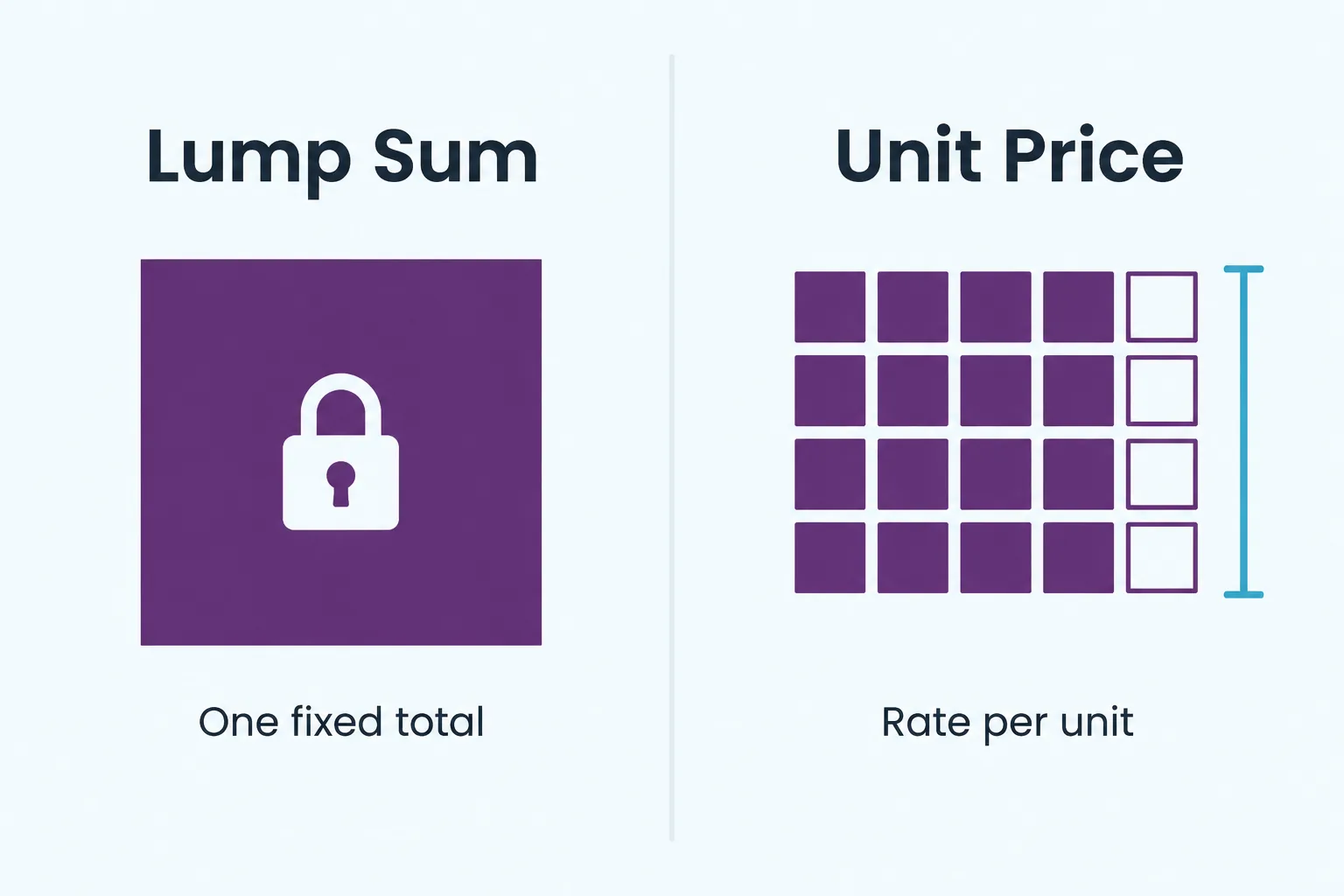
A lump-sum bid sets one price for a defined scope; a unit-price bid lists rates for measurable work items. Which structure fits depends on how clearly the scope and quantities can be defined, what the bid documents require, and how the contract adjusts payment when quantities change.
| Topic | Short answer |
|---|---|
| Lump sum bid | One total for a defined scope; the contractor generally carries cost overruns within that scope, subject to contract terms. |
| Unit price bid | A rate per stated unit; the bid total usually extends estimated quantities, while payment follows the contract’s measurement rules. |
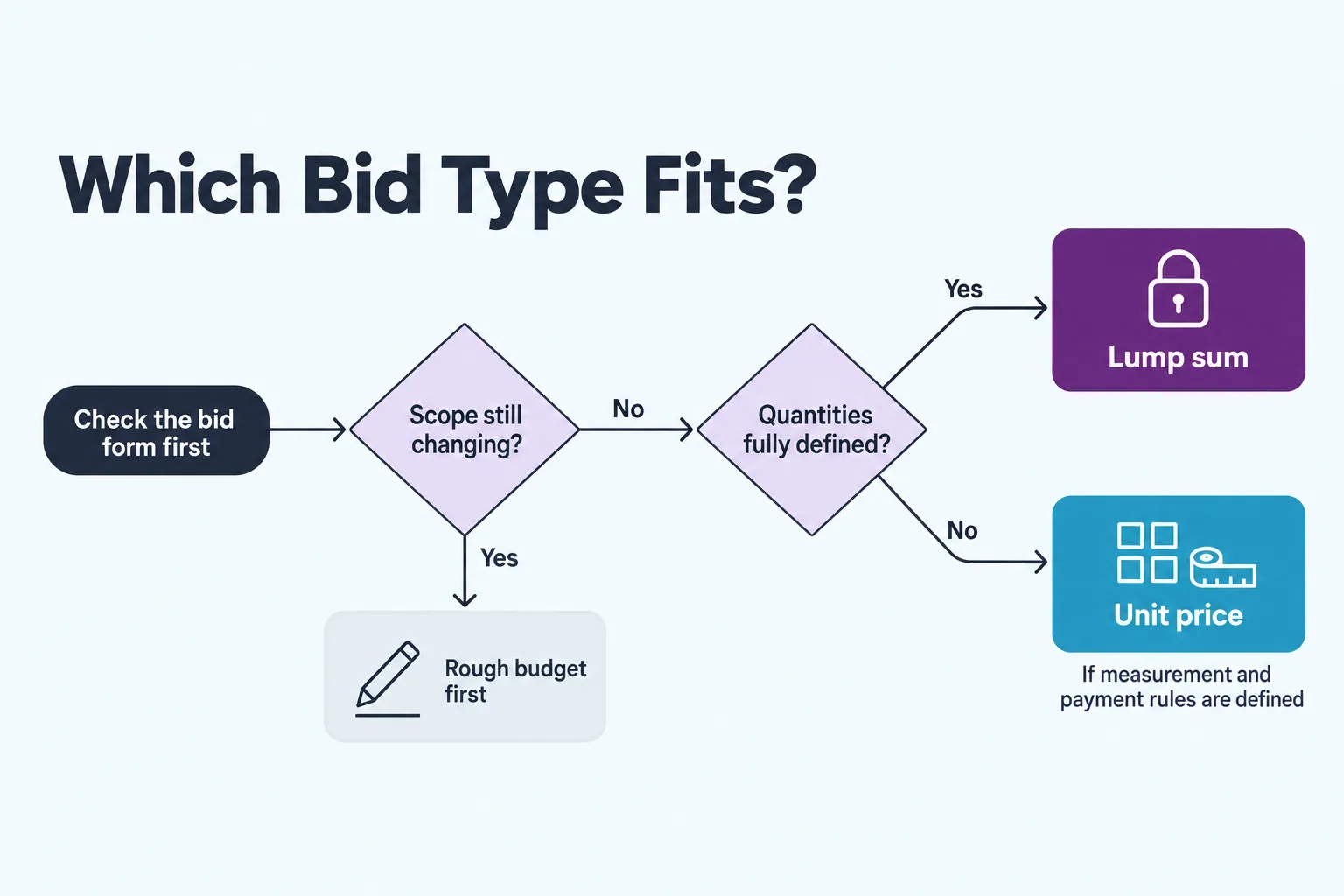
| Decision rule | A defined scope may suit lump sum; uncertain but measurable quantities may suit unit pricing. Follow any required bid form. |
| Takeoff role | A scope-based takeoff supports estimating under either structure. |
| Hybrid option | A bid can combine a lump-sum base with scheduled unit prices when the bid documents allow it. |
What a Lump Sum Bid Means
A lump-sum bid gives the owner one total price for a defined scope. AIA describes stipulated-sum contracting as an agreed fixed amount for the work. If the contractor must complete the same defined scope for that amount, estimating or productivity overruns can reduce its margin; approved scope changes and other contract adjustments may change the amount due. See AIA’s overview of construction contract types for the stipulated-sum context.
Progress payments on lump-sum work may use a schedule of values, but the contract sets the billing and approval process. A change in scope does not automatically increase the lump-sum price; follow the contract’s change-order and adjustment provisions. A disciplined building estimation process helps document the quantities and assumptions behind the bid.
What a Unit Price Bid Means
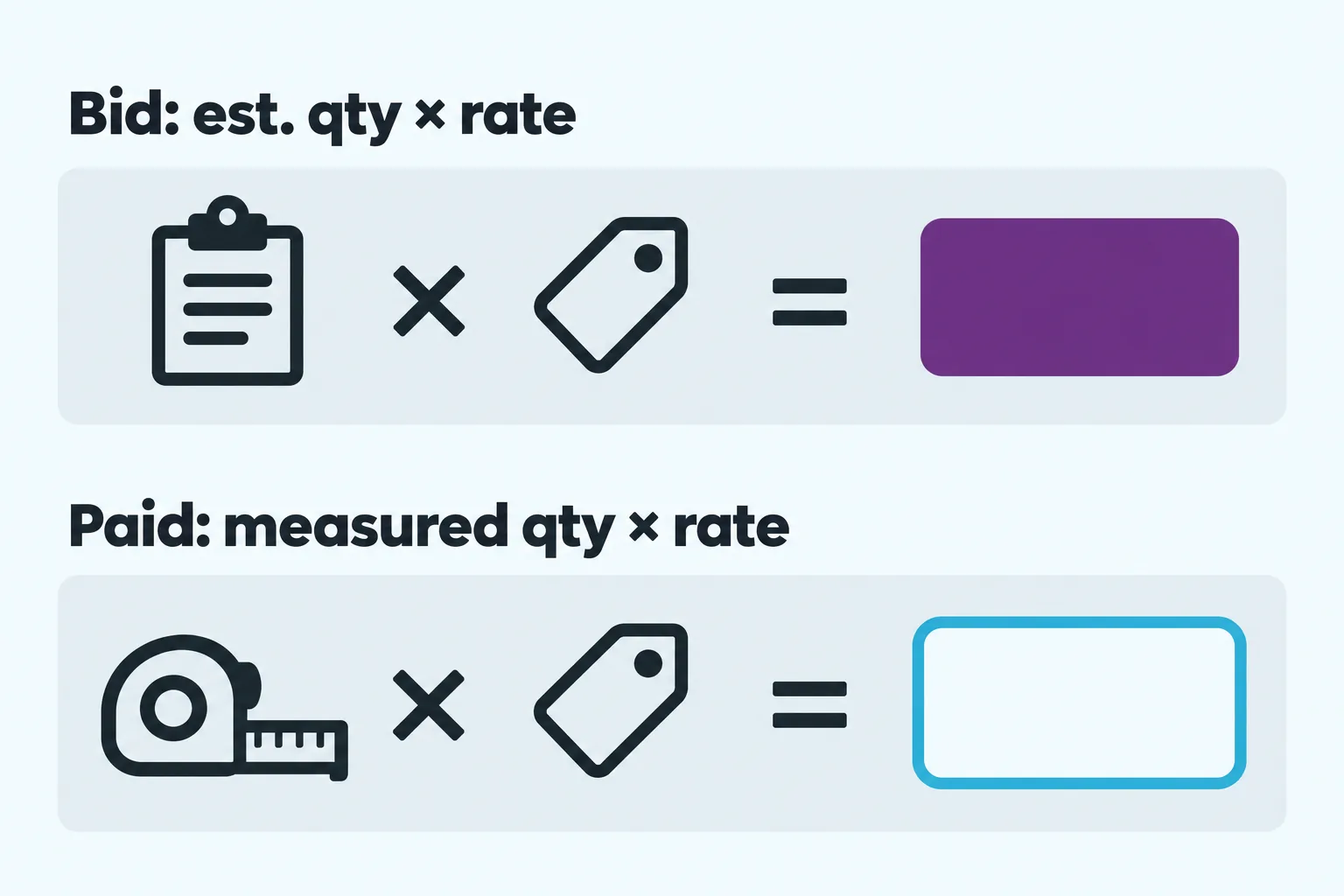
A unit-price bid lists a rate for each defined pay item. The evaluated bid total is commonly calculated by multiplying each estimated quantity by its bid rate and adding the line totals. Final payment may use accepted field-measured quantities where the contract provides for that method; bid documents can also set quantity limits, measurement rules, or adjustment procedures. Federal construction rules recognize lump-sum pricing, unit pricing, and combinations of the two, but each project’s solicitation controls its own terms. See FAR rules for pricing fixed-price construction contracts.
A unit rate should account for the costs included in that pay item, such as material, appropriate waste, labor, equipment, allocated overhead, and profit. Unit pricing is used for measurable work in areas such as earthwork, utilities, paving, and repairs. Finish-trade work may also use square-foot or per-sheet rates when the bid documents define those units and what each includes. A drywall takeoff or flooring quantity list can support the quantity side of that pricing.
Unit Price vs Lump Sum Bid: Side-by-Side Comparison
| Factor | Lump sum bid | Unit price bid |
|---|---|---|
| Price structure | One total for the defined scope | Rate per pay item, extended by estimated quantity |
| Quantity risk | Contractor generally carries cost overrun risk within a defined lump-sum scope, subject to contract adjustments. | Owner may pay for accepted quantity changes at scheduled rates where the contract provides. |
| Production-cost risk | Contractor’s labor and productivity assumptions affect margin. | Contractor’s cost to deliver each unit affects margin. |
| Scope and quantity certainty | Works best with defined scope and quantities that can be estimated with confidence. | Can suit work with measurable quantities that may vary, if the contract defines measurement and payment. |
| Payment basis | Progress billing follows the contract, often through a schedule of values. | May be based on accepted measured quantities multiplied by rates, as the contract specifies. |
| Quantity or scope change | Use the contract’s change and adjustment process. | An existing pay-item rate may apply to quantity changes if the contract says so; new or changed work may require a new rate or change order. |
| Bid comparison | A single total may hide different assumptions or exclusions. | Line rates help compare bids when units, descriptions, and estimated quantities match. |
| Possible fit | Well-defined scope, such as a complete finish package. | Defined, measurable work where quantities may vary, such as some removal or repair items. |
A bid may combine a lump-sum base with unit prices for specified, measurable additions or deductions. Those rates apply only under the conditions stated in the bid documents. A drywall bid template can help organize scope and pricing details for that trade.
Downsides of Each Bid Type
| Failure mode | Lump sum | Unit price |
|---|---|---|
| Cost certainty | The contract total is established for the defined scope, subject to stated changes or adjustments. | An evaluated total can be calculated at bid time; final value may vary with accepted measured quantities and contract terms. |
| Disputes | Scope gaps and change order friction | Quantity and measurement disagreements |
| Administration | Lighter | Heavy field measurement and documentation |
| Pricing risk | Uncertainty may be reflected in the contractor’s price; the final payment follows the agreed contract amount and terms. | Rates may be unbalanced or fail to recover fixed setup costs on low-quantity items. |
Review unit-price schedules for rates that are disproportionately high or low compared with the work and estimated quantities. FHWA federal-aid guidance on unbalanced bids notes that a mathematically unbalanced bid may still be awarded if it is not materially unbalanced. Review criteria and consequences depend on the solicitation and applicable procurement rules; do not assume every unbalanced schedule is automatically rejected.
When to Use Each Bid Type
| Project condition | Better fit |
|---|---|
| Complete construction documents, fixed finish schedule | Lump sum |
| Owner needs a firm price for a clearly defined scope | Lump sum may fit, subject to the contract’s scope and adjustment terms. |
| Repeatable build-out with a complete, consistent scope | Lump sum may fit when the work can be priced as a defined package. |
| Some quantities remain uncertain but can be measured under defined rules | Unit price may fit if the bid documents explain measurement and payment. |
| Repair or removal work with defined units and variable quantities | Unit price may fit if the bid documents establish measurement and payment rules. |
| Repeated scope with a required per-unit schedule | Unit price may fit; use lump sum when each scope is fully defined and bid as a package. |
| Bid forms that require unit-price pay items | Use the format and quantities required by the solicitation. |
| Early budget with scope still in motion | Neither yet; use a rough order of magnitude figure |
For a partly defined project, a hybrid may work: price the documented scope as a lump sum and use scheduled unit rates for specific, measurable items whose quantities may change. The solicitation must allow that structure and state when those rates apply.
How a Unit-Price Bid Total Is Calculated
For each bid item, multiply the estimated quantity by the unit rate to get the extended line total. Add the line totals to calculate the evaluated bid amount. If the contract pays on accepted field-measured quantities, the final amount for each item may differ from its bid-time extension.
Illustrative example: a bid form lists 800 square feet at a rate of R per square foot, so the evaluated line total is 800 × R. If the contract later recognizes 900 accepted square feet, payment may use 900 × R, subject to the contract’s measurement rules, limits, and adjustment clauses.
The bid form and contract, not the formula alone, determine the payable amount.
Bid-Document Checks Before Pricing
Before submitting either type of bid, confirm:
- Which pricing format the bid form requires; bidders may not be free to choose a different structure.
- The exact pay-item description, unit of measure, and estimated quantity.
- How quantities are measured, recorded, approved, and paid.
- Whether quantity thresholds, minimums, maximums, or rate adjustments apply.
- How the contract treats additions, deductions, new work, allowances, and change orders.
- Whether mobilization, setup, taxes, waste, and other costs belong in a unit rate or separate line item.
How Takeoff Accuracy Affects Both Bid Types
A quantity takeoff supports both pricing methods. On a lump-sum job, a missed quantity may reduce margin when the contractor must still complete the defined scope for the agreed amount. On a unit-price bid, estimated quantities affect the evaluated total, while payment may follow accepted actual quantities if the contract provides for it.
Pay units matter at the takeoff stage. Drywall may be measured by sheet or by square foot of board installed and finished; flooring and painting scopes may use square feet of the specified work. The estimator must match the takeoff scope and units to the bid form. Quantify’s construction estimating services and outsourced construction estimating can support contractors that need additional takeoff capacity during busy bid periods.
How to Build a Unit Rate That Holds Up
Related readingBid Accuracy Improvement: A Practical Guide For ContractorsRead the guide →| Rate component | What it covers |
|---|---|
| Material | Board, flooring, adhesive, fasteners, coatings, plus a waste factor for the pattern and room shape |
| Labor | Crew hours at a documented production rate, converted to the pay unit |
| Equipment | Lifts, stilts, mixers, and anything with a rental or ownership cost |
| Overhead | Supervision, insurance, mobilization, and general conditions allocated per unit |
| Profit | The margin applied after the loaded cost is set |
Production rates shift with conditions. The labor cost to hang and finish drywall per square foot can change with finish level, ceiling height, room size, and soffit count. Break pay items out by relevant conditions, and check the assumptions behind the labor cost to hang and finish drywall before applying a rate across a larger area. Do not front-load unit rates; review the solicitation’s pricing requirements and any applicable rules for unbalanced bids.
Key Takeaways
| Rule | Detail |
|---|---|
| Quantity risk | Often sits with the contractor on a defined lump-sum scope and with the owner for measured unit-price quantities, subject to contract terms. |
| Scope and quantity certainty | Defined scope tends to suit lump sum; measurable quantities that may vary can suit unit pricing. |
| What can reduce margin? | Missed quantities within a defined lump-sum scope or unit rates that do not cover the contractor’s cost to perform. |
| Hybrid option | A lump-sum base with scheduled unit prices may suit a defined scope with specific measurable uncertainties. |
| Core estimate input | A measured takeoff with clear scope and quantity assumptions. |
Frequently asked questions
What is the difference between lump sum and unit price?
Can a construction bid combine lump sum and unit-price items?
Can you give me an example of a unit price?
Are estimated quantities guaranteed on a unit-price bid?
What does LS mean on a bid form?
What does a unit price vs lump sum bid example look like on a fit-out?
Get Quantities You Can Bid With Confidence
Both bid structures rely on clear scope and well-supported quantities. Quantify North America provides takeoff and estimating support for flooring, drywall, ceilings, and painting. Ask whether the takeoff can be organized around the units in your bid form. Review the drywall estimating service or contact the team about an upcoming bid.