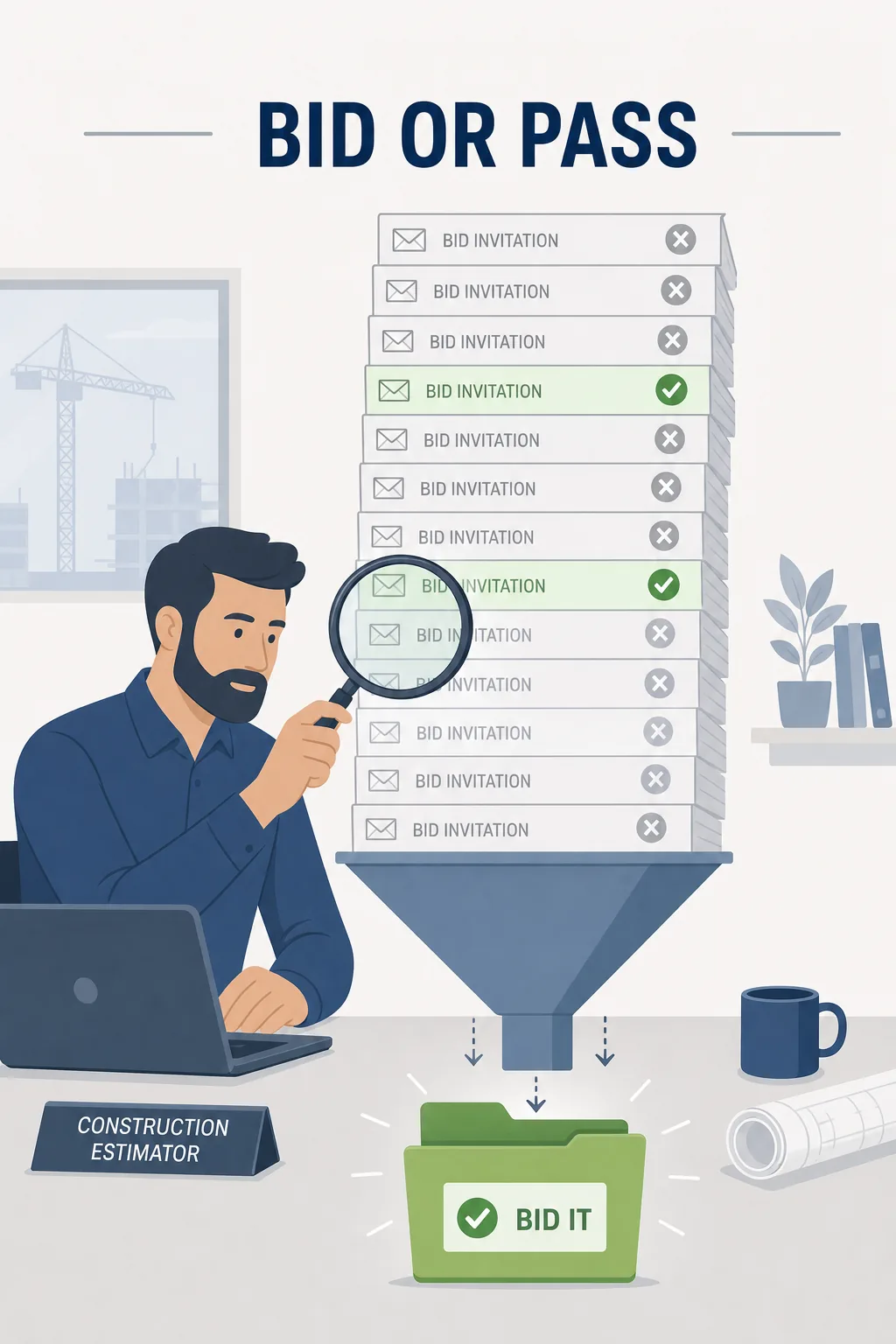
Contractors rarely lose money by bidding too low. More often, the damage starts when they bid on the wrong work, burn hours on weak opportunities, and win projects that never should have made it past the first review. Knowing how to prioritize which jobs to bid helps your team protect estimating time, focus on profitable work, and avoid the trap of chasing every invitation that lands in the inbox.
For flooring, drywall, ceilings, painting, and other commercial trades, the best bid is not always the biggest job. It is the job your team understands, can price with confidence, can staff without chaos, and can complete at the margin your company needs. This guide outlines a practical way to rank bid opportunities before takeoff begins.
How to Prioritize Which Jobs to Bid
The simplest way to understand how to prioritize which jobs to bid is this: do not treat every bid invite as equal. A bid is not just paconstruction takeoffperwork. It is an investment of estimating time, project knowledge, software work, supplier coordination, review, and follow-up.
Before your estimator opens the plans, ask whether the construction job fits your trade, your crew, your schedule, your profit goals, and your relationship strategy. If it fails those early checks, a fast no-bid may be the most profitable decision of the week.
That may sound blunt, but it is how disciplined contractors protect their pipeline. A flooring contractor with strong commercial retail experience should not give the same attention to a vague out-of-town public project as they would to a local tenant improvement from a repeat GC.
A drywall contractor should not rush into bidding on a job when wall types, ceiling heights, and finish levels are unclear. A painting contractor should be careful when coating systems, substrates, and access conditions are poorly defined.
Here’s the thing: job bidding is not about staying busy. It is about choosing construction bids where your team has a real chance to win and make money.
Why Contractors Shouldn’t Bid Every Construction Job
Many contractors fall into the same pattern. The inbox fills up with invitations, the team wants to keep the pipeline full, and suddenly every project feels urgent. On paper, that looks like business development. In real life, it can drain the estimating department.
A weak bid still costs time. It still pulls your estimator away from better work. It still requires plan review, takeoff, pricing, scope notes, and follow-up. If your team submits many bids without a clear filter, you may end up with a poor bid-hit ratio and a tired staff.
Construction research backs this up. A 2024 study in Buildings found that “client’s financial capability, the risk associated with the project, and the project’s anticipated future benefits and profitability” were among the most significant factors in bid/no-bid decisions for contractors.
That one finding says a lot. A bid decision is not only about whether your company can do the work. It is also about whether the client can pay, whether the project carries too much risk, and whether the work can lead to profit or future value.
Border States makes a similar practical point for contractors: a company is often better off preparing strong proposals for five projects it fits well than chasing 20 poor-fit opportunities. That is the heart of how to prioritize which jobs to bid.
Use a Bid/No-Bid Scorecard Before the Takeoff
A bid/no-bid scorecard gives your team a repeatable way to judge each opportunity. It also removes some of the emotion from the bidding process. Instead of saying, ” This one feels good”, your team can ask, ” Does this job meet our standard?”
A simple 1-to-5 score works well. A score of 1 means a poor fit. A score of 5 means a strong fit. Add the weighted score, then decide whether the job is worth full estimating effort. If you want to build the scorecard from the ground up, our guide to a full framework for bid/no-bid decision criteria walks through the factors worth weighting and how to set your cutoff.
A simple way to keep the decision honest is to use this first-screen formula:
Bid Priority Score = Scope Fit + Profit Potential + Capacity + Risk Control + Relationship Value
If the job does not pass that first screen, do not send it straight into full takeoff. That is where many contractors lose time. They open the drawings, start counting, chase supplier numbers, and only later realize the job was never a strong fit. A quick bid priority review protects your estimator before the detailed work begins.
Think of it like a gate. The opportunity has to earn its place on the estimating board. If the scope is familiar, the margin looks realistic, the team has room, the risk is manageable, and the client relationship has value, then the job deserves a deeper look. If not, a no-bid is not a loss. It saves time.
| Bid Factor | Suggested Weight | What to Review Before You Bid |
| Scope fit | 20% | Does the project match your trade, past work, crew skill, and estimating knowledge? |
| Profit potential | 20% | Can the job meet your margin after labor, material, overhead, risk, and supervision? |
| Client or GC relationship | 15% | Is this a repeat client, trusted GC, or strategic account? |
| Team capacity | 15% | Can your team estimate and perform the work without hurting active jobs? |
| Risk level | 15% | Are there vague specs, tight phasing, poor access, payment concerns, or heavy exclusions? |
| Location and logistics | 10% | Does travel, delivery, parking, staging, or supervision make sense? |
| Bid deadline | 5% | Is there enough time for a clean takeoff, review, and proposal? |
| Bid Type | Best-Fit Bid | Poor-Fit Bid |
| Scope | Matches your trade, crew skill, and past project history | Sits outside your normal work or has unclear responsibilities |
| Profit | Supports your target margin after labor, material, overhead, and risk | Looks busy on paper, but leaves little room for profit |
| Documents | Plans, specs, addenda, and schedules are clear enough to price | Missing details force too many guesses before bid day |
| Client | Comes from a known GC, repeat client, or strategic account | Comes from an unknown buyer with weak communication or unclear award history |
| Capacity | Can be estimated and performed without hurting active jobs | Pushes the team into rushed takeoffs, late nights, or weak reviews |
| Decision | Bid with confidence | Clarify, qualify, outsource support, or no-bid |
A project that scores above 4.0 should usually move to the top of the bid list. A project between 3.0 and 3.9 needs judgment. A project below 3.0 should usually be a no-bid unless there is a strong strategic reason to pursue it.
This process works especially well when paired with an accurate construction takeoff. Once your team has chosen the right jobs, precise quantities become the next step. That is where clear estimating support can help prevent missed scope, rushed guesses, and weak proposals.

Rank Jobs by Scope Fit Before You Price Them
Scope fit should come before price. A project may look attractive because the contract value is large, but if the scope sits outside your normal work, the risk rises fast.
For a flooring contractor, strong-fit projects may include clear finish plans, product schedules, floor patterns, transitions, wall tile elevations, and phasing notes. For a drywall contractor, strong-fit projects often include complete wall types, ceiling plans, finish levels, shaft details, and framing specs. For a painting contractor, good bid candidates usually include clear coating systems, substrate details, surface prep requirements, and access conditions.
This is where Quantify North America’s trade-specific approach fits naturally. Quantify supports contractors with estimating services for commercial flooring, drywall, ceilings, and painting, helping teams move from drawings to reliable quantities without forcing internal staff to carry every deadline alone.
Founded by Kathy Case, whose background spans decades of commercial construction, tile, flooring, project management, sales, and estimating, Quantify brings field-aware judgment to the takeoff process, not just software output.
That matters because a takeoff is not useful if it ignores how the work is actually built. Quantify’s value is especially clear at this stage because the company does more than count materials. Its estimating support can include color-coded drawings, material quantities, scope notes, and software-based takeoff files that help contractors review the bid with more confidence before submission.
For trade-specific help, contractors can review Quantify’s flooring estimating services, drywall estimating support, and painting estimating guidance.
Check Profit Potential Before You Chase the Bid
A winnable job is not always a profitable job. That is a painful lesson for contractors who win work by shaving prices instead of checking the true cost.
Before you bid on construction jobs, look at labor productivity, material price exposure, supervision, mobilization, equipment, bonding, insurance, schedule pressure, and overhead. If any of those items are uncertain, the estimate needs more review. If too many are uncertain, the job may not deserve your time.
Contractors benefit from comparing actual job costs against estimates, including labor, materials, equipment, overhead, markup, and contingency. This type of feedback loop supports more disciplined decisions when learning how to bid on a construction job.
Profit potential also depends on your estimating method. A fast square-foot guess may work for an early budget, but it can be risky for a hard bid. For jobs that matter, a detailed bottom-up estimating method can help your team price the work from labor, materials, production, waste, and scope details rather than broad assumptions.
Use Bid-Hit Ratio to See Which Types of Projects Deserve More Time
Your bid-hit ratio tells you how many bids it takes to win one job. If you submit 20 bids and win four, your ratio is 5:1. That number matters, but it becomes far more useful when you break it down by project type.
A contractor may have a 4:1 ratio with local private GCs and a 20:1 ratio with public low-bid jobs. That does not mean public work is always bad. It means your team should treat each category differently. Some types of projects deserve fast priority. Others need a harder look.
ConstructConnect notes that the bid-win ratio helps contractors understand how many projects they need in the pipeline and which opportunities may not have a high chance of success. That is why bid history should guide how to prioritize which jobs to bid.
| Project Type | Bids Sent | Jobs Won | Bid-Hit Ratio | Priority |
| Local retail flooring projects | 12 | 4 | 3:1 | High |
| Public school projects | 18 | 1 | 18:1 | Low unless strategic |
| Healthcare drywall renovations | 9 | 3 | 3:1 | High |
| Out-of-town commercial painting | 10 | 0 | No wins | No-bid or review |
| Repeat GC tenant improvements | 15 | 6 | 2.5:1 | Very high |
The goal is not to avoid every hard market. The goal is to stop treating all opportunities as equal. If your company wants to improve its construction bid win rate, start by studying which jobs already produce wins, profit, and repeat work.
Prioritize Jobs Where the Documents Are Clear Enough to Estimate
Bad documents can turn a simple job into a mess. Missing finish schedules, unclear alternates, conflicting drawings, vague specs, and late addenda all raise risk. When the documents are weak, your bid may need more time, more RFIs, more qualifications, or a no-bid decision.
This matters because the lowest number does not help if it is built on a missing scope. A contractor may win the job and then spend the project fighting change orders, schedule pressure, and margin loss.
When you review a construction job, check the plans before you commit to estimating hours. Are the drawings complete? Are the specs aligned with the plans? Are alternates clear? Are addenda included? Are there hidden phasing requirements? Are the finish schedules readable? Are there notes that conflict with details?
A strong estimating process should catch these problems early. Quantify’s construction estimating guide explains the value of organized scope review, while its guide to materials estimating can help contractors think through quantities before price pressure takes over.
Compare the Deadline Against Your Estimating Capacity
A bid due tomorrow is not always a priority. Sometimes it is just a distraction with a deadline attached.
That does not mean short-deadline jobs should always be declined. If the project is a strong fit, the GC is a good relationship, the documents are clean, and the profit potential is solid, a quick bid may be worth the push. But if the project is vague, low-margin, unfamiliar, and out of the area, the due date should not bully your team into bad work.
McCormick Systems points out that contractors need to track bids, deadlines, documents, and tasks while giving priority to important contracts first. The lesson is simple: a bid calendar should not be sorted only by due date. It should be sorted by value, fit, risk, and deadline together.
This is especially important for small teams. When the estimator, owner, and project manager are already stretched, every bid has an opportunity cost. If your company is dealing with estimating without enough staff, the answer is not always to work later. Sometimes the smarter move is to bid fewer jobs, use outside takeoff help, or follow a clearer priority system. Quantify also explains how contractors can bid for more jobs with a small team without letting accuracy fall apart.
Give Repeat Clients and Strong GC Relationships More Weight
Not all clients are equal. A job from a trusted GC who communicates well, pays on time, shares complete documents, and values clean proposals may deserve more attention than a one-time invite from a company you do not know.
Relationships affect the bidding process in several ways. A familiar GC may be more willing to answer questions. They may value your scope notes. They may invite you earlier. They may also give you feedback when you miss the job, which helps your future bids.
Still, relationship value should not override every other factor. A strong GC relationship does not fix a bad schedule, a risky scope, or a price that will not cover the work. The best bid decisions balance trust with math.
If your team wants to learn how to win construction bids, do not think only about price. Think about which clients give your company a fair chance to perform well. Good relationships help, but only when the project itself still makes sense.

Watch for Red Flags Before You Bid
Some jobs are not worth a full estimate. The sooner your team spots those jobs, the more time you save for better opportunities.
| Red Flag | Why It Hurts the Bid | Better Decision |
| Vague scope | Raises the chance of missed work and disputes | Ask for clarification or qualify the bid |
| Unrealistic schedule | Hurts labor productivity and supervision | Bid only with clear schedule assumptions |
| Unknown owner or GC | Adds payment and communication risk | Research before committing |
| Weak documents | Makes accurate takeoff harder | Send RFIs or no-bid |
| Out-of-area work | Adds travel, delivery, and management costs | Bid only if the margin supports it |
| Poor trade fit | Raises execution risk | Decline or partner with a better-fit trade |
| Too little review time | Leads to rushed quantities and mistakes | No-bid or outsource takeoff support |
Many contractors lose bids because they price too fast, miss scope, chase poor-fit work, or fail to explain what is included. Quantify’s resource on why contractors lose bids goes deeper into those patterns, while its piece on how estimating errors cost construction companies is useful for teams aiming to reduce surprises after award.
How to Find Jobs to Bid On Without Flooding the Estimating Team
Finding work is not the hard part for many contractors. Sorting good opportunities from noisy ones is harder. Contractors can find jobs through GC invitations, plan rooms, public procurement sites, bid boards, architects, suppliers, owner relationships, networking groups, and commercial construction databases. Using filters such as project size, scope, bid date, and location helps narrow the focus to higher-value opportunities.
That matters because lead flow without discipline can overwhelm your team. If you want to know how to find jobs to bid on, the answer should not stop at “find more leads.” The better question is: which leads match your company’s best work?
A contractor who wants to get commercial jobs should build a simple lead filter. Start with geography, trade scope, project size, document quality, GC relationship, bid date, and expected margin. Then let only the better-fit jobs move into full estimating.
Trade-Specific Examples: Which Jobs Should Get Priority?
Flooring contractors should prioritize projects with clear finish schedules, room plans, product specs, floor patterns, wall tile elevations, transitions, and realistic phasing. Commercial flooring jobs can become difficult when plans are vague about materials, layout, or vertical finishes. If the project includes tile, stone, LVT, carpet, or mixed flooring systems, clear documents matter even more. Contractors who need support can use Quantify’s flooring takeoff and estimating services to get reliable quantities before bid day.
Drywall and ceiling contractors should look for complete wall types, reflected ceiling plans, heights, shaft details, framing specs, gypsum board types, finish levels, and addenda control. A drywall job with missing heights or unclear finish levels can lead to costly assumptions. For teams that need a stronger quantity process, Quantify’s drywall takeoff guide is a useful resource.
Painting contractors should prioritize jobs with clear coating systems, substrate conditions, wall and ceiling areas, special coatings, access notes, and surface prep requirements. A job with “paint as required” buried in vague notes can be risky if the scope is not reviewed closely. Quantify’s painting estimating services can help contractors organize quantities and scope before they price.
Concrete, excavation, and dirt work contractors should review soil conditions, haul-off, equipment access, survey data, weather exposure, trench depth, compaction requirements, and site logistics before they bid. Anyone researching how to bid concrete jobs, how to bid excavation work, or how to bid dirt work jobs should start with quantity confidence and risk review before markup.
Job Bidding Example: How a Contractor Should Rank Three Opportunities
A simple example shows how this works in real time. Suppose a contractor has three bid invites due this week. One is local and familiar. One is large but risky. One is a strong relationship, but needs scope review.
| Bid Opportunity | Scope Fit | Profit Potential | Capacity | Risk | Relationship | Decision |
| Local retail flooring project with repeat GC | 5 | 4 | 4 | 3 | 5 | Priority bid |
| Out-of-state public job with unclear specs | 2 | 3 | 2 | 2 | 1 | No-bid |
| Healthcare drywall renovation with a known GC | 4 | 4 | 3 | 4 | 5 | Bid after scope review |
The local retail flooring job deserves top priority because it fits the contractor’s skill set, has a known GC, and is realistic for the team. The out-of-state public job may look tempting because of its size, but it carries a weak fit, poor relationship value, and unclear documents. The healthcare drywall renovation could be a good bid, but only after the team reviews phasing, access, infection-control requirements, and finish details.
This is how to prioritize which jobs to bid without guessing. The scorecard does not replace judgment. It gives judgment a structure.
When to Outsource Takeoffs Instead of No-Bidding
Sometimes a project is worth bidding, but the team simply does not have enough estimating capacity. That is where outside takeoff support can make sense.
A strong estimating partner can help with plan review, material quantities, color-coded drawings, software files, and bid support while your internal team stays focused on pricing strategy, client relationships, and proposal review. This can be especially useful for contractors with uneven bid volume. One week may be quiet. The next week may bring six bid invites, two addenda, and one major proposal due Friday.
Quantify North America was built for that exact pressure point. When a job passes the bid priority screen, but your team does not have enough hours to complete a clean takeoff, outside estimating support can keep the opportunity alive without forcing a rushed number. Quantify helps commercial flooring, drywall, ceiling, and painting contractors turn project documents into organized quantities, color-coded scope references, and bid-ready information that the team can actually review before submission.
For a busy contractor, that can be the difference between declining a good-fit job and sending a confident proposal. Contractors can learn more about outsourcing construction estimating, review the ROI of outsourcing estimating, or compare the cost of construction estimating services before they decide.
Common Mistakes Contractors Make When Prioritizing Bids
The first mistake is chasing the biggest job instead of the best-fit job. Large projects can look attractive, but they often carry larger risks, more paperwork, tighter coordination, and heavier cash flow demands. If the project does not match your team’s experience, size alone is not a reason to bid.
The second mistake is ignoring the bid-hit ratio. If your company keeps losing the same type of project, the answer may not be “try harder.” It may be “study why.” Maybe the market is too crowded. Maybe your cost structure does not fit that work. Maybe the GC is only price-checking. Maybe the documents require more pre-bid questions than your team can handle.
The third mistake is bidding on unfamiliar clients without checking their reputation, payment behavior, or award patterns. A bid for a job opportunity is not only about the scope. It is also about who controls the contract.
The fourth mistake is waiting too long to review documents. If the estimator finds missing scope after the takeoff is half done, the team has already lost time. A 20-minute document scan at the start can prevent hours of wasted work.
The fifth mistake is treating every deadline as an emergency. Good contractors know the difference between a true priority and a noisy invite. And that is why it matters.
FAQs
What Is Job Bidding?
Job bidding is the process contractors use to submit a price and scope proposal for a project. In construction, a job bid usually includes quantities, labor, material, equipment, overhead, markup, exclusions, clarifications, and schedule assumptions. A strong bid tells the client not only what the price is, but what the price includes.
How Do You Bid on a Job as a Contractor?
To bid on a job as a contractor, start by qualifying the opportunity. Then review the plans and specs, complete a takeoff, price labor and materials, add overhead and markup, note exclusions, prepare the proposal, and follow up after submission. The best contractors also compare the job against their bid/no-bid criteria before they start.
How Do I Bid on Construction Jobs Without Wasting Time?
Use a scorecard before takeoff. Rank each job by scope fit, profit potential, relationship value, capacity, risk, location, and deadline. If the project scores low, decline it early. If it scores high but your team lacks capacity, consider outside estimating support rather than rushing the bid.
How Many Bids Should a Contractor Submit?
There is no perfect number. A small contractor with a strong bid-hit ratio may need fewer bids than a larger firm chasing public work. The better question is how many accurate, profitable, good-fit bids your team can submit without hurting active projects or lowering proposal quality.
How Can Contractors Win More Construction Bids?
Contractors can win more construction bids by choosing better-fit work, improving takeoff accuracy, tracking bid-hit ratio, asking pre-bid questions, writing clear scope notes, and building strong GC relationships. The goal is not to bid on everything. The goal is to bid the right work well.

Bid Less Randomly, Win More Deliberately
Learning how to prioritize which jobs to bid changes the way a contractor uses time. Instead of reacting to every invite, your team can rank opportunities by fit, profit, risk, capacity, relationship, and deadline. That one habit can improve bid quality, reduce estimating stress, and help your company avoid work that looks good only until the contract starts.
For commercial flooring, drywall, ceilings, and painting contractors, the right quantities make that decision even stronger. When your team has a bid worth pursuing but not enough time to complete the takeoff, Quantify North America can help with accurate estimating support built around real contractor workflows.
If your team wants to bid the right jobs with more confidence, reach out to Quantify North America and get estimating support before the next deadline controls the calendar.