
Estimating without enough staff has become a defining challenge for many U.S. businesses, particularly in construction and project-driven industries. When workloads expand, but team size does not, estimates suffer, deadlines tighten, and profitability comes under pressure.
This article examines why understaffing affects estimating so deeply, how short staffing shows up in real numbers, and what practical, data-backed approaches companies use to protect accuracy even when they are short-staffed.
What Estimating Without Enough Staff Really Means
Estimating without enough staff is not simply about being busy. It reflects a structural gap between the volume of work required and the number of people available to complete it accurately.
When businesses are understaffed or short of staff, estimating teams often absorb responsibilities that were once spread across several roles. Longer hours become routine, open positions remain unfilled, and experienced team members shoulder increasing workloads.
In professional settings, being understaffed at work often leads to rushed assumptions, reduced cross-checking, and limited time for detailed takeoffs. The short-staffed meaning goes beyond inconvenience.
It directly affects how costs, labor, materials, and risk allowances are calculated. When companies say “we are short-staffed,” what they usually mean is that the estimating function no longer has the margin for careful review that accurate projections require.
In the USA, this situation has become increasingly common as businesses face persistent labor shortages across technical and professional roles.
Why Estimating Teams Are Understaffed
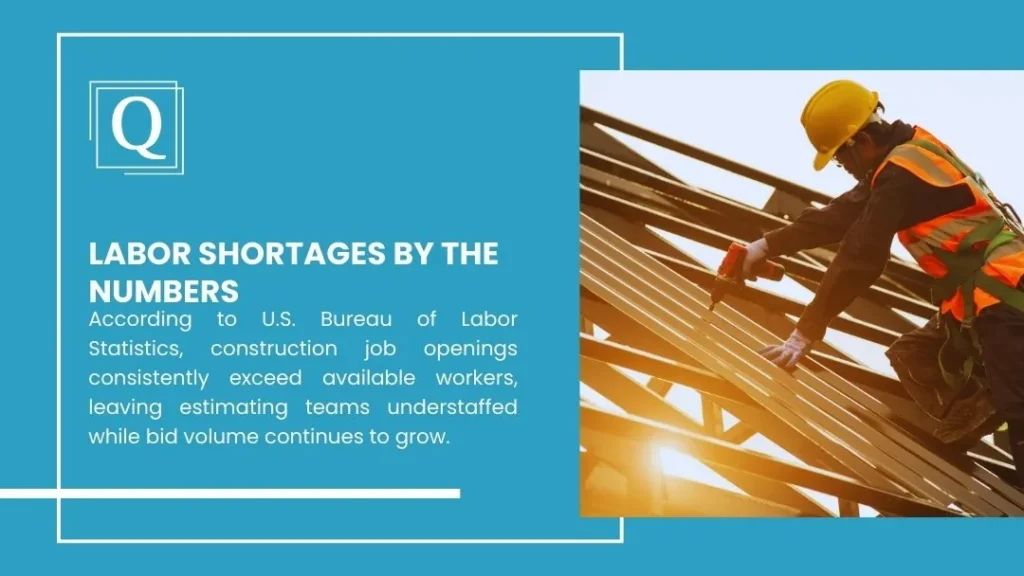
Understaffing problems in estimating did not appear overnight. According to the U.S. Bureau of Labor Statistics, the construction industry alone has faced hundreds of thousands of unfilled positions in recent years, with skilled technical roles among the hardest to recruit. As companies struggle to hire, estimating teams become low-staffed even as bid volume grows.
This shortage creates a scenario where too much work and not enough staff becomes the norm rather than the exception. Estimators are often expected to manage multiple projects simultaneously, review drawings under time pressure, and finalize numbers with limited peer review. When businesses are understaffed and overworked, estimating accuracy becomes vulnerable.
Economic uncertainty also plays a role. Some organizations hesitate to add headcount due to cost concerns, leading to deliberate understaffing. Others rely on lean teams during peak periods, assuming temporary pressure will ease. In practice, many estimating departments remain short on staff for extended periods, turning a short-term gap into a long-term operational risk.
How Understaffing Impacts Estimating in the Construction Industry
Estimating without enough staff directly changes how bids are prepared, reviewed, and submitted. When an estimating department is short-staffed, fewer team members must handle the same or greater volume of work. Headcount is only one variable here, and how short timelines distort estimates deserves its own examination for any firm running lean. That imbalance often leads to longer hours, rushed quantity takeoffs, and reduced time for scope review.
According to labor market data published by the U.S. Bureau of Labor Statistics, construction job openings continue to outpace available workers, particularly in technical and professional roles. Estimating teams feel this shortage immediately because the work cannot be paused without consequences. When a business is understaffed, estimates move forward even when staffing levels fall short.
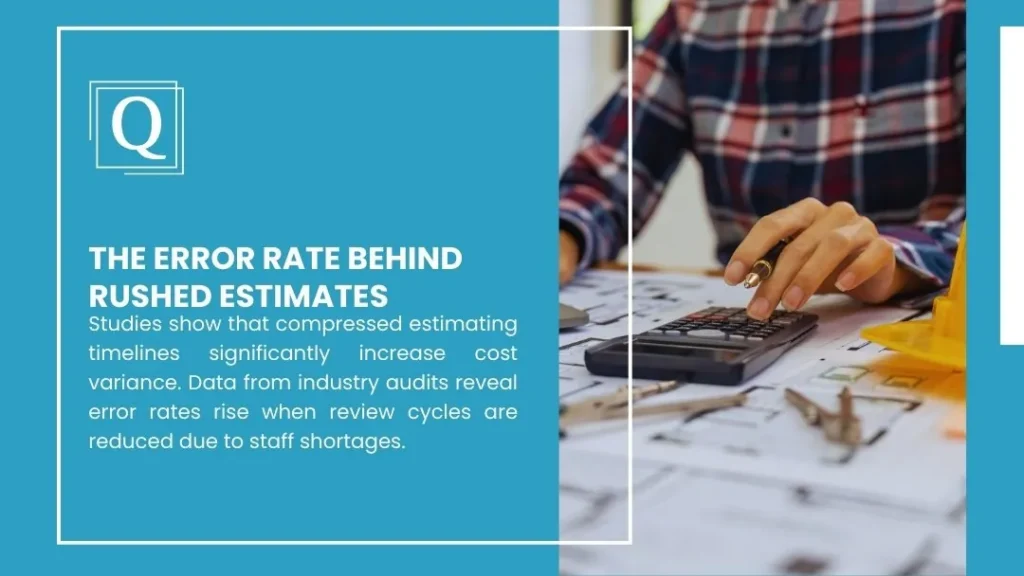
Research from construction workforce studies shows that insufficient staffing increases error probability in cost forecasting, especially when teams are forced to compress review cycles. Estimators working short-staffed often report difficulty maintaining consistency across bids, particularly on multi-trade projects where coordination matters most.
Estimating without enough staff changes how work moves through the organization long before errors become visible. Routine safeguards such as peer review, documentation, and scope validation receive less attention as assumptions replace verification under deadline pressure. The table below illustrates how staffing conditions affect estimating accuracy and operational outcomes.
How Staffing Levels Affect Estimating Accuracy and Outcomes
| Staffing Condition | Estimating Area Affected | Impact on Accuracy | Operational Result |
| Short-staffed at work | Quantity review | Single-pass checks replace multi-step verification | Higher revision rates |
| Understaffed and overworked | Labor analysis | Simplified assumptions replace task-level detail | Missed scope items |
| Low-staffed teams | Bid strategy | Limited scenario evaluation under time pressure | Missed bid deadlines |
| Insufficient staffing | Documentation | Reduced supporting notes and audit trails | Margin exposure |
Estimating without enough staff not only affects internal operations. It also shapes how firms present themselves to clients, particularly when turnaround times stretch beyond expectations and revisions increase.
The Hidden Risks of Estimating While Short-Staffed
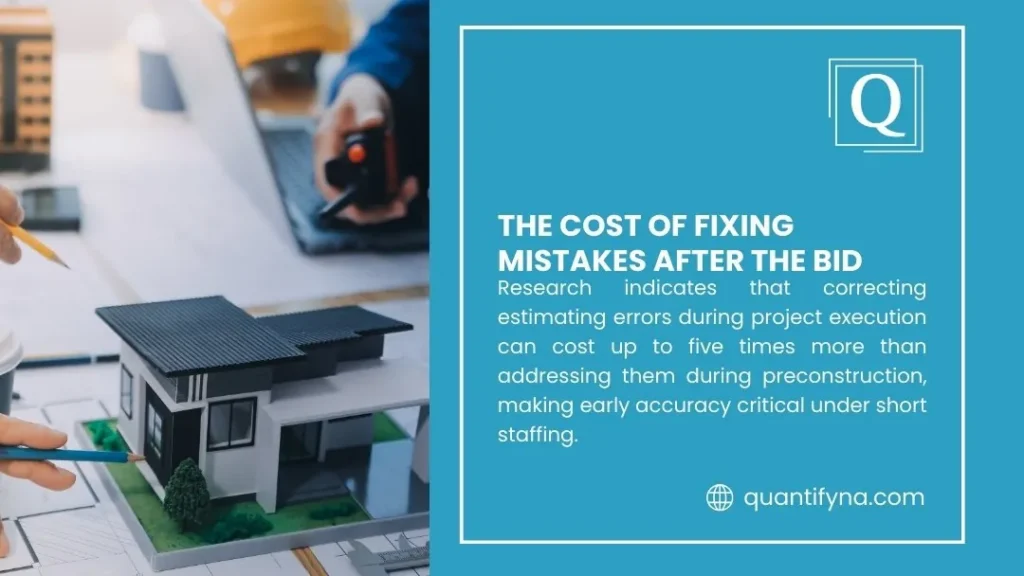
Estimating without enough staff introduces risks that extend well beyond internal stress. Errors made during estimation often surface months later during execution, when correction costs are at their highest. Short-staffed work environments increase the likelihood of missed scope items, underestimated labor hours, and incomplete material counts.
Insufficient staffing also reduces the ability to account for uncertainty. When estimators lack time, contingency planning suffers. Projects bid under these conditions may appear competitive initially, but struggle to remain profitable. Short-staffed businesses frequently experience a higher rate of revisions, client disputes, and internal rework.
Another overlooked issue is knowledge loss. When a small number of estimators manage a heavy workload, institutional knowledge becomes concentrated. If even one team member leaves, the organization may face a sudden lack of estimating capacity, compounding existing understaffing issues.
Practical Ways to Estimate Accurately When You Are Short-Staffed
Despite these challenges, many businesses continue estimating without enough staff while maintaining acceptable accuracy. The difference lies in process discipline and strategic support rather than sheer effort.
One effective approach involves refining estimation methodology. Techniques such as bottom-up estimating allow teams to focus on critical cost drivers while reducing reliance on broad assumptions. A detailed explanation of this approach helps you to understand how structured breakdowns help offset limited staffing capacity.
Another strategy involves leveraging external expertise during peak workloads. Many firms rely on specialized partners through outsourcing construction estimating arrangements. This approach allows businesses to handle bid surges without committing to permanent headcount while preserving estimate quality.
Technology also plays a role, though tools alone do not solve understaffing problems. When paired with experienced oversight, modern estimating platforms reduce repetitive tasks and free time for judgment-based decisions. A deeper look at available estimating tools explains how software supports, rather than replaces, professional estimators.
| Strategy | Impact on Estimating Accuracy |
| Methodical estimating frameworks | Reduces reliance on guesswork |
| External estimating support | Stabilizes workload peaks |
| Task prioritization | Protects critical estimates |
| Process standardization | Improves consistency |
| Knowledge documentation | Limits disruption from turnover |
These methods help teams remain functional even when they are working short-staffed or facing a prolonged lack of staff.
Communicating Short Staffing Professionally in Estimating
How a company explains short staffing matters, especially when deadlines or revisions arise. Knowing how to say we are short-staffed professionally can preserve trust while setting realistic expectations.
In estimating contexts, transparency works best when paired with solutions. Rather than simply stating “we are short of staff,” experienced teams explain capacity limits while outlining steps taken to maintain quality. Professional phrasing acknowledges the issue without undermining confidence in the final estimate.
Clear communication also prevents internal burnout. Team members who understand workload limits are more likely to collaborate effectively during periods of short staffing.
Long-Term Planning for Estimating Teams Facing Understaffing
Short staffing often begins as a temporary condition but becomes permanent without intervention. Long-term solutions require a mix of workforce planning and operational flexibility. Many businesses adopt hybrid models that combine internal estimators with external support during peak demand.
Training plays a critical role as well. Cross-functional skill development allows team members to assist with estimating tasks when needed, reducing reliance on a single role. Companies that document estimating processes also recover faster when staff changes occur.
For organizations seeking scalable solutions, professional construction estimating services provide structured support without long-term hiring commitments. These services often integrate directly into existing workflows, minimizing disruption.
Why Accurate Estimating Still Matters When Resources Are Limited
Estimating without enough staff does not excuse inaccuracy. In competitive U.S. markets, bids remain the foundation of profitability. Businesses that accept declining estimate quality due to insufficient staffing often experience greater losses downstream.
Organizations that address understaffing proactively protect both margins and reputation. By combining disciplined methods, professional support, and realistic communication, companies can continue producing reliable estimates even when staffing levels fall short.
Keeping Accuracy Intact When Teams Are Short-Staffed
Estimating under short staffing conditions is now a reality for many U.S. businesses. While the pressure is real, accuracy does not have to collapse under it. Companies that recognize the risks early, apply structured estimating approaches, and seek targeted support position themselves to remain competitive despite workforce constraints.
For organizations facing ongoing estimating pressure due to a lack of staff, partnering with experienced estimating professionals offers a practical path forward. Explore how specialized estimating solutions support teams across the USA by visiting Quantify North America’s construction estimating expertise, and contact us to discuss tailored support.