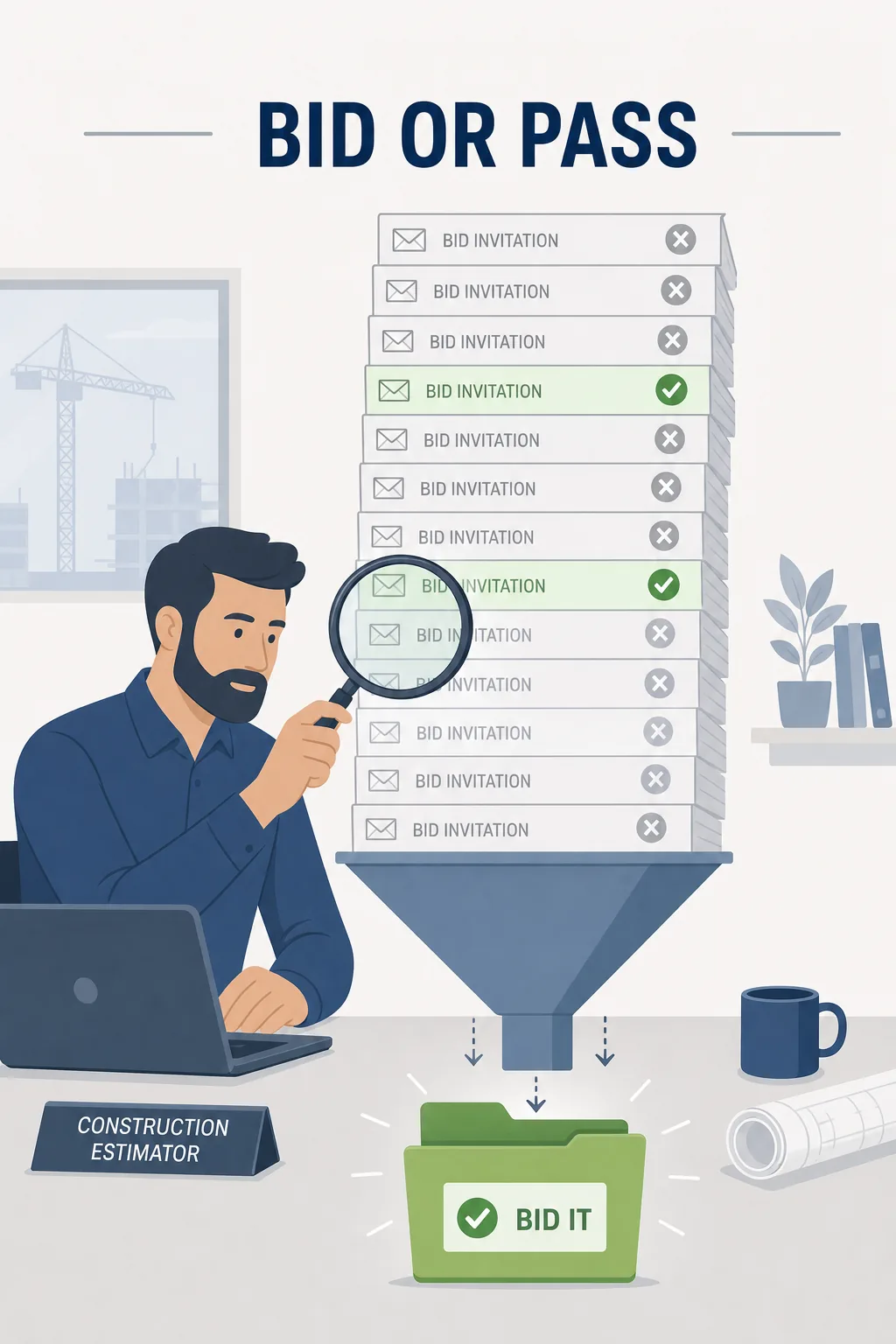
The construction bid win rate, sometimes called bid win rate, bid hit ratio, or win ratio, measures the percentage of bids that become real projects. In the USA, general contractors and specialty trades often sit between 20% and 30% on average, with big shifts depending on project type and delivery method.
This guide explains what the metric really means, how to calculate win rate correctly, how to read USA benchmarks, why tracking matters, which factors move your success rate up or down, and what practical steps help you move from “bid to win” instead of “bid to participate.”
What Construction Bid Win Rate Really Means
In construction, the construction bid win rate is the share of submitted bids that turn into awarded work over a defined period, usually a year. Banks, consultants, and software vendors often talk about it as the bid hit ratio or win ratio, but the logic stays the same: how many shots you take, and how many actually land.
In construction, a bid-hit ratio refers to how often a contractor wins work compared to how many proposals they submit; for example, landing one project out of five bids would be recorded as a 5:1 ratio.
Some teams prefer to think in percentages, others in ratios. A 25% success rate equals a 3:1 bid hit ratio; you lose three to win one. In RFP-heavy segments, people will also talk about RFP win rate, which applies the same logic to formal proposal processes.
Whether you describe it as bid win rate, bid-to-win rate, or proposal success rate, you are still tracking the same underlying reality: the efficiency of your business development and estimating machine.
Here is a simple way to keep the terminology straight.
| Term | How It Is Expressed | Practical Interpretation |
| Bid win rate | Percentage of bids that turn into contracts | 10 wins out of 40 bids = 25% |
| Bid hit ratio | Ratio of bids submitted to bids won | 4:1 means you win one for every four attempts |
| Win ratio | Generic term for win percentage across opportunities | Often used interchangeably with bid win rate |
| RFP win rate | Percentage of RFP or RFQ submissions that you win | 30 wins out of 100 RFPs = 30% |
| Bid to win rate | Informal phrase for overall success in competitive bids | Often used in equipment and heavy civil marketing |
These measures matter because they show whether your company competes in the right project type, at the right volume, with realistic odds.

How to Calculate Your Construction Bid Win Rate
Most firms overthink how to calculate the win rate. The formula itself is simple; the discipline to track it by segment is where the work lies. The base formula used by construction data platforms and bid-management tools is:
Construction bid win rate = (Number of bids won ÷ Total bids submitted) × 100
If a contractor submits 32 bids in a year and secures 8 of them, the construction bid win rate stands at 25%. That same story can be written as a bid hit ratio of 3:1, since it takes roughly four tries to win one job.
Where better operators pull ahead is in how they slice the data. They do not just calculate a single win ratio; they segment by project type, client, contract form, and region. Some industry guidance recommends that contractors track separate hit ratios for public and private projects instead of lumping everything into one average, because the markets behave differently and can distort bidding expectations.
A contractor might discover that the RFP win rate for negotiated healthcare projects is strong, while the success rate for open hard-bid schools is poor. The formula stays the same, but the insight becomes far sharper. When paired with strong quantity takeoff and estimating processes, such as those described in dedicated construction estimating guidance, the number shifts from trivia to a management tool.
Benchmarks: What Is a Good Win Rate in the USA
Contractors often ask for a magic good number, but the reality in the USA is nuanced. A good construction bid win rate depends on scope, delivery method, and how broad your opportunity pipeline is. Even so, there are meaningful ranges reported by advisors and data platforms.
Industry commentary and analytics reports frequently place the average win rate for construction firms around 20–25%, roughly one win out of every four or five bids. Industry research pegs the average bid-to-win rate for general construction contractors at roughly one success out of every six bids, about a 17% hit rate, an outcome that would look unacceptable in most other settings but is considered normal in this sector.
More detailed breakdowns by delivery method show clear differences. Typical industry guidance suggests that a 10–20% win rate is common for hard-bid or publicly competitive work, while negotiated or invited-bid projects can see win rates closer to 30–50% or higher, depending on relationships and market conditions.
A large survey of several thousand general contractors and subcontractors reported that bid-hit ratios on public work often fall in the 6:1 to 10:1 range for general contractors, while negotiated or design-build opportunities tend to land closer to 2:1 to 4:1.
| Contract or Market Type | Typical Bid Win Rate | Usual Bid Hit Ratio | Notes on Competitive Conditions |
| Hard bid public works | 10–20% | About 5:1 to 9:1 | Many bidders, low margins, rigid RFP criteria |
| Competitive private tenders | 20–30% | About 3:1 to 5:1 | Relationship and track record start to matter more |
| Negotiated/invited proposals | 30–50% or higher | About 1.5:1 to 3:1 | Smaller bidder pools, emphasis on capability, and pre-construction input |
| Design-build and CM at-risk | 30–50% or higher | Often 2:1 to 4:1 | Integrated teams, heavier weighting on experience, and a project approach |
| Complex professional RFPs | 21–50% across industries | Varies widely | Surveys of proposal teams show that most firms have between 21% and 50% |
For specialist trades and subcontractors, hit ratios can look slightly better than for general contractors in the same territory, especially where strong relationships and niche expertise exist. What matters most is not whether your construction bid win rate matches the average, but whether it aligns with your strategy and supports your required backlog and margin targets.

Why Tracking Your Bid Win Rate Matters to Growth
A construction company that does not track the construction bid win rate is effectively flying without instruments. It might feel busy, but it has no numeric proof that the business development effort turns into a profitable workload rather than churn.
When general contractors and specialty trades track win ratios by client, project type, region, and bid size, several patterns quickly emerge. They see which owners award work consistently, which RFP structures fit their delivery model, and which sectors yield the healthiest success rate. Industry guidance often recommends pairing historical bid data with established cost benchmarks so teams can judge which opportunities are actually worth chasing.
The construction bid win rate also acts as a leading indicator for revenue and staffing. A stable 30% win ratio on a consistent volume of opportunities allows more predictable forecasting of backlog and cash flow than a 10% success rate with wild swings from quarter to quarter.
That makes it easier to plan field crews and estimate capacity. Over time, a company that tracks these metrics can refine a genuine bid to win culture instead of chasing every project that hits the inbox.
RFP win rate adds another layer. In segments where public agencies or institutional owners rely on formal proposals, RFP win rate data reveals whether the firm’s narrative, resumes, and project examples speak the client’s language. Surveys of proposal teams across industries have found average RFP win rates hovering in the mid-40% range, but with a significant spread based on sector and specialization, which suggests plenty of room for improvement for many construction teams.
Core Factors That Affect Your Construction Bid Success Rate
Every contractor occupies a different niche, yet the drivers behind the construction bid win rate tend to repeat. Estimating methods, market selection, and client relationships combine to push a firm’s success rate up or down.
The table below maps the core factors, how they influence bid win rate, and what that means day to day.
| Factor | Effect on Bid Win Rate | What It Means in Practice |
| Opportunity qualification | Filters out low-odds pursuits | Firms that score opportunities before bidding usually maintain stronger hit ratios. Learning to score opportunities against clear bid no-bid criteria is often the fastest way to lift your win rate without changing anything about how you price work. |
| Estimating accuracy and detail | Reduces pricing errors and scope gaps | Reliable quantity takeoff and labor assumptions support competitive yet safe pricing. |
| Project type focus | Concentrates expertise where the team delivers best | Specialty in certain project types, such as healthcare or retail, correlates with higher success rates. |
| Client relationships | Increases trust and repeat awards | Owners and construction managers often prefer teams with proven delivery histories. |
| Quality of bid documents | Clarifies scope, schedule, and value proposition | Clear alternatives, accurate schedules, and a coherent narrative help evaluators choose with confidence. |
| Market competition intensity | Changes odds by region and sector | Crowded public markets show lower win rates than selective or negotiated segments. |
| Internal process discipline | Ensures consistent pricing and lessons learned | Teams that review wins and losses regularly refine both costs and project selection criteria. |
Taken together, these forces explain why two contractors in the same city, bidding on similar scopes, can have very different success rates over time.
What Bid Win Data Reveals About Long-Term Business Health
A healthy construction bid win rate does more than make the sales pipeline look good. It signals whether the company’s strategy, operations, and pricing logic line up with the market. A chronically low success rate often hides deeper issues: chasing the wrong project type, underestimating indirect costs, or relying on outdated cost databases.
Analytics providers that track contractor wins across regions encourage firms to compare their numbers against competitors and sectors. Their findings show that consistent win rate outperformance usually coincides with focused sector positioning and disciplined internal controls, rather than pure aggressiveness on price.
When construction bid win rate improves while gross margin holds steady or rises, several positive effects follow. Backlog stabilizes, cash flow becomes more predictable, and overhead is spread across a more reliable stream of work rather than a few unpredictable big wins. That stability makes it easier to retain skilled field crews and estimators, invest in training, and adopt better estimating tools. Each of those choices in turn supports a stronger bid hit ratio, which keeps the cycle moving in the right direction.
The same logic applies in RFP-heavy sectors. Proposal surveys show that only a small minority of firms sustain win rates above 50%, while most cluster somewhere between 21% and 50%. Contractors that push toward the upper end of that band usually do so with a clear focus on where they add unique value rather than a generic response to every RFP.
Over the long term, tracking and analyzing bid win data becomes less about bragging rights and more about risk management. It allows leadership to see whether the company continues to win the right jobs, at the right price, for the right clients, before financial statements reveal trouble.

Time to Elevate Your Bids and Your Business Success
Construction is unforgiving, yet it is also measurable. When you know your construction bid win rate, by client and by project type, you gain an honest picture of how effectively your effort converts into real work. You also gain a compass for every future pursuit.
Treat that percentage as a management metric, not just a scoreboard. Tighten your estimating, choose opportunities with intent, refine how you present value, and review each result as data, not drama. With that approach, the next round of numbers can tell a different story: fewer wasted bids, a stronger bid win rate, and a business that no longer needs luck to win the work it deserves.
Ready to stop guessing and start winning? Jump to Quantifyna and see how fast smarter bidding can change your bottom line.