Across the United States, construction estimating services cost anywhere from about $150 for a small, single-trade project to $3,000 or more for complex, multi-trade commercial work, depending on scope, drawings, trades, and deadline pressure.
This guide explains how those prices are calculated, which pricing models estimating firms use, what you actually get for the fee, and how to decide whether outsourcing construction estimating services is better than keeping an estimator in-house.
Why Construction Estimating Services Cost Matters More Than Most Contractors Admit
A construction estimate is not just a number on a spreadsheet. It is a structured forecast of material and labor costs, overhead, and risk for a specific construction project. Industry bodies describe cost estimates as structured predictions based on documented scope, location, and timing, with varying levels of accuracy depending on project definition.
Professional frameworks such as those used by AACE International break cost estimates into classes, from early rough order of magnitude budgets to fully detailed bid-level estimates once drawings reach near final design.
That distinction matters because the more complete the design and quantity takeoff, the more work the estimating service must perform, and the more the construction estimating service’s cost will rise.
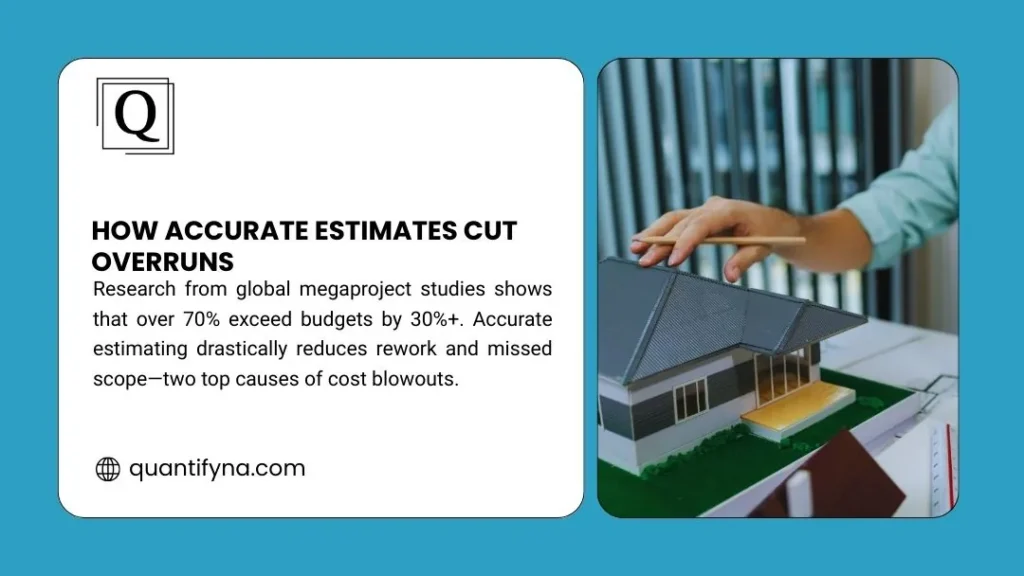
For contractors in the USA, estimating errors are not a minor inconvenience. Studies of large construction projects reveal that a vast majority of megaprojects experience cost overruns exceeding 30 percent, accompanied by significant delays in completion.
Separate research on rework indicates that mistakes and design deviations can consume roughly ~5–20% of a project’s total cost. The message is blunt: poor project estimates and weak construction cost estimating processes carry real financial risk.
That is why more firms now view construction cost estimating services as part of risk management, not just administrative overhead.
How Construction Estimating Services Cost Is Usually Structured
Across the USA, most estimating firms follow a handful of pricing models. Exact numbers vary by trade, region, and complexity, but typical patterns show up again and again in their public pricing pages and FAQs. Here is how construction estimating services are often framed.
| Pricing Model | How It Works | Typical Range In The USA* |
| Hourly rate | Client pays per hour of estimator time for quantity takeoff and pricing | Rates typically range from $10 to $75 per hour, depending on experience level, provider, trade, and project location. |
| Per-project flat fee | One fee per set of drawings, often per discipline (e.g., drywall, concrete, interior painting services) | Roughly $150–$400 for small projects, $300–$1,000+ for medium work, $1,000–$3,000+ for complex or multi-trade projects. |
| Per-trade or per-discipline fee | Separate pricing for concrete estimating, drywall cost estimates, exterior painting cost, or plumbing cost estimator work | Often $200–$400 per trade for typical-sized projects. |
| Percentage of project value | Fee calculated as a small percentage of the construction cost, more common for large or complex projects | About 1–5% of the estimated construction costs in some consulting setups. |
These ranges are drawn from US-based estimating and takeoff firms that publish example pricing for residential and commercial projects. Actual quotes still depend on drawings, scope, and deadline.
Some specialist providers offer tiered levels of service: basic quantity takeoff only, detailed cost build-up, or full bid preparation including alternates and value-engineering ideas.
Trade-focused firms such as Quantify North America differentiate between budget, detailed, and full-service tiers for flooring, drywall, and painting estimates, so that contractors can match the level of detail to the importance of the bid. You can see this approach in their dedicated pages on drywall estimating and flooring estimating services.
The Main Factors That Push Construction Estimating Services Cost Up Or Down
Two estimates with the same square footage can have very different fees attached. Estimating companies look at a mix of technical and commercial factors before they send a quote.
Complexity & Project Size: First, project size and complexity drive workload. A simple backyard shed with standard slab and wood framing requires less effort than a full 3-car garage with complex rooflines, a concrete pad, and coordinated rough plumbing.
A modest repaint, where the contractor already knows how much it costs to paint a 1,500 sq ft house interior, will need less effort than a hospital, where every room type uses different finishes and wall protection.
Detail Level: Second, the number of trades and the detail level change the picture. A basic quantity takeoff of drywall sheets only is one thing. A full construction estimate that covers drywall installation cost per square foot, tape and float, ceiling repair cost, exterior house painting cost, flooring options, masonry work, and concrete slab cost per square foot is much more involved.
When a contractor asks for a full breakdown of material and labor for painting the house exterior, drywall, basement ceiling, and new construction plumbing in the same bid, the construction estimating services cost will reflect that workload. Quality of drawings and specifications: Third, the quality of drawings and specifications matters. Clean, coordinated plans where dimensions and sections are complete take less time to quantify. Generic PDFs with missing elevations, vague finish tags, and constant revisions slow down the estimate process, and providers either increase the fee or lengthen the lead time.
Market Condition & Location: Fourth, location and market conditions have a direct impact on the cost of construction estimating services. Firms operating in regions such as New York City or California work with higher labor rates, stricter regulatory environments, and more complex permitting requirements than providers in lower-cost markets.
Some New York–based estimating companies publish pricing that reflects this reality, often showing higher per-project fees than similar services in other states. These differences come from regional labor and overhead costs rather than a universal percentage increase, since there is no standardized national benchmark for estimating fees.
Turnaround Time: Finally, turnaround time influences price. A rush, 24-hour turnaround on a large multi-trade set tends to carry a premium. Estimating services are usually busiest when bid calendars are full, which pushes up the cost of last-minute work.
Typical Cost Ranges For Construction Estimating Services In The USA
Bringing those factors together, you can describe broad bands of construction estimating services cost aligned with real-world project sizes. These are not rules, but they align with the published pricing of US-based takeoff and cost estimating providers.
| Project Type | Typical Scope of Work | Realistic Cost Range for Estimating Services |
| Small Residential or Light Commercial | Interior repaint, finish basement, 8×12 shed, concrete pad for 2-car garage addition, basic drywall ceiling repair | $150–$400 for one or two trades with a straightforward quantity takeoff. This range matches published pricing for small, single-trade residential estimating. |
| Medium Project | Cost to paint a 1,500 sq ft house interior and exterior, partial basement remodel with framing, drywall, and flooring, 10×12 shed with slab and utilities | $300–$1,000+ depending on trade count, drawing quality, and level of detail required. Multi-trade residential estimates commonly fall in this bracket. |
| Large Commercial or Multi-Trade Project | Multi-unit residential, office fit-outs, healthcare, or educational facilities involving structural concrete, drywall installation cost, flooring, interior painting service, and MEP trades | $1,000–$3,000+ for standard commercial projects. Complex or high-spec buildings may exceed $5,000–$10,000+ when multiple revisions, alternates, or detailed cost breakdowns are required. |
Contractors bidding repetitive work, such as a program of similar 4-bedroom home models or standardized three-car garage plans, sometimes negotiate preferred rates or blended pricing tied to monthly volume instead of per-job quotes.
That is why the only reliable way to know the construction estimating services cost for a specific project is to ask for a written proposal that shows exactly what is included in the scope.

Outsourcing Vs Hiring: What Does “Cost” Really Mean Here?
Many owners and general contractors look at construction estimating services’ cost only at the invoice level and ignore the background economics. According to the U.S. Bureau of Labor Statistics, the median annual salary for cost estimators in 2024 was US $77,070 (about US $37/hour). That salary cost does not include payroll taxes, software, training, and downtime when the pipeline is quiet.
A contractor who hires a full-time estimator takes on that fixed cost whether there are two bids per month or twenty. For some firms that volume is sensible. For many small to mid-sized contractors, the math simply does not work.
Independent analyses of outsourcing construction estimating show that third-party estimates in North America often range from about $200 to $3,000 per project, giving access to skilled estimators with specialist trade knowledge without long-term payroll commitments.
The trade-off looks something like this:
| Option | Typical Financial Profile | Best Fit |
| In-house estimator | Fixed salary and benefits, ongoing training and software costs, long-term capacity even when workload dips | High-volume residential and commercial builders and larger general contractors who generate many project estimates each month |
| Outsourced estimating service | Variable cost per estimate, no long-term payroll, access to a wider pool of professional estimators and trade specialists | Small and mid-sized contractors, specialty trades, and firms with volatile pipelines or limited office staff |
Neither option is “right” in every situation. A busy regional builder who quotes dozens of homes, ADU cost options, and garage addition cost proposals every month may justify a team of in-house estimators using a dedicated construction cost estimator platform.
A five-person drywall company that needs occasional help with drywall takeoff and drywall bid template preparation for large tenders will usually do better by paying for construction cost estimating services only when required.
What You Actually Get When You Pay For Construction Estimating Services
A serious estimating service does more than count drywall cost per sheet or pull concrete slab cost figures from a book. A typical construction estimate for a building project includes:
| Deliverable | What It Includes | Why It Matters |
| Accurate Quantity Takeoff | Detailed counts of drywall sheets, drywall installation cost quantities, paint by color and finish, flooring by room, masonry units, and concrete formwork/rebar | Provides the foundation for all cost estimates and prevents material shortages and overruns. |
| Material & Labor Breakdowns | Costs sorted by CSI division or trade, showing labor, materials, equipment, subcontractor, and overhead as separate line items | Gives project managers visibility into what drives project costs instead of relying on a single lump-sum number. |
| Location-Adjusted Pricing | Real-world construction costs using local labor rates and supplier pricing for the project’s ZIP code | Ensures estimates reflect true regional conditions, essential when bidding in high-cost or low-cost markets. |
| Documented Assumptions & Exclusions | Clear explanations of what is included or excluded (ex, repiping, rough-in plumbing cost per fixture, asphalt milling driveway) | Prevents misunderstandings and scope disputes once the project is awarded. |
| Specialty Deliverables (Boutique Firms) | Color-coded finish plans for interior painting, structured flooring spreadsheets (carpet cost per square foot, tile cost per square foot), and labor cost to hang and finish drywall | Helps specialty trades validate crew productivity, compare material options, and bid more competitively. |
| Professional Estimating Methodology | Digital takeoff tools, cost databases, and structured construction cost estimator software | Ensures disciplined, repeatable estimate processes aligned with industry cost-classification standards. |

Why Investing in Professional Estimates Pays Off
Compared with the financial scale of most construction projects, the construction estimating services cost is minimal. A mid-sized estimate that runs about $800 can help secure contracts worth hundreds of thousands, and prevent bidding mistakes that drain profit. With rework and overruns consuming 4–12 percent of project budgets nationwide, relying on rushed takeoffs becomes an expensive risk.
Contractors who pair disciplined internal processes with a reliable estimating partner consistently see stronger bid-hit ratios, clearer pricing, and more predictable margins. When the numbers are accurate and well-documented, your team can stay focused on building instead of scrambling to correct errors.
If you’re falling behind on takeoffs or unsure whether your pricing on drywall, flooring, painting, or concrete is competitive, that’s the signal to bring in a dedicated estimating partner. Accurate quantities and realistic cost projections strengthen every bid you submit. Ready to win more work with confidence? Partner with a professional estimator today and turn the construction estimating services cost into one of the smartest investments in your business.