
A prevailing wage bid uses the wage and fringe requirements that apply to the covered project, along with the bid package’s scope, schedule, and submission rules. Contractors estimating this work need to verify coverage and the controlling wage determination, map labor hours to the correct classifications, and price quantities, production, and administration on a documented basis. This guide explains those estimating steps; it is not legal or payroll advice.
How to Bid Prevailing Wage Jobs at a Glance
| Stage | What You Do | What It Affects in the Bid |
|---|---|---|
| 1. Locate the bid package | Pull the invitation to bid, drawings, specifications, bid form, and attached wage determination | Scope, bid bond, due date, addenda tracking |
| 2. Pull the wage determination | Confirm the county, construction type, and effective date named in the contract | The hourly floor you are legally bound to pay |
| 3. Match classifications | Assign every hour of scope to a published trade classification | Which rate applies to which task |
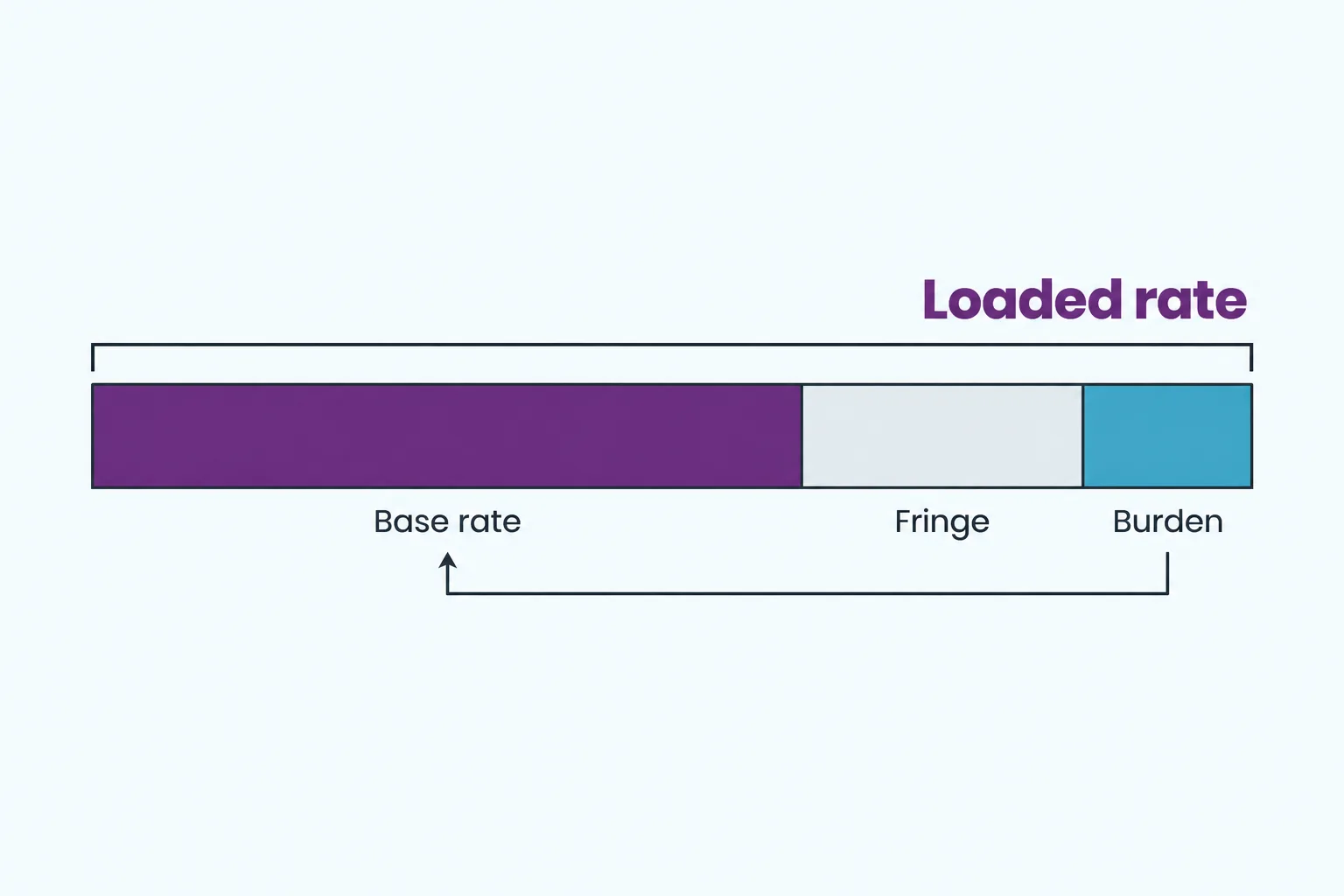
| 4. Build loaded rates | Base rate plus fringe, plus employer burden on the taxable portion | True cost per labor hour |
| 5. Submit with compliance priced in | Registration, bonding, and certified payroll administration | Responsiveness and margin retention |
What Prevailing Wage Means on a Public Works Project
Prevailing wage generally refers to the minimum wage and fringe requirements established for covered public construction, organized by worker classification and location. Coverage, applicable rates, and required fringe treatment depend on the governing law and contract. Confirm that the project is covered and use the determination incorporated into its bid or contract documents.
Federal construction contracts covered by the Davis-Bacon Act and certain federally assisted contracts covered by related statutes can carry federal prevailing-wage requirements. State and local projects may be governed by separate state or local laws. Federal funding alone does not establish that every project is covered; check the applicable statute, funding program, solicitation, and contract clauses.
The agency sets the wage floor, not the bid price.
Your competitors carry the same hourly floor you do. The construction estimating work that separates a winning number from a losing one still comes down to quantity accuracy, crew production, waste, and overhead recovery.
| Factor | Federal work | State and local work |
|---|---|---|
| Who sets rates | U.S. Department of Labor | State labor department or equivalent agency |
| Where rates appear | Determination attached to the solicitation | Determination attached to the solicitation or state rate page |
| Coverage trigger | Federal or federally assisted construction contracts | Public works contracts above a state threshold |
| Payroll reporting | Weekly certified payroll to the contracting agency | Weekly certified payroll, often through a state portal |
Where Public Works Bid Packages Are Posted
Public agencies advertise openly. Federal solicitations appear on the federal contracting portal. State transportation departments and state e-procurement systems carry highway, heavy, and building work. Counties, municipalities, school districts, and public universities post to their own purchasing pages, and commercial plan rooms aggregate much of it.
Flooring, drywall, ceiling, and painting subcontractors rarely deal with the agency directly. The package usually arrives as an invitation to bid from a general contractor, and that route is also how most GCs find subcontractors for public work. Either way, read the full package rather than the scope letter alone.
A prevailing wage package typically holds the invitation to bid, drawings, specifications, the wage determination as an attachment, bond requirements, the bid form, and any addenda. Addenda matter. One issued days before bid day can revise the determination, the classifications, or the scope, and a bid that misses an acknowledgment gets rejected before the price is ever read.
How to Look Up the Correct Wage Determination
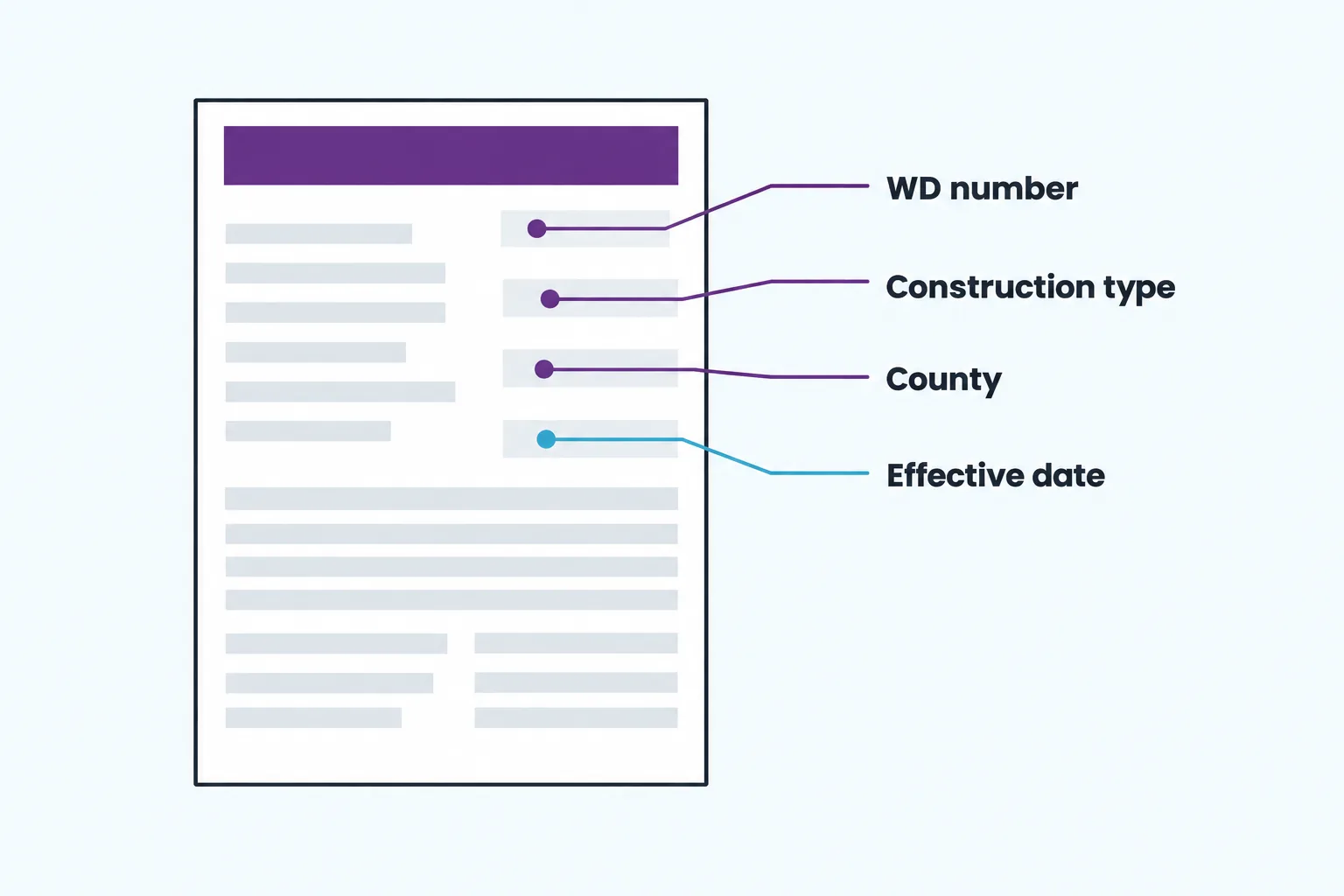
Start with the determination attached to the package, because that is the document incorporated into the contract. Verify it against the official publication named in the solicitation. Check four fields: the determination identifier, the construction type (building, residential, highway, or heavy), the county, and the effective date.
On longer jobs, confirm which determination the solicitation or contract incorporates and how the contract treats revisions. The applicable determination is generally identified in the bid or contract documents; rules for updates and changes can depend on the governing program and contract terms. Do not assume that the award-date rate or a later publication automatically controls.
Never reuse a rate sheet from a previous job. Rates change, counties differ, and a highway determination priced against a building project will be wrong on nearly every line.
How to Match Trade Classifications Without Guesswork
The determination lists classifications, not scopes of work. You map your scope onto those classifications, and the gap between two closely related classifications can swing a labor number substantially.
| Sample scope | Likely classification | Where the misclassification risk sits |
|---|---|---|
| Hang gypsum board | Carpenter or drywall hanger | Hanger and finisher often carry separate rates |
| Tape, finish, sand | Taper or finisher | Level of finish drives hours, not the rate |
| Carpet and resilient installation | Floor layer | Resilient, carpet, and sheet goods may split |
| Ceramic tile setting | Tile setter | Setter and finisher are separate classifications |
| Wall and ceiling paint | Painter | Spray, containment, and specialty coatings may differ |
Split estimated hours by the classifications supported by the applicable determination and contract rather than blending different work into one average rate. A drywall estimating breakdown can separate hang and finish quantities and hours for review. Confirm any apprentice rate, program eligibility, and ratio requirements under the rules that govern the project before including apprentice hours.
How to Build a Loaded Labor Rate with Fringes
Build the labor cost in clear steps: identify the required wage and fringe package for the classification, determine how fringe will be provided, then add applicable employer costs using your payroll and insurance inputs. Check the governing rules and your accountant, payroll provider, and insurer where treatment is uncertain.
Employer costs can include payroll taxes and workers’ compensation, but their calculation bases and treatment vary. Do not assume every cost applies to the same wage base or that paying fringe through a plan always lowers the total loaded rate. Verify plan eligibility, prevailing-wage credit rules, annualization requirements, tax treatment, and insurance rating with qualified advisers.
| Line (illustrative only, not published rates) | Cash-in-lieu route | Bona fide plan route |
|---|---|---|
| Base hourly rate | $30.00 | $30.00 |
| Required fringe | $15.00 | $15.00 |
| Fringe paid as cash wages | $15.00 | $0.00 |
| Taxable wage base | $45.00 | $30.00 |
| Burden at an assumed 32% | $14.40 | $9.60 |
| Fringe paid to plan | $0.00 | $15.00 |
| Loaded hourly cost | $59.40 | $54.60 |
This illustration assumes a $30 base wage, $15 fringe, and an assumed 32% burden applied only to the displayed taxable wage base. It is a math example, not a published rate or a rule for calculating every employer’s costs. Replace each input with the controlling determination and your verified payroll, tax, benefits, and insurance calculations.
The rest of the chain mirrors a bottom-up estimating approach: takeoff quantity divided by a supported production rate equals estimated hours; hours multiplied by the verified loaded rate equals estimated labor cost. Price overtime under the applicable federal, state, and contract rules. The premium calculation and when overtime is due can differ, so do not apply a single base-rate or daily-overtime rule to every project.
Fringe Paid as Cash vs Fringe Paid to a Plan
| Consideration | Fringe paid as cash | Fringe paid to a bona fide plan |
|---|---|---|
| Taxable wage base | Depends on payment and applicable rules | Depends on payment and applicable rules |
| Workers’ compensation treatment | Confirm with the insurer | Confirm with the insurer |
| Certified payroll reporting | Report as required by instructions | Report as required by instructions |
| Net bid impact | Calculate from verified inputs | Calculate from verified inputs |
Contractors seeking fringe credit for benefit contributions should verify that the plan and contribution qualify under the applicable rules. Annualization and documentation requirements may affect the credit; do not assume a universal calculation method.
Why Takeoff Accuracy Decides the Prevailing Wage Bid
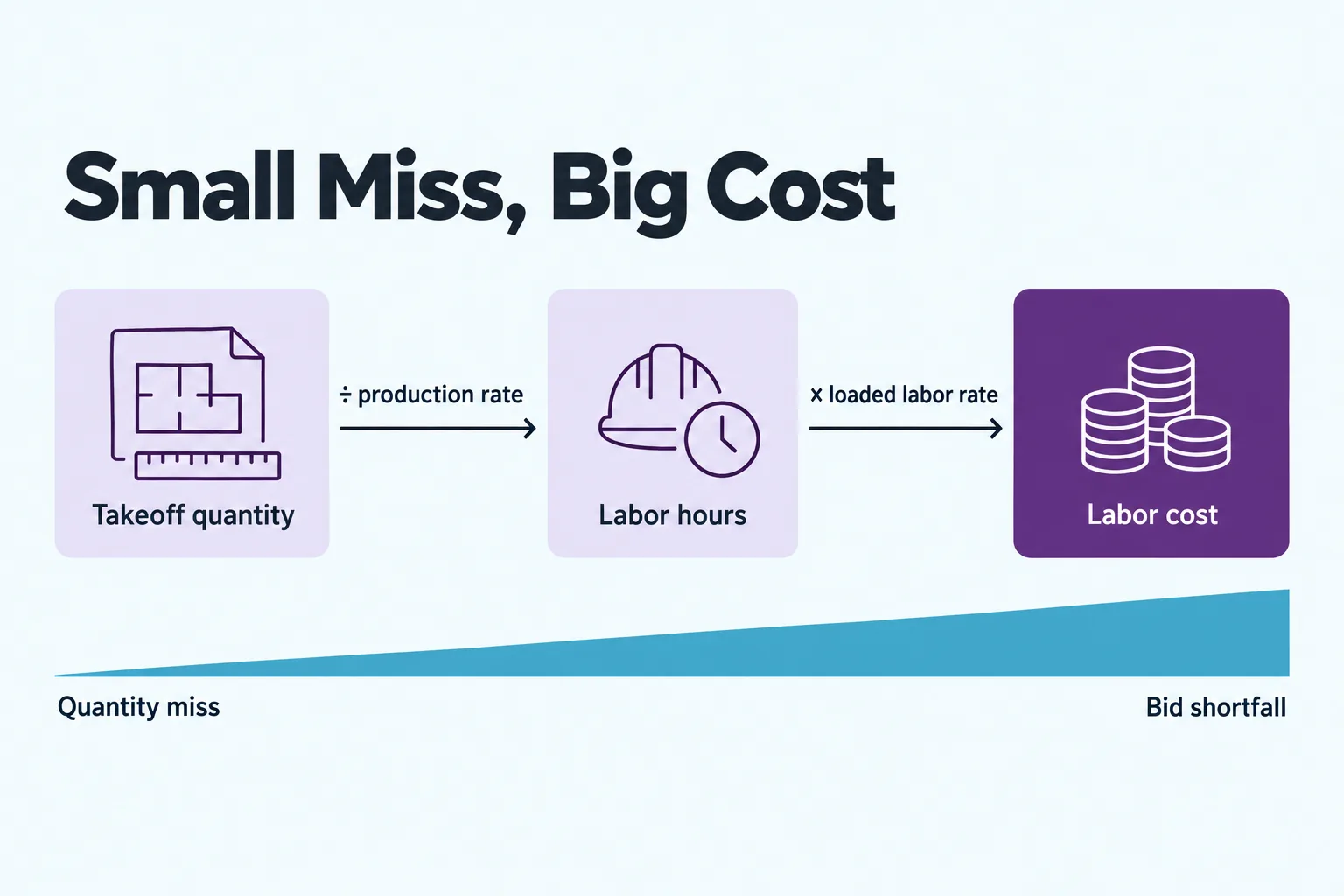
After you identify the wage requirements, quantity accuracy and production assumptions remain important bid inputs. A quantity miss affects material and labor; an unrealistic production rate can understate hours at the project’s applicable loaded labor cost. Keep these assumptions visible so the estimate can be checked before submission.
A documented drywall takeoff helps the estimator track board area, sheet counts, finish levels, and framing height as labor-hour inputs. For flooring, account for the specified material, room layout, seams, pattern repeat, substrate, and site conditions. Confirm any labor classification against the applicable determination and contract rather than inferring it from the material alone.
Flooring takeoff and estimating software can help keep quantities traceable to the plan set. Software does not choose the applicable wage determination or validate production assumptions, so document those inputs separately and review the takeoff against the bid package.
How to Estimate Labor Hours for Drywall and Flooring
Estimate hours from documented crew production on comparable work, then price those hours using the applicable project rates and conditions. Do not carry a private-work unit price into a public bid without checking its wage, scope, and productivity assumptions. A drywall labor-cost breakdown can be a reference point only when you can identify and replace its underlying assumptions.
| Scope | Unit | Production inputs to document | Prevailing-wage estimate check |
|---|---|---|---|
| Hang and finish drywall | Square foot or sheet | Board type, height, finish, access, and crew output | Separate hours by verified classification and rate |
| Acoustical ceilings | Square foot | Grid, ceiling height, lifts, and phasing | Price hours using project conditions and applicable rates |
| Carpet and resilient | Square yard or square foot | Layout, seams, substrate, access, and phasing | Verify material waste and project-specific labor assumptions |
| Paint and coatings | Square foot | Coats, substrate, prep, access, and containment | Verify scope boundaries and applicable classifications |
Illustrative Example: Convert a Takeoff Into Labor Cost
Assume a hypothetical flooring scope of 1,000 square feet, an estimator-supported production rate of 100 square feet per labor hour, and a verified loaded rate of $50 per hour. The estimate would carry 10 labor hours and $500 in labor cost before materials, equipment, supervision, overhead, and other project costs. These figures are illustrative only; they are not a Quantify benchmark or a recommended production rate. Replace them with quantities, production records, and rates that fit the actual plans, site conditions, classification, and contract.
Formula: takeoff quantity ÷ supported production rate = labor hours; labor hours × verified loaded rate = estimated labor cost.
Project conditions such as security screening, badging, escorts, occupied-building phasing, restricted hours, or night shifts can affect production. Include only conditions confirmed in the bid documents or site information, and show their effect in the labor-hour assumptions instead of hiding them in markup.
Registration and Pre-Bid Eligibility Requirements
Several states require registration with the labor agency before a bid can be submitted or accepted. That is a responsiveness issue, not a paperwork detail, and an unregistered bidder can be disqualified regardless of price.
Requirements vary by jurisdiction and project. In New Jersey, check the state’s public works contractor registration requirements before bidding or performing covered work. California’s SB 854 public works guidance explains contractor registration requirements and applicable exceptions. Confirm current eligibility, deadlines, and fees directly with the relevant agency.
| Requirement | Who it applies to | When it must be in place |
|---|---|---|
| Labor agency registration | Primes and subs, where required by state law | Before bid submission |
| Bid bond | Usually the prime, sometimes subs | With the bid |
| Performance and payment bonds | Prime, passed down by contract | At award |
| Agency prequalification | Bidders on larger contracts | Before the bid date |
| Apprenticeship commitment | Contractors using apprentice rates | Before apprentice hours are worked |
Pennsylvania Prevailing Wage Requirements
Pennsylvania’s prevailing wage requirements apply to covered public works contracts, with applicability and thresholds determined under state law. Before submitting a bid, check the Pennsylvania Department of Labor and Industry’s current Prevailing Wage FAQs and the project documents for coverage, rates, posting, payroll, and record requirements. This state example does not establish rules for other jurisdictions.
Certified Payroll and Compliance Costs to Price Into the Bid
Covered federal projects generally require weekly certified payroll information. The U.S. Department of Labor explains that WH-347 is optional; contractors may use another format if it includes the required information and certification. State and local reporting forms, schedules, and portals vary. Check the contract and governing agency instructions for the required format and submission channel.
Estimate the administrative effort required by the contract, including payroll preparation, review, corrections, and recordkeeping. Frequency and duration depend on the applicable rules and project schedule; avoid assuming identical weekly work on every project.
| Compliance task | Frequency to confirm | Who typically handles it | Where it belongs in the bid |
|---|---|---|---|
| Certified payroll submission | Per governing rules and contract | Payroll administrator or bookkeeper | General conditions or project overhead |
| Apprentice ratio tracking | As required by the applicable program and rules | Field supervision plus payroll | Project overhead |
| Fringe benefit statements | As required by the applicable rules and contract | Payroll or benefits administrator | Project overhead |
| On-site rate posting | As specified by project rules | Superintendent | General conditions |
| Record retention | As specified by applicable rules and contract | Office administration | Company overhead |
Late or inaccurate submissions can lead to payment delays, back-wage obligations, penalties, or other consequences under the governing law and contract. Verify the remedies and deadlines that apply to the project.
Markup, Overhead, and Risk on Public Works Bids
Review overhead and markup against the actual scope, contract conditions, administrative workload, bonding, financing, and risk. Public work does not automatically require a particular markup; calculate project costs and cash-flow exposure from the bid documents and your own business inputs.
| Risk item | How it shows up | How to cover it in the bid |
|---|---|---|
| Retainage | Cash held until closeout | Price carrying cost into overhead |
| Slow payment cycles | 45- to 90-day agency cycles | Build working capital cost in |
| Bond premiums | Charged at award | Carry as a direct line item |
| Wage escalation | Updated determination mid-contract | Review contract wage clauses, price known increases |
| Liquidated damages | Daily assessment for late completion | Schedule realistically, verify work hour limits |
Include estimating, project administration, bonding, and financing costs where appropriate to the scope and contract. Quantify’s commercial flooring estimating can support quantity development; the contractor remains responsible for its bid assumptions and compliance decisions.
Submit pre-bid questions in writing and get answers in an addendum. Good questions cover the construction type of the governing determination, the correct classification for a disputed scope, and any restriction on work hours.
Common Mistakes on a First Prevailing Wage Bid
| Mistake | Cost consequence | Fix before bid day |
|---|---|---|
| Shop labor rate used instead of the loaded rate | Bid short by the full fringe and burden gap | Rebuild rates by classification |
| Fringe omitted or double counted | Either a short bid or a lost job | Show fringe once, cash or plan, never both |
| Wrong county, type, or superseded date | Entire labor base incorrect | Verify all four fields on the determination |
| Addenda ignored | Bid rejected as non-responsive | Track and acknowledge every addendum |
| No compliance allowance | Margin consumed by payroll administration | Add a weekly administration line |
| Registration not confirmed | Disqualification regardless of price | Verify registration status early |
A Prevailing Wage Bid Checklist You Can Reuse
Use this as a planning template, then adapt it to the project’s solicitation, agency rules, and internal approval process.
| Phase | Item | Confirmed by |
|---|---|---|
| Pre-bid | Agency registration active | Estimator or office manager |
| Pre-bid | Determination and contract wage clauses located; coverage, location, construction type, and applicable date checked | Estimator |
| Pre-bid | Scope hours mapped to classifications supported by the determination | Estimator |
| Pre-bid | Apprentice program and ratio confirmed | Operations |
| Pre-bid | Bond capacity verified | Office manager |
| Bid day | Takeoff quantities locked and saved | Estimator |
| Bid day | Hours split by classification; wage, fringe, burden, and payment assumptions documented | Estimator |
| Bid day | Project-specific compliance administration included where applicable | Estimator |
| Bid day | All addenda acknowledged, bid form signed | Estimator |
| Post-award | Payroll system configured, weekly certified payroll calendar set | Payroll |
| Post-award | Rates posted on site, record retention plan documented | Superintendent and office |
If your team already works from a standard drywall bid template, add classification and fringe columns to it rather than maintaining two separate formats.
Key Takeaways
| Point | Why it matters |
|---|---|
| The wage floor is fixed by law | Every bidder carries the same hourly minimum |
| Quantities and production rates are the real lever | Margin is won on accuracy, not on cheaper labor |
| Fringe payment route changes the loaded rate | Cash-in-lieu raises the taxable base and burden |
| Classification mapping drives labor cost | Hanger, finisher, setter, and painter rates differ |
| Registration and certified payroll are bid-day items | Both affect responsiveness and margin, not just closeout |
Once applicable wage requirements are identified, a traceable takeoff and realistic labor-hour assumptions help the team evaluate its bid before submission.
Related readingHow to Prioritize Which Jobs to Bid: Contractor GuideRead the guide →Frequently asked questions
How do I obtain the prevailing wage rate for my job?
How does prevailing wage work in simple terms?
How do contractors bid on jobs at prevailing wage?
Can a subcontractor bid a prevailing wage job through a general contractor?
Is it worth outsourcing takeoffs on prevailing wage bids?
Bid Your Next Public Works Job on Quantities You Can Defend
Once the wage is set by the agency, the estimate lives or dies on quantity accuracy. Quantify North America provides construction estimating and quantity takeoff support for trades including flooring, drywall, ceilings, and painting. The takeoff can support your quantity review; your team determines applicable wage classifications, labor rates, compliance requirements, and final pricing. If your next public bid deserves quantities you can defend line by line, get in touch with the Quantify team with your plan set and bid date.