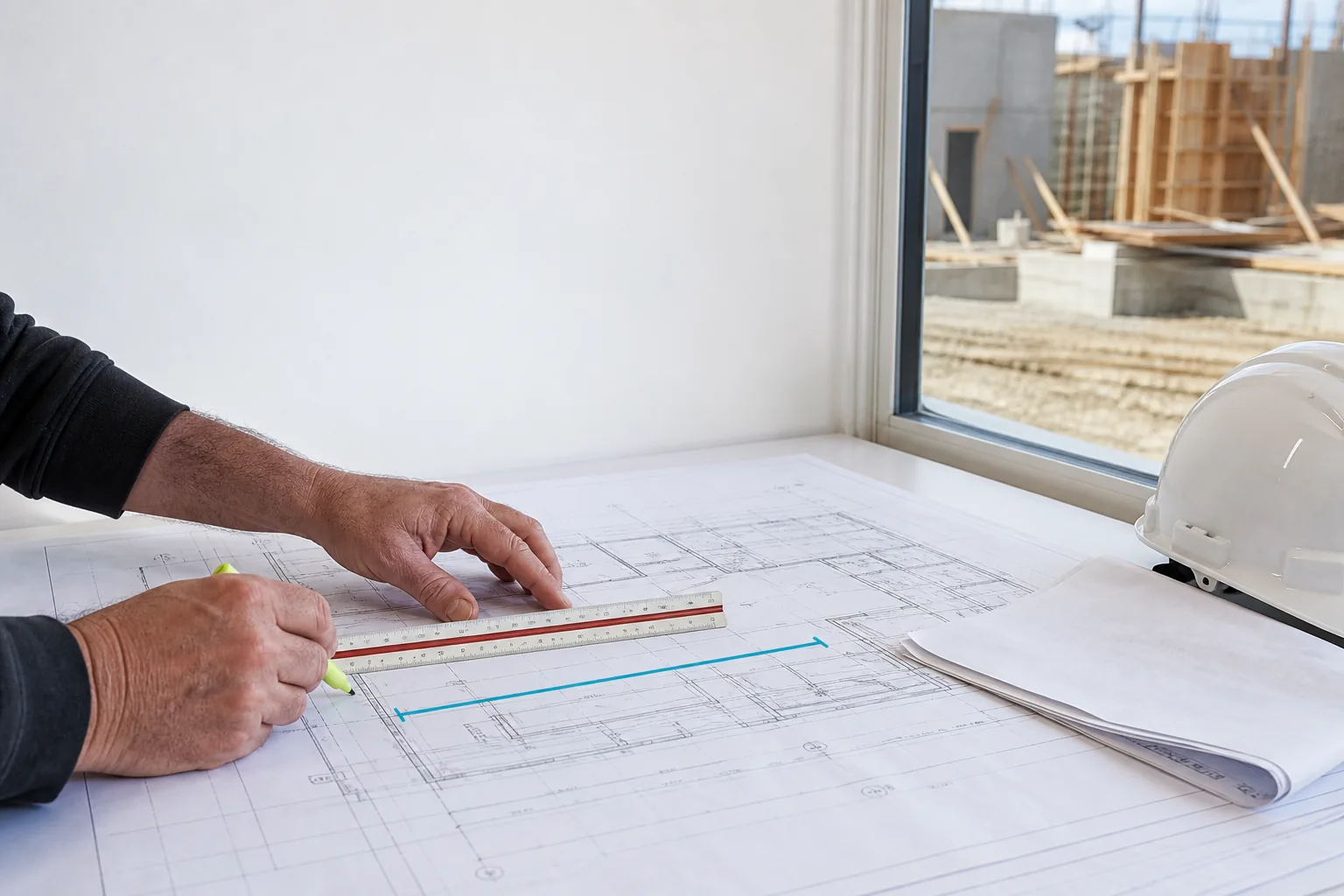
Most contractors know how to bid drywall jobs. Fewer know how to bid drywall jobs faster without missing scope, underpricing labor, or chasing change orders later. Speed doesn’t come from rushing. It comes from systems. In this guide, we will explore how it works when you structure your drywall takeoff, pricing model, and proposal process correctly. That principle applies directly to drywall jobs. If you want a repeatable system for scoring opportunities before the takeoff starts, our guide on how to prioritize which jobs to bid walks through the filters that keep estimating hours focused on winnable work.
How to bid drywall jobs faster? Start With a Structured Pre-Bid Review
If you want to understand how to bid drywall jobs faster, the answer begins before you ever open your drywall estimating software. Speed comes from clarity. And clarity comes from knowing exactly what you’re bidding.
Every solid drywall bid starts with three quick filters: scope definition, ceiling height complexity, and finish level. Miss any one of those, and you’ll redo your drywall takeoff later. That’s where time disappears.
According to the U.S. Bureau of Labor Statistics, specialty trade contractors face tight margins and rising material volatility in construction markets. That’s why drywall bids must move quickly but stay precise. Reworking the cost estimation is real money.
The first pass through drawings should answer:
- Is this a full install or a partial sheetrock job?
- Are there varying ceiling heights?
- What finish level is specified?
- Is there a specialty board or moisture-resistant drywall required?
Instead of reading every page twice, isolate drywall scopes immediately. This is a basic construction estimating discipline that cuts wasted review time. When contractors ask how to bid drywall jobs faster, this pre-bid review step alone can shave hours from large commercial sets.
Improve Speed With a Disciplined Drywall Takeoff System
The drywall takeoff stage is where most delays happen. Manual counting, backtracking, and forgotten partitions force rework. You don’t need to move faster with your mouse. You need fewer revisions.
A structured drywall takeoff follows a sequence: exterior walls, interior partitions, ceilings, specialty details, and finally waste factors. Jumping between sheets slows you down.
Digital takeoff tools reduce friction significantly. According to a BYU thesis comparing time and accuracy of digital and manual methods, digital plan measurement can reduce takeoff time by 30–50% compared to manual scaling methods. The difference looks like this:
| Method | Average Takeoff Time (10k sq ft) | Error Risk | Revision Rate |
| Manual scale & count | 5–7 hours | High | Frequent |
| Basic digital plan viewer | 3–5 hours | Medium | Occasional |
| Dedicated drywall takeoff software | 2–3 hours | Low | Minimal |
If you truly want to master how to bid drywall jobs faster, the drywall takeoff phase must become repeatable and predictable.
Price Materials Using Current Drywall Cost Benchmarks
Speed without updated pricing leads to losses. That’s not efficiency. That’s gambling. Material volatility in gypsum markets has fluctuated significantly over recent years. U.S. Geological Survey gypsum statistics report production changes tied to construction demand cycles. Pricing must reflect current supplier quotes, not last year’s spreadsheet.
Instead of calling suppliers during every bid, build a live drywall price chart you update weekly. A simplified pricing reference looks like this:
| Item | Typical Cost Range (USA) |
| 1/2″ drywall board | $0.40–$0.65 per sq ft |
| 5/8″ fire-rated board | $0.55–$0.85 per sq ft |
| Joint compound & tape | $0.05–$0.12 per sq ft |
| Fasteners & accessories | $0.03–$0.07 per sq ft |
When contractors search for how to bid drywall jobs faster, they often ignore this material pricing structure. That’s why bids stall at the pricing phase.

Labor Cost: The Real Driver Behind Faster Drywall Bids
Drywall labor determines whether your bid wins or bleeds. The Bureau of Labor Statistics lists median hourly wages for drywall installers and finishers in the U.S. at approximately $28.27 per hour, depending on region. That doesn’t account for burden, overhead, or productivity differences.
The labor cost to hang and finish drywall depends on ceiling height, finish level, and job size. A practical productivity reference:
| Scope | Average Productivity | Labor Cost Range |
| Hang 8’ walls | 35–50 sheets per day per crew | $0.70–$1.20 per sq ft |
| Hang 12’ walls | 25–35 sheets per day | $1.00–$1.60 per sq ft |
| Level 4 finish | 800–1,200 sq ft per day | $0.80–$1.50 per sq ft |
| Level 5 finish | 500–800 sq ft per day | $1.50–$2.50 per sq ft |
If you’re serious about learning how to bid drywall jobs faster, standardizing labor assumptions is critical. Otherwise, every drywall bid becomes a debate with yourself.
Use Drywall Estimating Software Instead of Rebuilding Spreadsheets
Here’s what slows contractors down: re-creating estimates from scratch every single time. Modern drywall estimating software allows saved assemblies, auto-calculated waste, and labor rate libraries. According to industry reporting, contractors using specialized software report improved bid accuracy and reduced estimating cycle times.
Whether you use drywall estimator software or broader drywall contractor software, the principle is the same. Store your assemblies once. Reuse forever.
If you’re evaluating estimating tools, review this resource on software and estimating tools used in construction bidding workflows. When someone asks how to bid drywall jobs faster, software isn’t optional anymore. It’s expected.
Build a Reusable Drywall Bid Template
Speed comes from reuse. A drywall bid template eliminates repetitive formatting, scope descriptions, exclusions, and payment terms drafting. Instead of rewriting your drywall bid every time, plug numbers into a predefined structure.
A strong drywall bid template includes:
| Section | Purpose |
| Scope of work | Clarifies inclusions |
| Exclusions | Prevents disputes |
| Material pricing | Transparent line items |
| Labor breakdown | Defensible cost structure |
| Alternates | Flexibility for GC |
When contractors understand how to bid drywall jobs faster, templates play a bigger role than most realize.
Eliminate Rework: Why Contractors Lose Time on Drywall Bids
Rework during estimating is the silent profit killer in drywall construction. It rarely shows up on a timesheet, but it shows up in missed deadlines, rushed revisions, and second-guessing numbers at the eleventh hour. Contractors who want to master how to bid drywall jobs faster must first understand where time leaks out of the process.
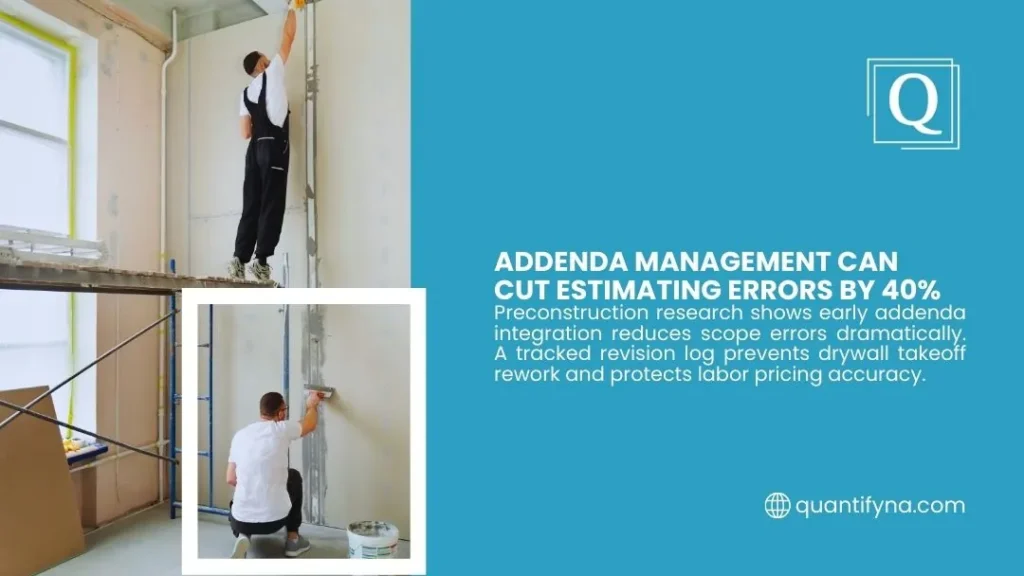
Most delays trace back to fragmented information flow. Drawings are reviewed in pieces. Addenda are skimmed instead of integrated. Ceiling height changes get discovered after quantities are calculated. Finish levels are assumed rather than confirmed. By the time inconsistencies surface, the drywall takeoff must be reopened and recalculated.
Industry research repeatedly shown that poor preconstruction coordination contributes significantly to project inefficiencies across trades. While those studies focus on broader construction performance, the implications apply directly to drywall bids. When documentation isn’t reviewed in a disciplined sequence, rework follows.
The most common time-loss patterns look like this:
| Rework Cause | What Happens | Time Impact | Preventive Control |
| Addenda ignored early | Scope revisions discovered late | 1–3 hours revision | Integrate addenda before takeoff begins |
| Ceiling height misread | Labor recalculation required | 30–90 minutes | Confirm wall types and heights upfront |
| Finish level unclear | Underpriced labor or material | 1–2 hours correction | Cross-check specs before pricing |
| Fire-rated assemblies missed | Incorrect board counts | 45–120 minutes | Identify rated walls first pass |
| Repair vs new install mixed | Wrong productivity assumptions | 30–60 minutes | Separate scopes before estimating |
Each of these mistakes forces you to reopen the drywall estimating file. That’s not just inconvenient; it disrupts focus and compresses proposal time.
Contractors asking how to bid drywall jobs faster often assume the solution lies in moving more quickly through drawings. In reality, the solution lies in moving once, correctly. Structured review, disciplined drywall takeoff sequencing, and immediate addenda integration eliminate the need to backtrack.
Rework doesn’t happen because estimators are careless. It happens because workflows are inconsistent. Once you standardize the order of operations, bid turnaround accelerates naturally.
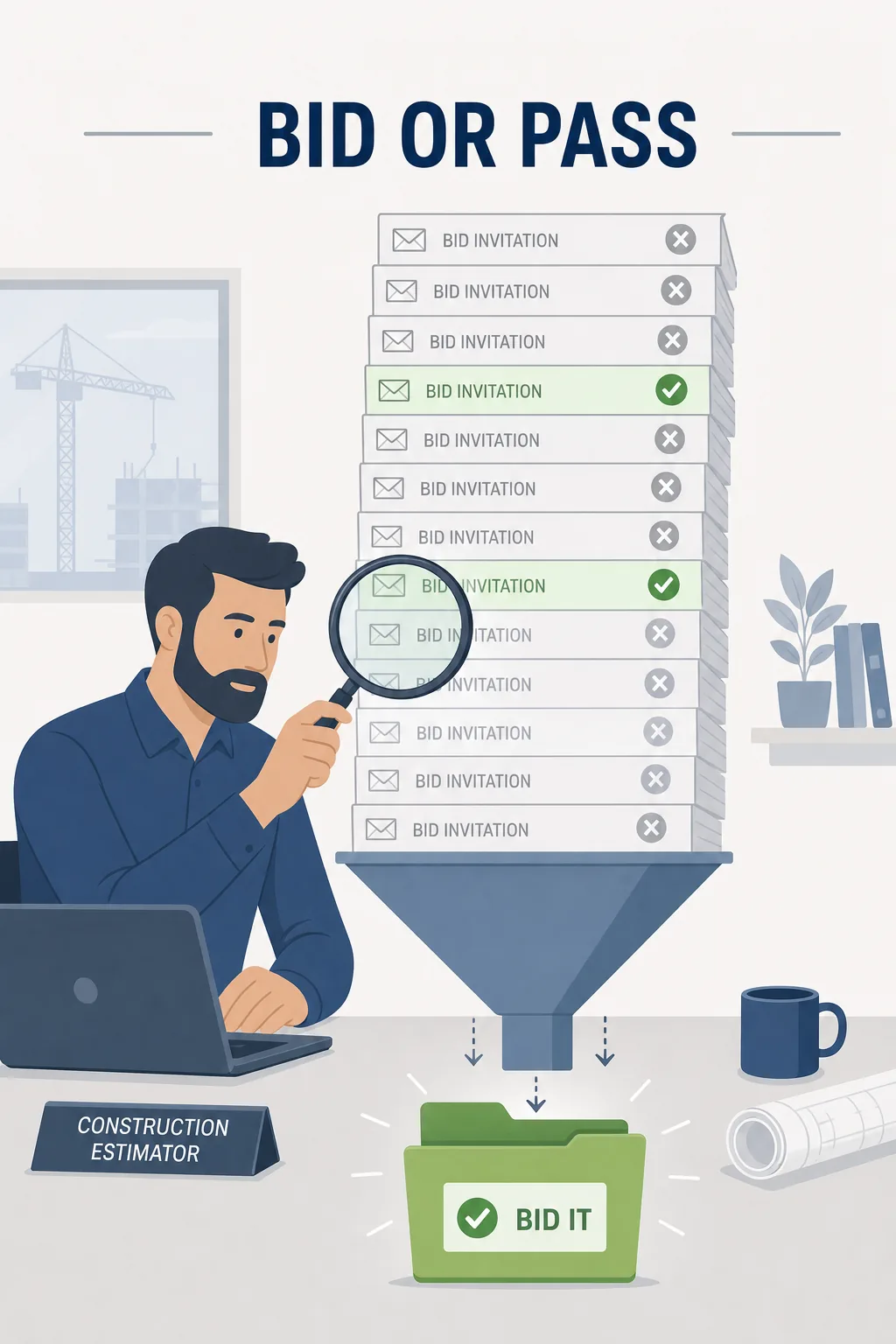
Bid Selection Strategy: Stop Bidding Everything
One of the least discussed truths in drywall construction is this: you cannot bid your way into profitability by chasing every opportunity.
Speed is not just about how quickly you produce drywall bids. It is also about where you choose to invest your estimating time. Contractors who learn how to bid drywall jobs faster often discover that selective bidding increases both efficiency and win rate.
According to data, contractors with defined bid selection criteria consistently outperform those who rely on reactive bidding. Our framework for defined bid no-bid decision criteria shows how to decide which drywall opportunities deserve your estimating time before you open the drawings. That principle applies directly to drywall jobs. Before committing to a drywall bid, evaluate it against structured criteria.
| Evaluation Factor | Low-Value Indicator | High-Value Indicator | Impact on Estimating Time |
| Project Size | Extremely small repair | Mid-size or repeatable scope | Reduces marginal bids |
| GC Relationship | No prior history | Established working relationship | Higher win probability |
| Schedule Clarity | Vague timelines | Defined start and completion dates | Less revision risk |
| Spec Complexity | Heavy specialty requirements | Standard assemblies | Faster drywall takeoff |
| Competition Level | Unknown bidder pool | Known competitor count | Better forecasting |
If your drywall contractor software or CRM tracks historical data, review which types of projects produce consistent wins. Align your bidding pipeline with those profiles.
Contractors frequently underestimate the cost of lost time on low-probability bids. Even a four-hour estimate represents overhead. When multiplied across dozens of unproductive pursuits, it slows growth.
Learning how to bid drywall jobs faster is not just a mechanical process. It is a strategic discipline. Selective bidding protects your estimating capacity so your team can focus on jobs that fit your crew, your pricing model, and your labor productivity assumptions.
The contractors who scale effectively are not always the ones bidding the most jobs. They are the ones bidding for the right jobs.
Small Team? You Can Still Bid for More Jobs
Limited staff often becomes the bottleneck. Estimating without enough staff is one of the biggest operational slowdowns in specialty trades.
According to industry reporting from Associated Builders and Contractors, workforce shortages continue to impact project timelines across the U.S. That extends to estimators. If your team is small, structured workflows allow you to bid on more jobs without burnout.
When asking how to bid drywall jobs faster, team structure matters just as much as takeoff speed.
Should You Outsource Drywall Estimating?
Some drywall contractors reach capacity quickly. Instead of hiring full-time staff, they outsource construction estimating services.
The ROI of outsourcing estimating often outweighs payroll expansion during peak periods. It allows contractors to maintain bid volume without overhead expansion.
If you’re considering that route, understand the outsourcing construction estimating and cost considerations. Understanding how to bid drywall jobs faster sometimes means recognizing when to delegate.
Real Example: Manual vs Structured Drywall Bidding Process
Let’s compare two approaches to illustrate the time difference.
| Process Stage | Manual Workflow | Structured Workflow |
| Plan Review | Repeated scanning | One structured pass |
| Drywall Takeoff | Manual counts | Digital measured |
| Pricing | Supplier calls per bid | Updated cost library |
| Labor | Job-specific guess | Standardized productivity |
| Proposal | Rewritten each time | Template reuse |
| Total Estimate Time | 10–14 hours | 4–6 hours |
That difference defines how to bid drywall jobs faster in real-world conditions.
Speed Without Sacrificing Precision
Contractors who master how to bid drywall jobs faster understand one principle clearly: speed without structure creates risk. Precision without efficiency creates stagnation. The balance between the two defines sustainable growth.
Accurate drywall estimating depends on updated drywall cost per square foot data, standardized labor productivity assumptions, organized drywall takeoff methods, and reusable drywall bid templates. When these elements function together, estimating ceases to be chaotic.
Quantify North America has built its reputation around this balance. With decades of commercial project management insight behind its leadership, the company supports contractors who need dependable drywall estimating systems that reduce rework, improve bid accuracy, and allow teams to pursue more opportunities without expanding payroll unnecessarily.
If your current process feels rushed, fragmented, or reactive, this might work for you. Instead of rebuilding spreadsheets every week, consider structured drywall estimating support that mirrors your workflow and integrates seamlessly into your bidding cycle.
Learning how to bid drywall jobs faster is not about shortcuts. It is about discipline, clarity, and repeatable systems. When those systems are in place, estimates move more quickly, bids look sharper, and confidence replaces guesswork. And that shift changes everything.