
A bid alternate is an optional scope or product change with a separate price in the bid documents. To price it, identify exactly what changes from the base bid, quantify affected work, apply project-specific labor and material assumptions, and follow the bid form’s instructions. A substitution or deduction may call for the net cost change from the base scope, so do not assume every alternate is priced as a new, standalone package.
Article Summary: How to Price Bid Alternates at a Glance
| What you do | Why it matters |
|---|---|
| Read the alternates instructions, bid form, specifications, drawings, and addenda together | They define the scope, pricing method, selection rules, and submittal format |
| Measure the affected scope separately and compare it with the base scope | A clear quantity record supports review of the add, deduct, or substitution |
| Price the changed work and related impacts | Labor, materials, equipment, access, phasing, and productivity may differ |
| Apply indirect costs and markups as required by the bid documents and your cost model | Tax, bonding, overhead, and profit treatment can vary by project |
| Enter the amount and direction exactly as requested | The solicitation controls whether the response is an amount, ADD, DEDUCT, NO CHANGE, or another entry |
This is ordinary construction estimating discipline applied one scope item at a time.
What Bid Alternates Are and How They Work
The bidder submits a base bid and prices the alternates listed in the solicitation. The owner’s evaluation and selection process, including the order of acceptance, any funding limits, and whether options can be combined, depends on the bid documents and procurement rules. The base bid should cover the specified base scope without relying on an alternate unless the documents say otherwise.
| Type | What changes | Sign on the bid form | Common estimating error |
|---|---|---|---|
| Additive | Adds scope and cost (upgraded flooring, extra ceiling area, a second coat) | ADD | Base-bid labor rates applied to a much smaller quantity |
| Deductive | Removes scope and subtracts cost | DEDUCT | Only field area is credited while trim, prep, and accessories stay in the price |
| Substitution | Replaces a specified product, assembly, or method; price the difference if the form requests a net change | ADD or DEDUCT, as instructed | Related scope and cost differences are missed |
Public bid documents may set an acceptance priority and rules for unselected alternates. The FHWA guide to additive or deductive alternate bidding describes one public-agency approach; the project solicitation and procurement rules control.
How to Price Bid Alternates: Step by Step
Build the price from the bid documents and affected quantities, then apply the rates and cost treatment the project requires. A bottom-up estimating method keeps assumptions visible and calculations reviewable.
Step 1: Read the Alternate Instructions, Bid Form, and Addenda Together
Review the solicitation’s alternate descriptions alongside the bid form, drawings, specifications, and addenda. Some projects organize alternates in Division 01, but document structure varies. Match the alternate number and scope to the form, and note any unclear interfaces, such as substrate preparation, transitions, or fire caulking, for clarification before the question deadline.
Step 2: Take Off the Affected Scope Separately
Record the quantities affected by each alternate separately from the base bid. For a deductive alternate, identify the materials, labor, accessories, and related work removed, then note anything that remains. For example, a drywall takeoff for deleted partitions may need to account for board, corner bead, finish, and accessories, not wall area alone.
Step 3: Price Labor, Material, and Equipment Separately
Use production assumptions that reflect the alternate’s quantity, work area, access, crew setup, and schedule. A smaller area may have a different unit cost than a large open field, but confirm that difference against your own production data. A drywall labor-cost guide can provide context; verify its assumptions before using them in a project estimate.
Step 4: Add Applicable Indirect Costs, Markups, and Risk Allowances
Follow the bid documents and your estimating method when applying overhead, profit, taxes, bond costs, and escalation. For deductions, distinguish costs that are removed from costs that remain; do not assume a proportional overhead or profit credit applies in every case. Bond premiums and tax treatment can depend on the contract, jurisdiction, surety, and company inputs. FHWA’s performance-bond cost analysis provides background, but confirm current project-specific costs with your surety. Include a price-validity term only when the solicitation allows it.
Step 5: Follow the Bid Form’s Entry Instructions
Enter the amount and direction in the format requested, such as ADD, DEDUCT, NO CHANGE, or another specified response. Do not assume that a blank, $0.00, and “N/A” are interchangeable; follow the solicitation’s instructions. Submit assumptions or qualifications only in the format the documents permit. If scope is unclear, ask a written question before the deadline and follow any addendum.
How to Calculate an Add, Deduct, or Substitution Alternate
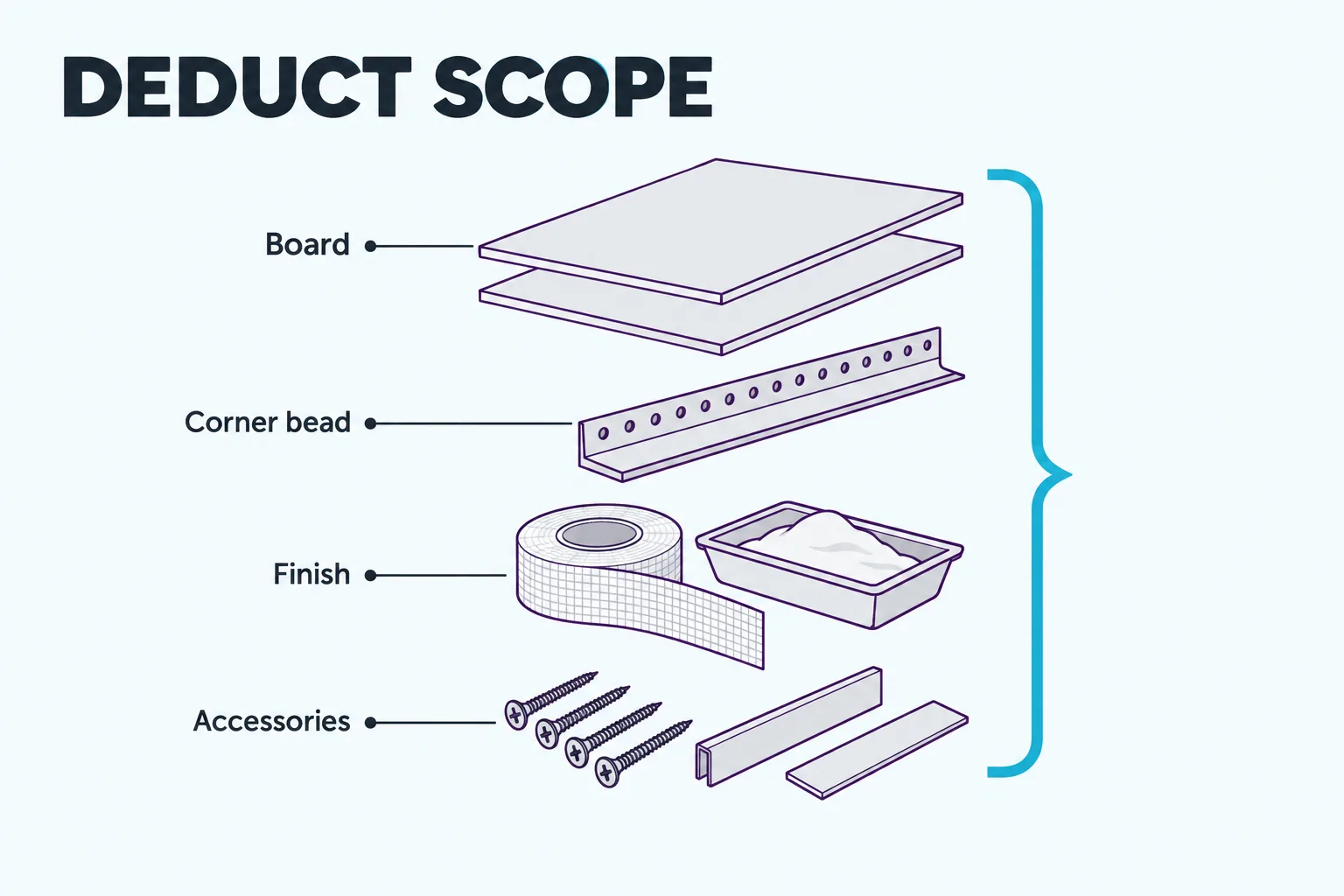
Use the bid form’s pricing direction to determine whether to price added scope, removed scope, or a net change. For a substitution that requests a net amount, compare the alternate assembly with the base assembly and include related costs. For a broader overview of cost-estimating components, see Quantify’s building estimation guide.
| Stage | Calculation |
|---|---|
| Changed direct cost | Labor + materials + equipment + subcontractor costs for affected work |
| Net scope cost | Changed direct cost plus applicable indirect costs, less costs actually removed |
| Alternate price | Apply the bid documents’ rules for overhead, profit, bond, tax, and other adjustments |
For a substitution, use a comparison like this (variables only; no market rates):
Net alternate amount = cost of alternate scope − cost of base scope removed + related added costs − related costs avoided.
If the result is positive, submit it as an ADD when the bid form calls for a net price. If negative, submit the corresponding DEDUCT. If the form requests the full alternate amount instead, use its required method.
The following amounts are placeholders for arithmetic only. They are not Quantify prices, market rates, or recommended markups; replace them with project quotes and company cost inputs.
For an additive alternate that calls for a full price, the existing example below shows a placeholder cost build-up. Its values are illustrative only, not company or market pricing.
| Line | Sample amount |
|---|---|
| Labor | $1,400 |
| Material | $1,600 |
| Equipment | $100 |
| Direct cost | $3,100 |
| Job overhead | $250 |
| Job cost | $3,350 |
| General overhead and profit | $630 |
| Bond and tax | $80 |
| Alternate No. 1 | ADD $4,060 |
Ripple Costs Estimators Miss on Alternates
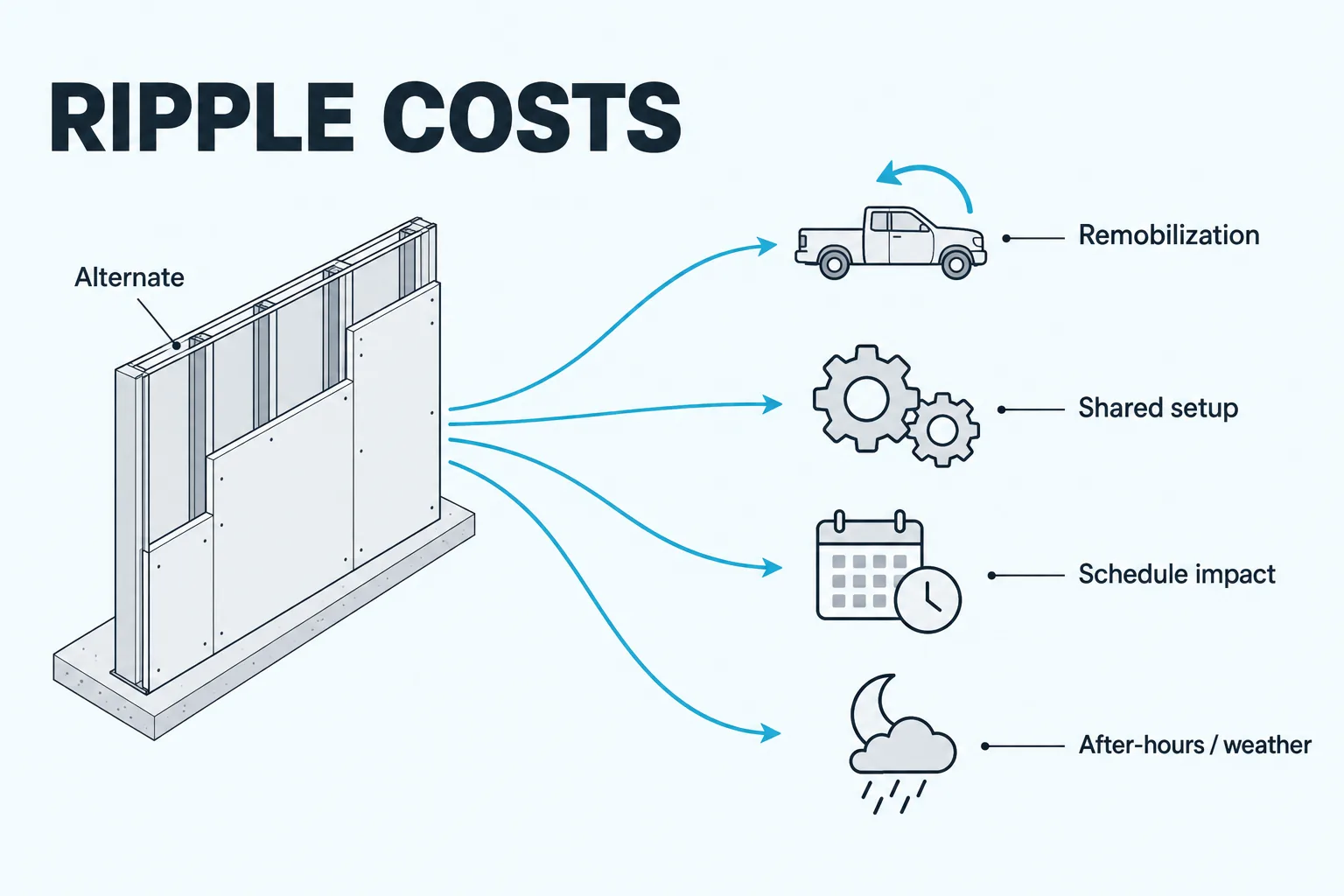
Check for cost changes beyond the measured material or area. The alternate may affect access, schedule, mobilization, supervision, or adjacent trades.
| Ripple cost | When it applies | How to handle it |
|---|---|---|
| Remobilization | The alternate area gets built out of sequence, and the crew returns | Carry a second trip in the alternate price |
| Shared setup or dependent alternates | Alternates share mobilization, interfaces, or one option depends on another | Price the combinations required by the solicitation; do not assume independent costs or add unauthorized conditions |
| Schedule or general-conditions impact | An accepted alternate changes sequencing or duration | Estimate added or avoided costs from the project schedule and contract |
| After-hours or weather-related work | The alternate requires restricted hours or seasonal work | Use project-specific labor and equipment assumptions |
| Waste factor | The alternate changes product, roll width, or run direction | Recalculate waste instead of copying the base-bid percentage |
Alternates, Allowances, and Change Orders Are Not the Same
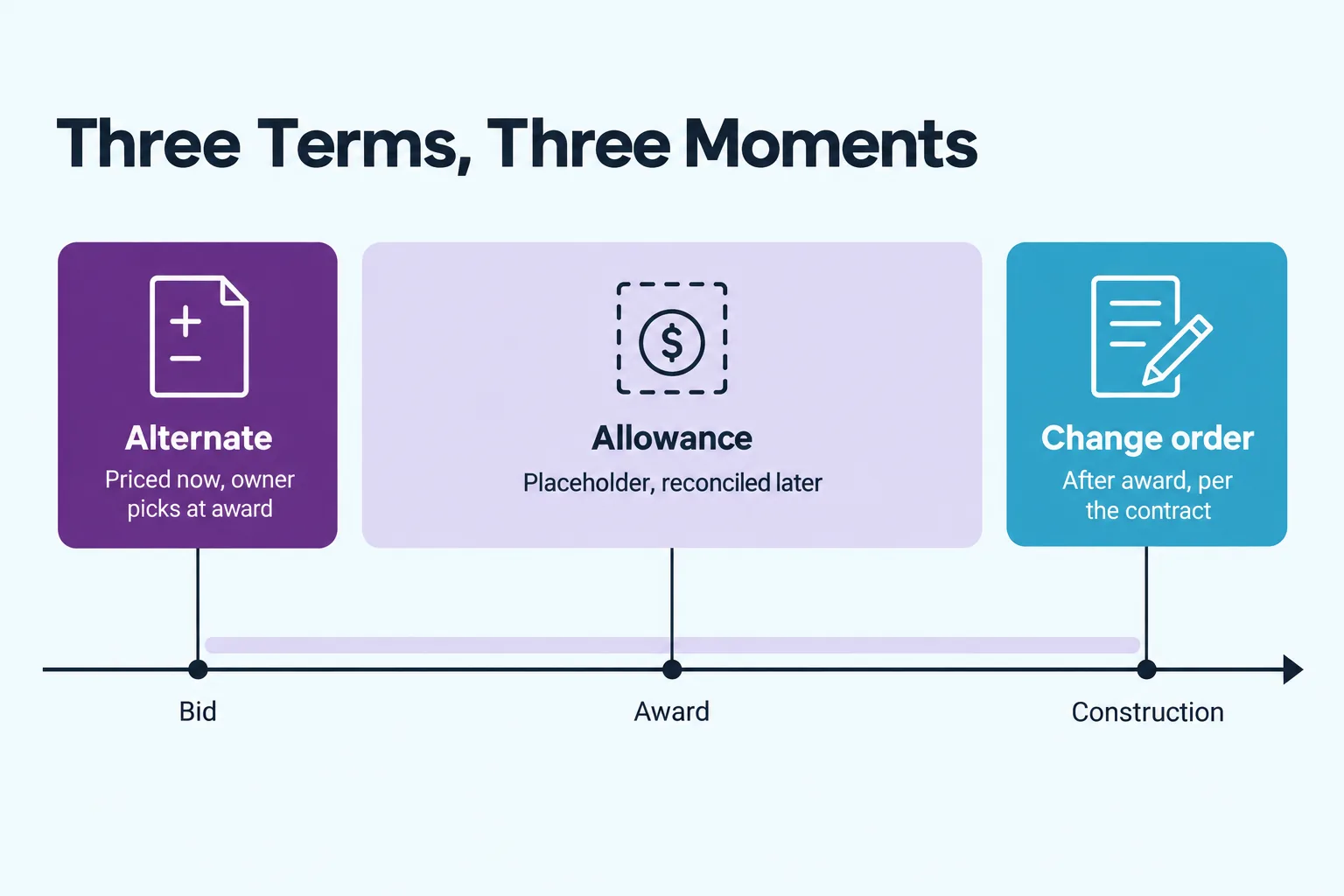
| Term | When priced | Who decides | Effect on contract sum |
|---|---|---|---|
| Alternate | At bid time, scope fully described | Owner, at or shortly after bid opening | Added or deducted when accepted |
| Allowance | Carried as a placeholder figure | Owner selects the item later | Reconciled against actual cost |
| Change order or variation | After contract award | Owner directs, contractor prices | Adjusted per the contract’s changes clause |
An allowance is a budget placeholder for an item whose final selection or cost is not established at bid time; its treatment depends on the contract. AIA’s overview of construction allowances explains how AIA contract documents handle allowance amounts. An alternate is a separately priced option defined in the bid documents.
After award, the contract’s change provisions govern a change order. The process and each party’s obligations depend on the contract and applicable law, so avoid treating a general summary as a reason to accept or refuse a change.
Trade Examples: Flooring, Drywall, and Painting Alternates
| Trade | Typical alternate | Line item most often left out |
|---|---|---|
| Flooring | Upgrade broadloom to carpet tile or LVT in a defined area | Moisture testing, floor prep, and transitions at the new material edge |
| Drywall and ceilings | Raise the finish level, add a soffit, extend partitions to the deck | Above-ceiling labor rate and fire caulk at the deck |
| Painting | An added coat, a higher-grade coating, or an accent color | Additional preparation, cut-in, and finish labor |
On the flooring side, a clean flooring estimating package keeps alternate quantities separate from the base-bid field area, which is what makes the credit or the add provable later.
Bid Form Check Before You Submit
| Check | Pass condition |
|---|---|
| Alternate number and label | Match the bid form word for word |
| Direction | Entered exactly as the bid form requests, including any “no change” option |
| Takeoff | Separate from the base bid and saved |
| Production rate | Adjusted for the alternate quantity and condition |
| Cost adjustments | Overhead, profit, tax, and bond applied as required by the bid documents and cost inputs |
| Ripple costs | Remobilization, schedule, and waste addressed |
| Assumptions | Submitted only in the manner allowed by the bid documents; unresolved scope raised through the specified question process |
If your team is balancing multiple bid deadlines, outsourced construction estimating may provide takeoff support, subject to the provider’s scope and availability.
Key Takeaways
Related readingEstimating Deadline Pressure: Bid Fast Without ErrorsRead the guide →| Takeaway | What it means for your bid |
|---|---|
| Estimate each alternate separately | Calculate a full price or net change as the bid form requires |
| Calculate deductions from actual cost changes | Separate avoided costs from costs that remain; follow the bid documents for overhead and profit |
| Check quantity and productivity assumptions | Use project conditions and supported production data |
| Follow the bid form | Match its numbering, price direction, and required response |
| Submit assumptions as instructed | Do not add qualifications in a format the solicitation does not allow |
FAQs About Bid Alternates
How do bid alternates work?
What is additive alternate bidding?
What is the formula for calculating the bid price?
How do you price a substitution alternate?
Should a deductive alternate include overhead and profit?
What happens if an alternate line is left blank?
Get Your Alternates Priced Right the First Time
Alternate pricing depends on clear quantities and an accurate reading of the bid documents. Quantify North America provides estimating and quantity takeoff support for trades including flooring, drywall, ceilings, and painting. If you need help measuring base or alternate scopes, contact the team with the project details and bid deadline to confirm available takeoff support.