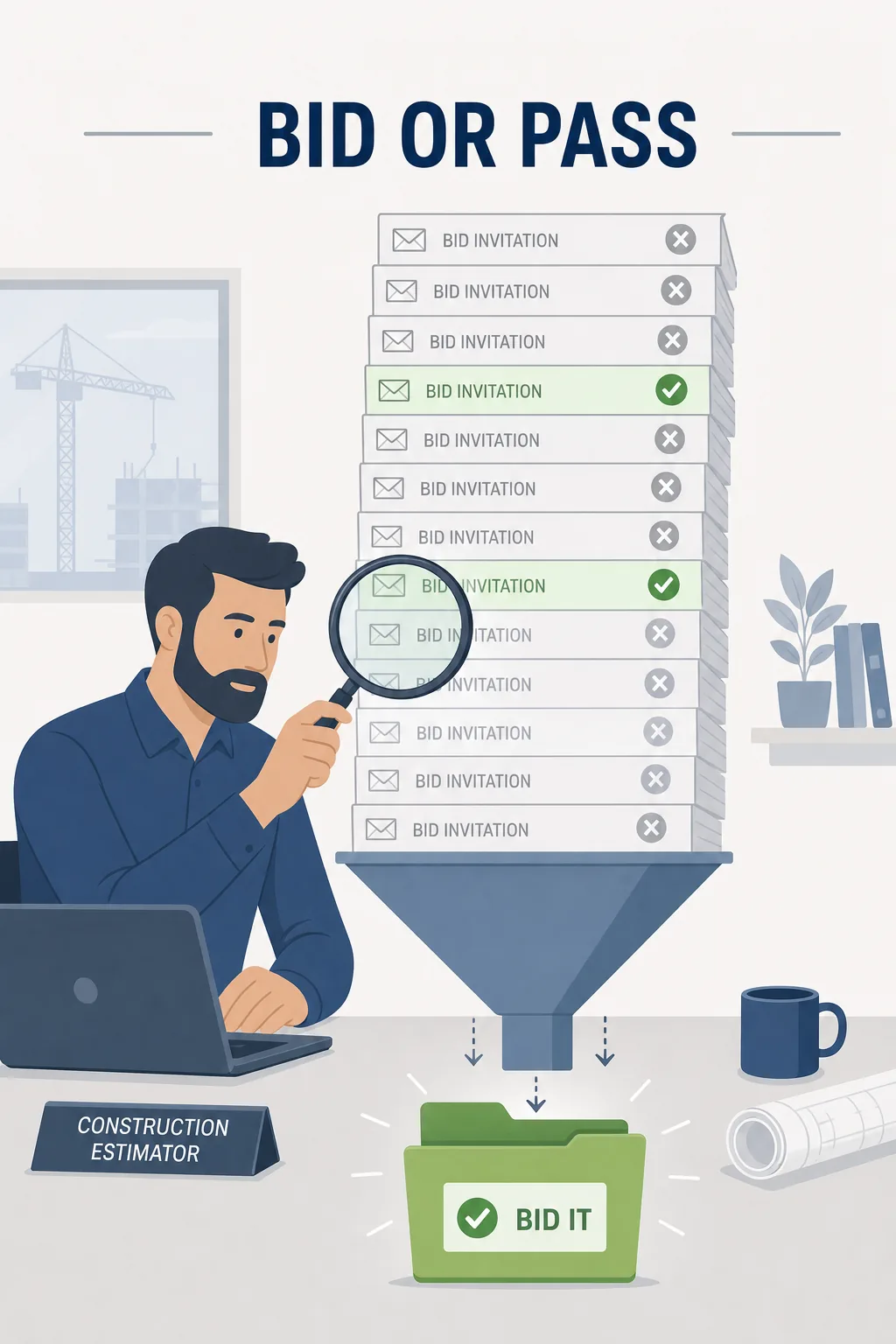
Summary
Most trade businesses get more invitations than their estimators can price well. The real skill is filtering, not chasing. This guide scores every invitation on five factors, uses a fast triage pass to reject weak leads, and ties your win rate to the accuracy of the estimate behind each bid, all before a single hour goes into a takeoff.
| Question | Short answer |
|---|---|
| What decides a good bid target? | Fit, profit potential, win probability, capacity, and payment risk |
| How fast should you screen? | A 15-minute pass before any detailed estimating |
| What ruins bid selection? | Bidding everything and trusting shaky numbers |
| What makes scoring trustworthy? | Accurate takeoffs that reflect real material and labor cost |
What “Prioritize Which Jobs to Bid” Really Means
Prioritization is a filtering decision you make before the takeoff, not after. When a drywall or flooring shop gets ten invitations in a week, the limit is rarely ambition, it is estimating capacity. Each detailed bid burns hours your team could spend on a job you are far more likely to win at a healthy margin.
So the first question is not “can we do this work?” but “is this worth our estimating time compared to everything else on the table?” That is opportunity-cost thinking, and serious buyers already treat bid selection with the same discipline. Federal agencies structure their solicitations and evaluations under the sealed bidding rules in FAR Part 14, a reminder of how much process goes into deciding who gets invited and how bids are judged. Your side of the table deserves the same rigor. A clean professional construction estimating process starts only after a job clears the filter.
The Five Factors That Decide If a Job Is Worth a Bid
Judge every invitation on five factors. Score each one, and a pattern appears fast.
| Factor | What to look for | Red flags |
|---|---|---|
| Strategic fit | Work close to your niche and past projects | Scope your crew has never handled |
| Profit potential | Room for margin after real cost | Race-to-the-bottom pricing |
| Win probability | Existing relationship, few bidders | Cold list, ten competitors |
| Capacity and timing | Crew and calendar are open | Bid deadline collides with active jobs |
| Payment and risk | Solid GC, clear terms | Slow payer, vague scope, retainage traps |
Weighting these five turns “bid on work that fits your strengths” into a repeatable decision. It also helps to study your own history, because the reasons behind lost work usually trace back to poor fit or thin margin. A data-driven look at why contractors lose bids makes those patterns visible. The same finite-hours logic applies well outside construction; a UCSF guide on prioritizing a job search against everything else frames the trade-off plainly: limited time forces you to rank, not react.
A Bid-or-No-Bid Scoring Model You Can Reuse
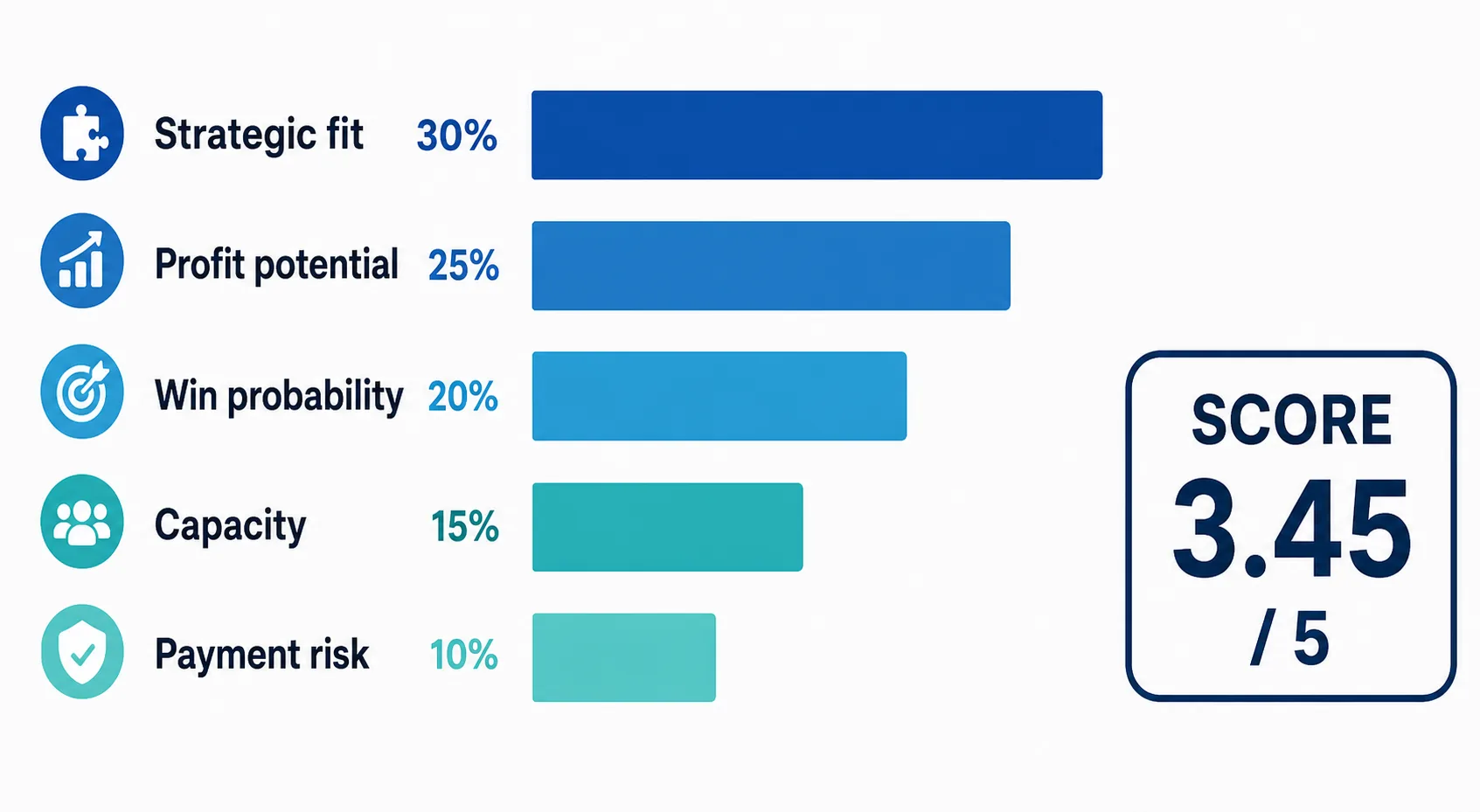
Turn the five factors into a weighted score. Rate each from 1 to 5, multiply by its weight, and total the result. Set a threshold, and the decision stops being a gut call.
| Factor | Weight | Rating (1-5) | Weighted score |
|---|---|---|---|
| Strategic fit | 30% | 4 | 1.2 |
| Profit potential | 25% | 3 | 0.75 |
| Win probability | 20% | 4 | 0.8 |
| Capacity and timing | 15% | 2 | 0.3 |
| Payment and risk | 10% | 4 | 0.4 |
| Total | 100% | 3.45 / 5 |
A total at or above 3.5 signals a full bid. Between 2.5 and 3.5 is a conditional bid worth a second look. Below 2.5, decline and move on. Once a job clears the line, a ready-made drywall bid template keeps the proposal consistent, so estimating hours go into pricing rather than formatting.
The 15-Minute Rule: Screen Fast, Then Commit
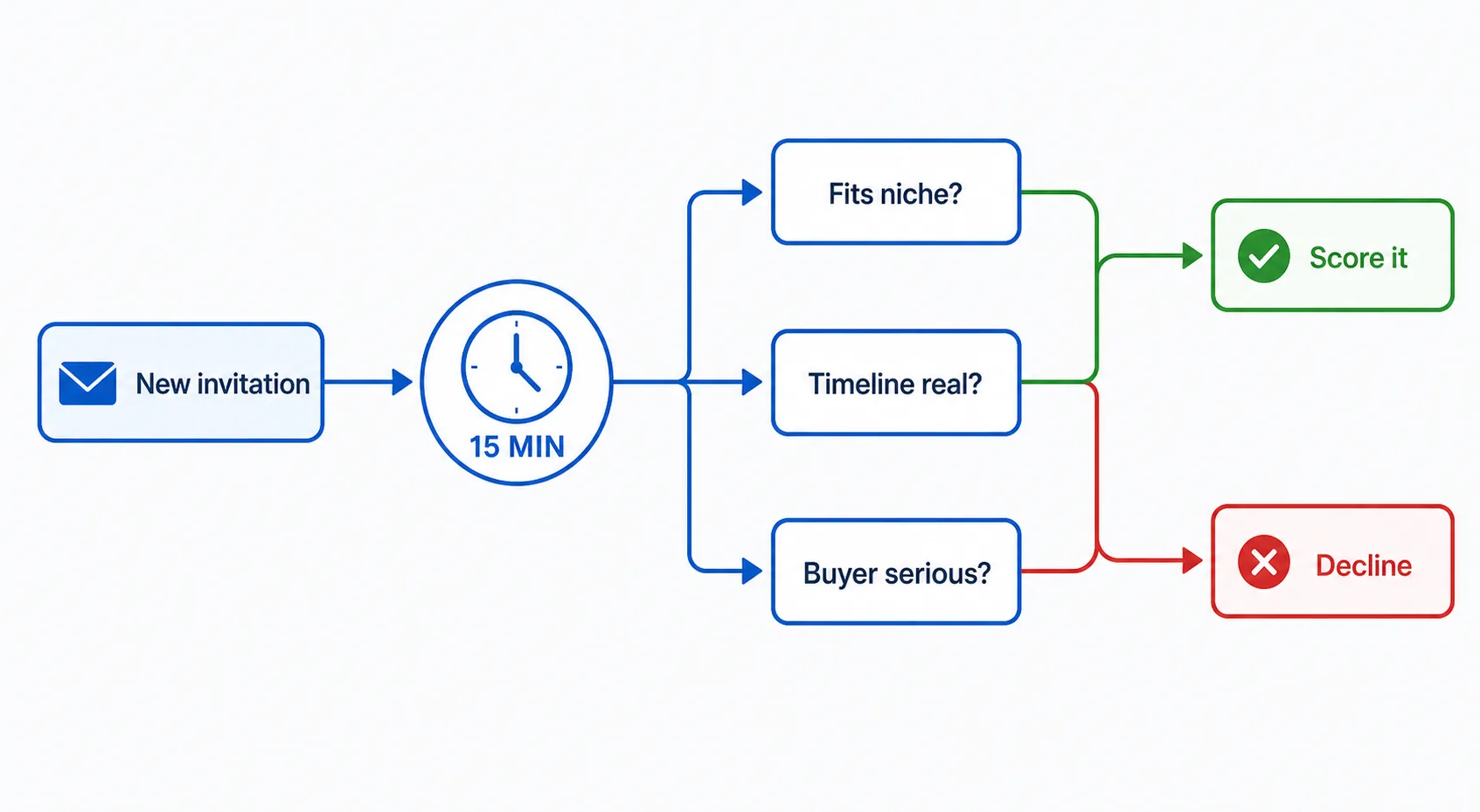
The 15-minute rule is a triage pass. Before you commit real estimating time, give each new invitation no more than fifteen minutes to answer three questions: does the scope match our niche, is the timeline realistic, and does the buyer look serious? Fail that quick read, and the invitation never reaches the scoring table.
This rule protects your best hours. It splits a stack of invitations into a short list worth full attention and a longer list you can decline the same day. Speed matters after a job passes, too, several ways to bid painting jobs faster show how to compress the estimating work once a lead earns it.
Fail the fifteen-minute read, and the invitation never reaches the scoring table.
Worked Examples, Three Invitations, Three Decisions
Run three realistic invitations through the model.
| Invitation | Fit | Margin | Win odds | Decision |
|---|---|---|---|---|
| Commercial flooring retrofit | High | Strong | Repeat GC | Bid |
| Small drywall patch, new cold lead | Low | Thin | Unknown | No-bid |
| Large multi-phase ceiling job | Medium | Good | Crowded field | Conditional |
The flooring retrofit scores well on every factor, and because you have priced similar carpet and tile work before, the numbers behind a fair carpet cost per square foot are already familiar. It earns a full bid. The small patch from an unknown caller scores low on fit and margin, so the fifteen-minute pass kills it. The multi-phase ceiling job is tempting but crowded; bid it only if the crew calendar clears and your labor cost to hang and finish drywall leaves room after a competitive price. That conditional path keeps you honest instead of optimistic.
How Estimate Accuracy Changes Which Jobs You Chase
Your scoring model is only as good as the numbers feeding it. Profit potential is a guess until the takeoff is real, and a shaky estimate can dress up a losing job or scare you off a winner. Other fields rank scarce resources the same careful way. A peer-reviewed analysis, When Clinical Trials Compete: Prioritizing Study Recruitment, shows how organizations weigh competing demands only after they quantify what each one truly costs. Bid selection runs on the same principle: measure first, decide second.
That is where estimating capacity becomes a strategic lever. When accurate takeoffs come back fast, you can score and bid more of the right jobs without burning out your team. Many shops ease the crunch by outsourcing their construction estimating so estimators stay focused on jobs above the threshold. Better selection paired with better numbers is how firms move from a busy pipeline to a profitable one, the same loop covered in how to win more construction bids.
Common Bidding Mistakes That Waste Estimating Hours
| Mistake | What it costs | The fix |
|---|---|---|
| Bidding everything | Estimating hours spread thin | Apply the score and the 15-minute rule |
| Ignoring win probability | Effort on jobs you will not win | Weight relationship and competition |
| Underpricing risk work | Margin erased by surprises | Price scope gaps and slow payment |
| No review of wins vs. losses | Same errors repeat | Compare estimate to actual after close |
The last row matters most. Institutions build formal guardrails against overcommitment; Indiana University’s guidance on enrollment into competing studies sets rules so teams do not stretch across too many demands at once. A short post-bid review does the same for your shop, it turns every won and lost bid into data that sharpens the next decision.
Key Takeaways
| Principle | Action |
|---|---|
| Filter before you estimate | Score fit, margin, win odds, capacity, risk |
| Screen fast | Use the 15-minute rule as the front gate |
| Make it repeatable | Apply the weighted model and a set threshold |
| Trust your numbers | Base profit scoring on accurate takeoffs |
| Learn every cycle | Review wins and losses after each close |
People Also Ask
Frequently asked questions
What must you do when considering which jobs to bid?
What is the 15-minute rule in bidding?
What are common bidding mistakes to avoid?
How do you properly bid jobs?