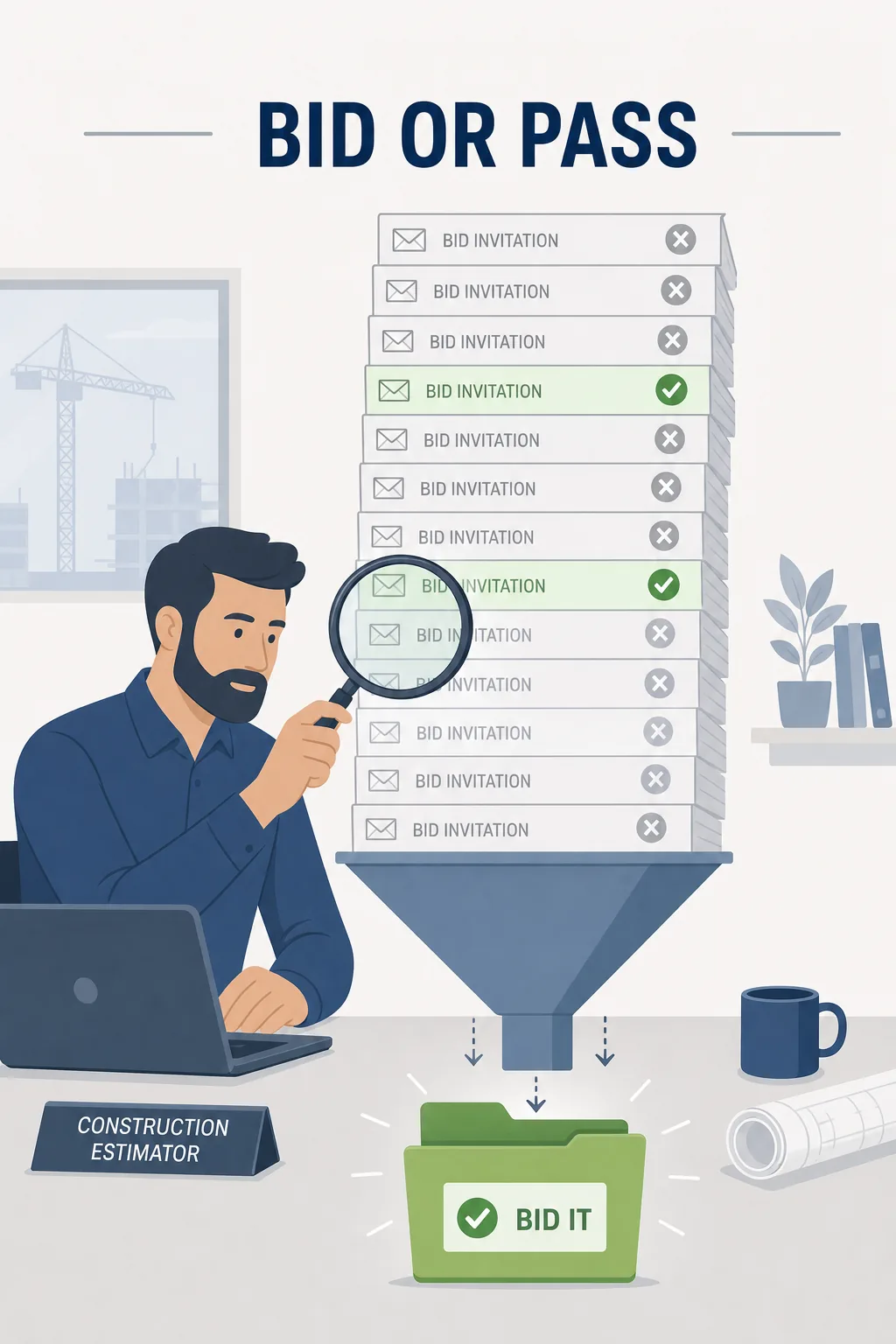
Summary: A bid no-bid decision is the go/no-go call a contractor makes before committing hours to a proposal. The bid no-bid decision criteria are the specific tests each opportunity must pass, margin, capacity, scope fit, client quality, competition, and risk. Applied consistently, these criteria protect your win rate and your estimating hours from jobs you were never positioned to win. The table below shows the factors at a glance; the sections that follow give you a scoring matrix, a reusable template, and worked examples.
| Decision factor | The question it answers |
|---|---|
| Profitability | Does the projected margin justify the pursuit cost? |
| Capability & capacity | Can your crews deliver this scope on schedule? |
| Scope & specs | Is the work defined clearly enough to price? |
| Client & payment terms | Does the client pay fairly and on time? |
| Competition | How many bidders, and how do you compare? |
| Risk | What could erase the margin, site, schedule, or terms? |
What a Bid No-Bid Decision Actually Means
A bid no-bid decision is a structured review that answers one question: should we pursue this project, or decline it? In construction, it usually happens the moment an invitation to bid or an RFP lands, before an estimator starts a takeoff. The point is not to talk yourself into more work. It is to protect three things at once, your available capacity, your historical win rate, and your margin. The Project Management Institute frames bid/no-bid analysis as a risk-based methodology rather than a gut call, and that framing matters: every proposal you write costs labor whether you win or lose.
Contractors who skip this step tend to chase everything, spread their estimators thin, and still lose. A disciplined process is one of the clearest lessons from a data-driven look at why contractors lose bids, many losses trace back to jobs that should never have been pursued.
The Core Bid No-Bid Decision Criteria
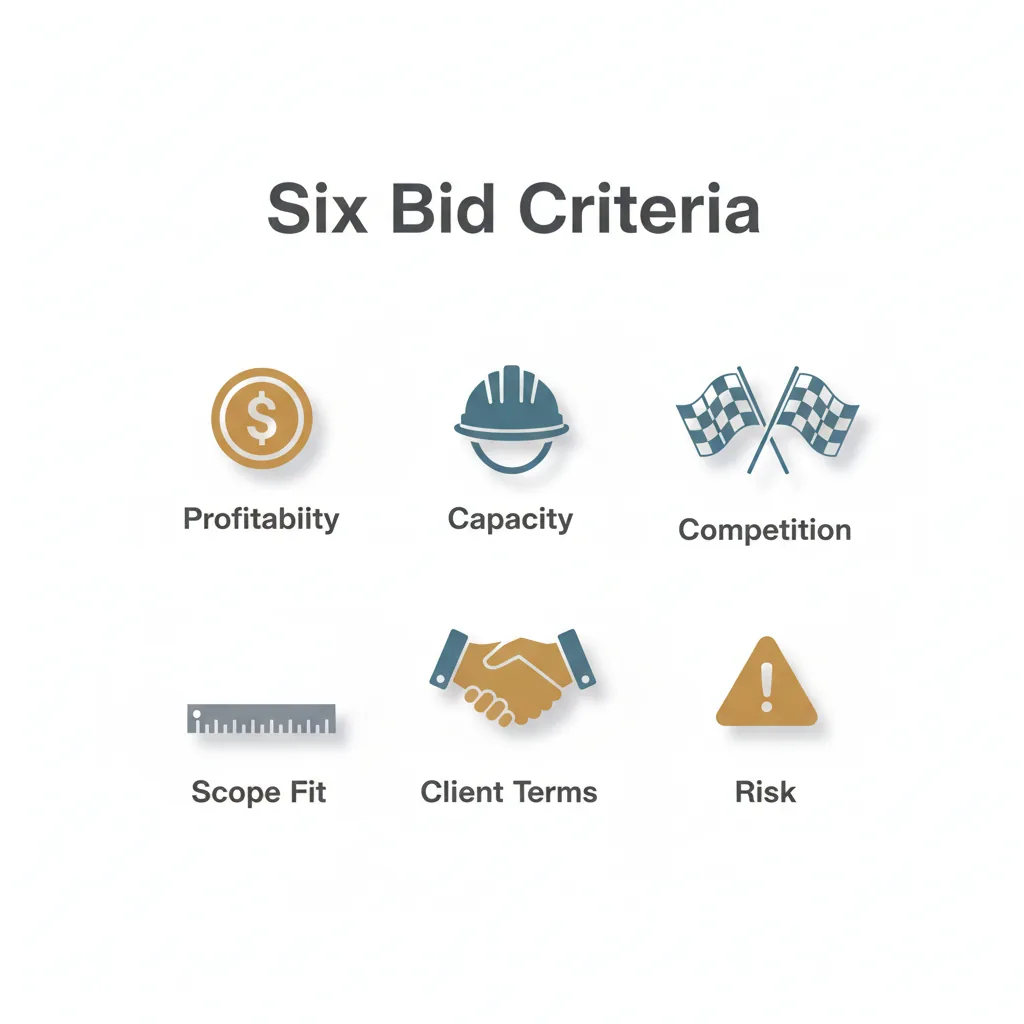
Most guides list five to seven factors. Grouped cleanly, they reduce to six. Each one carries a question and a red flag that points toward a no-bid.
| Criterion | Key question | Red flag = lean no-bid |
|---|---|---|
| Profitability | Does the expected margin beat your threshold after pursuit cost? | Margin thinner than your average, or padded to “buy” the job |
| Capability & capacity | Do you have the crews, equipment, and free schedule? | Every crew is booked through the delivery window |
| Project size & scope | Is the scope inside your proven range? | A job far larger, or a system you have never self-performed |
| Client history & terms | Is the client known, solvent, and fair on payment? | Slow-pay reputation, onerous retainage, or unclear change-order rules |
| Competition | How many bidders, and what is your real edge? | Ten bidders and a low-price incumbent already in place |
| Risk | What could erase the margin? | Aggressive schedule, liquidated damages, or an unresolved design |
The Associated General Contractors of America publishes standard contract documents and guidance on the site-condition and liability risks that belong in this review, from indemnity language to differing site conditions. Weigh those alongside the commercial factors. Once your criteria are set, the same discipline that helps you decline the wrong jobs also helps you win more construction bids across the USA, because your estimators spend their hours where they count.
A no-bid is a strategic answer, not a failure.
Common Reasons Contractors Choose No Bid
The most frequent triggers cluster into a short list.
| No-bid trigger | Why it ends the pursuit |
|---|---|
| No available capacity | A win would overload crews and hurt current jobs |
| Margin too thin | The price to compete would not cover the risk |
| Unfamiliar scope | Pricing an unproven system invites costly guesswork |
| Unclear or incomplete specs | You cannot bid what you cannot define |
| Risky client or terms | Slow payment or one-sided contract language |
| Geographic stretch | Travel and unfamiliar labor markets erode margin |
| Low win probability | An entrenched incumbent makes the odds poor |
Bonding capacity is a legitimate reason on its own. The U.S. Small Business Administration runs a surety bond guarantee program precisely because bonding limits how much work a smaller contractor can carry at once, so a project that exceeds your bonding capacity is a rational decline.
The Bid No-Bid Decision Matrix
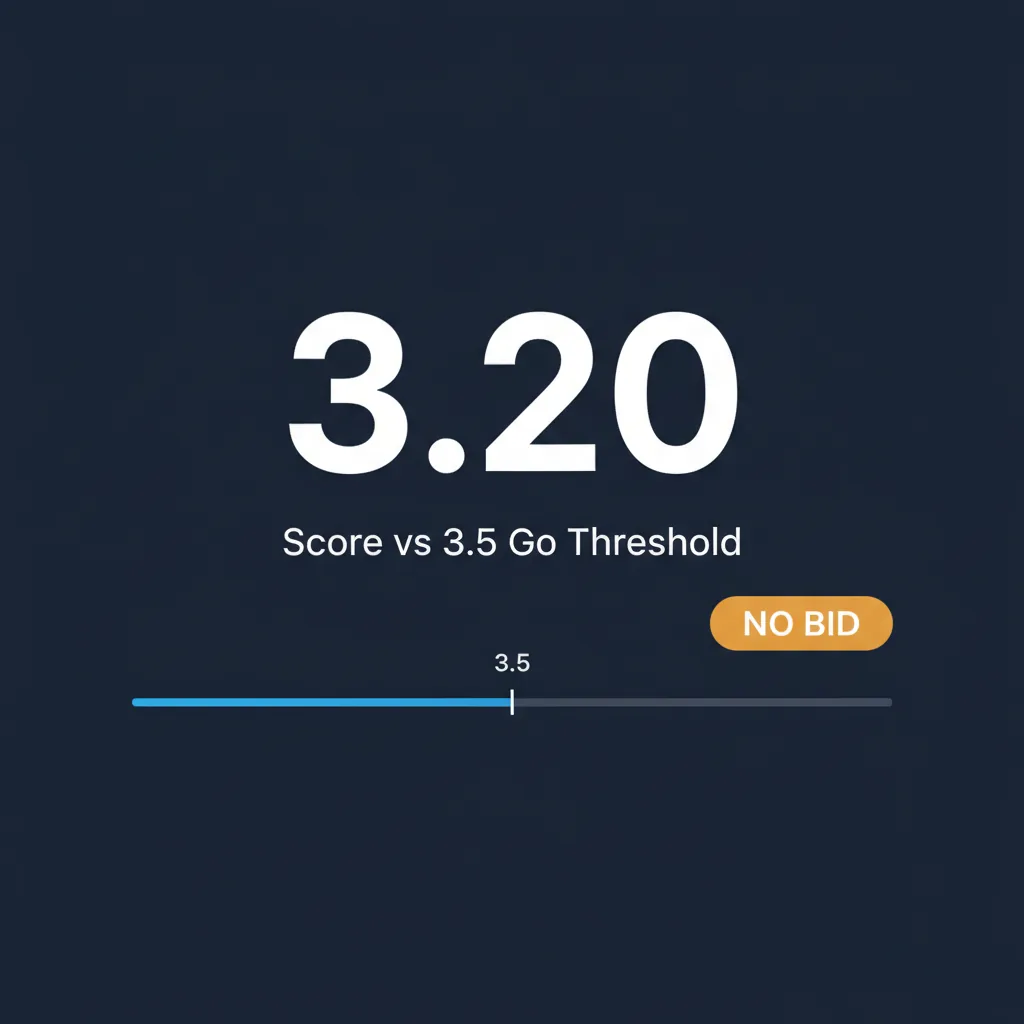
A decision matrix turns the criteria into a score. Assign each criterion a weight that reflects its importance to your firm, rate the opportunity on each from 1 to 5, multiply, and total the result against a go/no-go threshold you set in advance. The weights below are illustrative, set your own.
| Criterion | Weight | Score (1-5) | Weighted score |
|---|---|---|---|
| Profitability | 0.25 | 4 | 1.00 |
| Win probability | 0.25 | 3 | 0.75 |
| Capacity | 0.20 | 2 | 0.40 |
| Scope fit | 0.15 | 4 | 0.60 |
| Risk (5 = low risk) | 0.15 | 3 | 0.45 |
| Total | 1.00 | 3.20 |
With a go threshold of 3.5, this sample project scores 3.20 and points to a no-bid, capacity is the drag. The value of the matrix is that it forces the conversation onto evidence and removes the loudest voice in the room from the decision.
Bid No-Bid Decision Criteria Template
Copy the columns below, set your own weights and threshold, and score every invitation the same way.
| Criterion | Weight | Score (1-5) | Notes / evidence | Decision |
|---|---|---|---|---|
| Profitability | Est. margin vs. threshold | |||
| Capacity | Crews free in delivery window? | |||
| Scope fit | Self-performed before? | |||
| Client & terms | Payment history, retainage | |||
| Competition | Bidder count, incumbent? | |||
| Risk | Schedule, site, contract | |||
| Total vs. threshold | Bid / No-bid |
Trade contractors can pair this with a scope-specific pricing sheet, such as a drywall bid template, so the profitability score rests on real line items rather than a rough guess.
How Estimate Accuracy Drives the Right Decision
Most guides skip the part that matters most: a bid no-bid decision is only as good as the numbers behind it. If your takeoff is wrong, your profitability and capability scores are fiction, and the matrix simply automates a bad call. A margin of 12 percent on paper can turn negative when the quantities were optimistic.
The fix is to compare your estimate against actual cost when a job closes. That comparison shows whether your estimating process is realistic or whether you rely on optimistic assumptions that erode the margin. Reliable construction estimating services and detailed material lists give the scoring model honest inputs, for drywall, that means a defensible view of the labor cost to hang and finish drywall before you commit a price. AACE International treats estimate accuracy and cost estimate classification as the backbone of sound cost decisions, and a bid no-bid call is exactly that kind of decision.
When to Bid Selectively vs. Chase Volume
Two firms can bid the same number of jobs and get very different results. The one that scores every opportunity and declines the poor fits wins a higher share, because its estimators pour their hours into proposals it can actually convert. Every losing bid carries a cost, the estimating labor that produced it. Selective bidding protects those hours.
Capacity should never force a bad yes. When peak season fills your schedule, outsourcing construction estimating lets you keep pursuing strong opportunities without pulling your own team off billable work.
Key Takeaways
| Takeaway | Why it matters |
|---|---|
| Score every opportunity the same way | Removes bias and protects your win rate |
| A no-bid is a strategic answer | Declining weak jobs frees capacity for winnable ones |
| Weight the criteria to your firm | Your margin and risk tolerance are unique |
| Accurate takeoffs precede honest scores | Bad numbers make the whole matrix worthless |
| Guard your estimating hours | Losing bids cost real labor; spend it where you can win |
Frequently asked questions
What is the bid no-bid decision matrix?
What is the reason for a no bid?
What is the purpose of a bid no-bid discussion?
What should a bid no-bid criteria template include?
Put Real Numbers Behind Your Decision
Your bid no-bid scoring is only as strong as the takeoff underneath it. Quantify North America delivers precise material lists and reliable quantities so your profitability and risk scores rest on facts, not hope. Get an accurate drywall estimate, and the same rigor for flooring and painting, so your next go/no-go call is one you can defend.