Winning work is not just a numbers game anymore. If you want to know how to win more construction bids in the USA today, you have to think beyond “sharpen your pencil” and start treating bidding as a disciplined system. The contractors who grow are not the ones who always come in cheapest; they are the ones who bid the right jobs, price risk accurately, and present a bid that owners trust.
In this guide, we will walk through how to win more construction bids while protecting margin: how to choose the projects that deserve your time, how to build fact-based estimates instead of guesses, how to present your proposal so it reads as a project plan, and how specialist estimating support can lift both your bid-hit ratio and profitability.
Why Winning More Construction Bids Is Getting Harder in the USA
Across the United States, the construction market carries more work on paper than many crews can reasonably deliver, yet margins stay thin. Industry studies suggest that average net profit for contractors often sits near 5–6%, with 8–10% considered healthy for many general contractors and specialty firms. That leaves very little room for estimating mistakes or underpriced bids.
At the same time, owners and public agencies receive more bids per project than in past cycles. Public construction projects often attract multiple bidders, analyses in some regions report average bid counts near five per contract, and competition can squeeze margins. At the same time, volatile material prices and labor shortages are documented drivers of cost pressure in construction. In a low-bid procurement environment, aggressive price cutting without careful cost control can quickly erode profitability and increase project risk.
The firms that rise above this crowd do a few things differently. They know their numbers, they filter out bad opportunities early, and they treat accurate takeoff and estimating as a strategic asset, not an afterthought.
Start With the Numbers: Understand Your Bid-Hit Ratio and Profit Targets
Before you adjust your sales approach or rewrite proposal templates, you need a clear picture of how your current bidding effort performs. That starts with the simplest metric in the book: your bid-hit ratio.
Your bid-hit ratio tells you how many bids you must send to secure a single award. Many contractors discover, once they track it, that they submit well over ten bids for each win. In industry bidding commentary, contractors often track a “bid-hit ratio” (how many bids you submit versus how many you win).
For competitive public work, a win rate of roughly 1 contract per 8–10 bids is considered realistic by many practitioners, while for private work, a ratio near 1 in 4 is a common target, given smaller bidder fields.
To see where you stand, you need to track bids by project type, sector, and owner. That way, you can move past vague ideas about how to win more construction bids and start seeing which categories actually reward your effort.
Typical US bid-win ranges by project type
The following table does not replace your own data, but it illustrates how win rates often differ by project type.
| Project type | Typical win-rate range (USA) | What it often implies for strategy |
| Public hard-bid | 5–15% | High competition, tight specs, heavy paperwork |
| Private competitive bid | 15–25% | Relationship and track record matter as much as price |
| Negotiated / CM at Risk | 25–50% | Prequalified teams, heavier emphasis on approach and capability |
| Design–build partnerships | 20–40% | Early involvement and performance on past work carry more weight |
If your public work sits at one in twenty-five, for instance, you have a different problem to solve than a contractor who loses only private, negotiated projects.
Once you know your hit rate, you can line it up against your profit targets. Many US contractors use a “10–10” idea as a starting point: roughly ten percent overhead and ten percent profit, for a total twenty percent margin, adjusted up or down by sector and risk. Any serious plan for how to win more construction bids must still keep those margin requirements in view. Winning more jobs that barely break even is not growth; it is a slow collapse.
A practical next step is to compare your estimated gross margin on each job with the margin that actually appears when the project closes. That comparison shows whether your estimating process is realistic or whether you rely on optimistic assumptions that erode profit in the field.

Choose the Right Work: A Practical Bid / No-Bid Framework
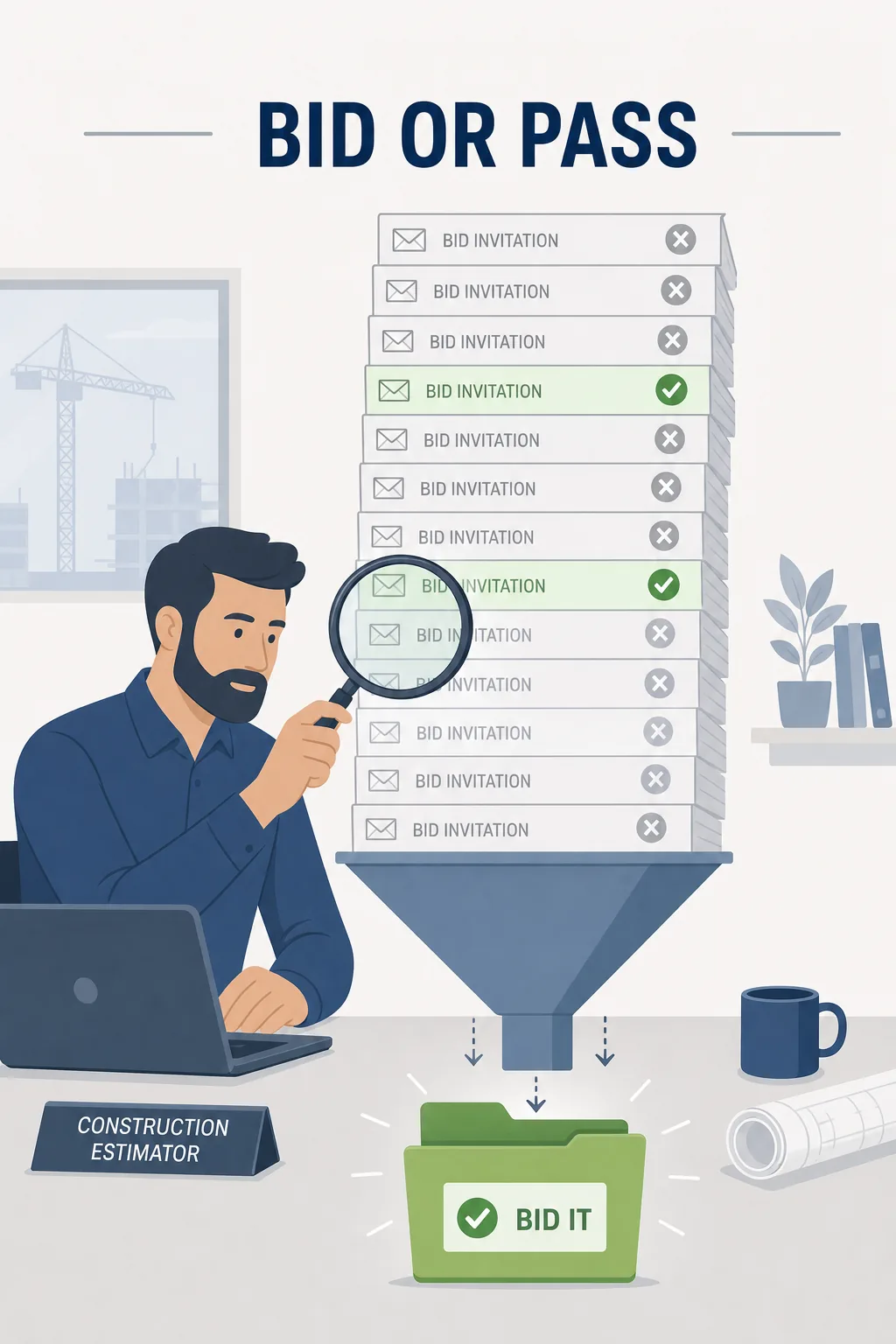
Once you understand your current results, the next question is not “how to win more construction bids” in general, but “which construction bids deserve a full effort. Time spent on the wrong tenders is the silent killer in many estimating departments. We break down the full process for deciding which jobs deserve your estimating hours so your team stops burning capacity on pursuits that were never realistic.
A simple bid / no-bid framework forces you to ask the same questions every time a new invitation arrives. You want to weigh project size, sector, location, delivery method, documentation quality, and the people on the other side of the table.
Contractors who take the time to qualify work often discover that a smaller number of well-chosen bids yields more awards and less stress than a frantic push to quote everything that hits the inbox. Industry advice for general contractors repeatedly highlights the value of targeted bidding and focus on repeat owners rather than raw volume.
Bid / no-bid criteria you can apply to every opportunity
| Criterion | Red-flag example | Green-flag example |
| Scope | Vague drawings, heavy allowances, unclear alternates | Clear construction documents and defined alternates |
| Location | Remote site without local subs or suppliers you trust | Region where you already have crews and relationships |
| Schedule | Compressed timeline with liquidated damages and no float | Realistic start and completion with room for weather and delays |
| Owner / GC profile | Unknown payer, history of disputes or slow payment | Repeat client or reputable GC with documented fair dealing |
| Contract terms | One-sided risk transfer, harsh retention and change clauses | Balanced contract with reasonable risk allocation |
| Competition | Dozens of bidders with no prequalification | Limited list, preferably where you are known or recommended |
| Documentation quality | Many unanswered RFIs, conflicting information in specs | Coordinated drawings and responsive design team |
When you link a framework like this to a structured review of the drawings and specs, it becomes easier to justify a no-bid decision. For a deeper look at turning those red flags into structured bid no-bid decision criteria, see our practical framework for qualifying opportunities before you commit estimating hours. Having a solid approach to construction estimating helps you organize document reviews so you catch risks early, instead of waking up to them halfway through the takeoff.
On jobs that pass this screen, investing in a thorough construction takeoff makes sense. When the project looks like a bad fit, saying no early protects your staff from unpaid night and weekend work that rarely leads to a signed contract.
Build Rock-Solid Estimates: Takeoff as the Foundation of Winning Bids
If you talk to owners or large general contractors about how to win more construction bids, one theme surfaces again and again: confidence. The award often goes to the team that looks least likely to surprise everyone with change orders and claims. That perception starts with the quality of your estimate.
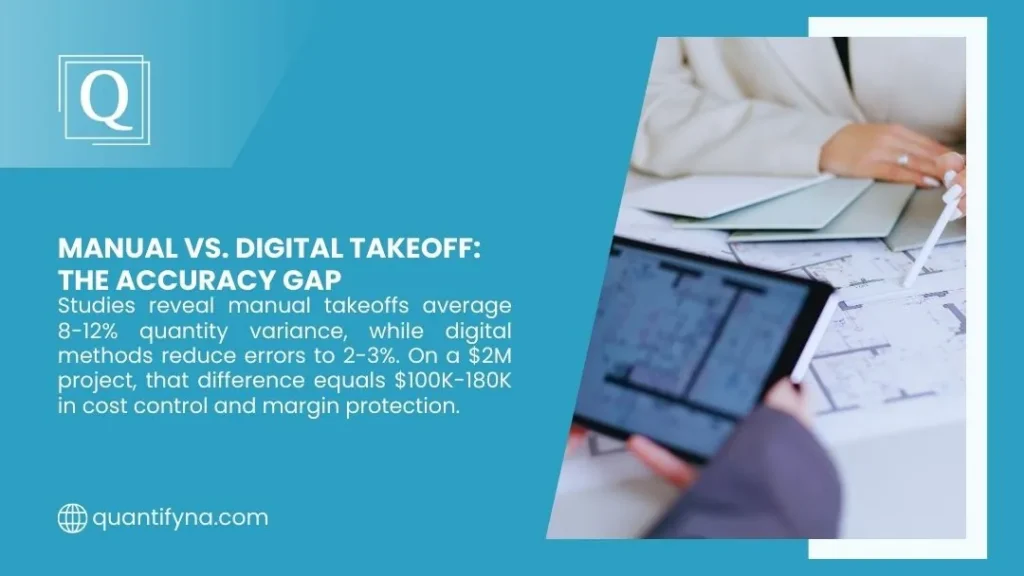
A strong estimate begins with disciplined quantity takeoff. For many projects in the USA, that means digital takeoff on PDFs or models, cross-checked across architectural, structural, and MEP sheets. Anyone who’s handled construction takeoff knows how fast a missed floor finish, a waste allowance, or an extra layer of drywall can wipe out already-thin margins.
More mature firms treat trade-specific estimating as a craft in itself. Flooring, drywall, and painting are classic examples. An error of a few hundred square feet, or a missed level of finish, can turn an apparently successful bid into a year of unpaid work.
You’re better off leaning on something more specific, flooring estimating or drywall estimating that walks through quantities, crew output, and material assumptions, because dialing in those trade-level details is what keeps your labor and takeoff expectations realistic instead of wishful.
Experienced estimators also work with clear estimate “classes”. Early concept work might justify a rough order of magnitude range, while a final bid on a fully documented commercial build in the USA should aim closer to a definitive estimate with a tight variance band. Internal standards, supported by practical content on building estimation and definitive estimate classes, keep these expectations consistent.
When your numbers rest on that kind of discipline, the price you submit tells the client that you have read the drawings, understood the scope, and built a realistic plan instead of a guess. That image does more for how to win more construction bids than any slogan.
Price Risk on Purpose, Not by Habit
Many contractors address risk by adding a percentage. 10% for contingency here, 5% on labor there. Over time, that habit begins to mask problems rather than solve them. If you want a durable method for how to win more construction bids, you need a clearer way to think about risk.
Real project risk shows up in four main places: uncertain scope, market volatility on materials, productivity swings in the field, and site-specific issues such as access or phasing. Rather than bury these under one number, a more advanced approach uses defined estimating methods.
Bottom-up estimating builds the job from individual tasks, quantities, and crew rates. It takes more effort but produces a level of detail that helps you see which activities actually drive cost. Bottom-up estimating lays out the job piece by piece so you can see how the work fits together, and that structure makes it easier to deliver consistent results on projects that look similar.
Top-down or analogous approaches draw on completed projects. When used with care, they speed up early budgeting and help answer owner questions long before drawings are complete. Parametric estimating extends this idea by tying costs to drivers such as square footage, unit counts, or linear frontage. For contractors who deal with repetitive building types, a parametric estimating reference can be one of the most useful tools on the shelf.
For complex or high-risk projects, three-point estimating gives a more honest view of uncertainty. By setting optimistic, most likely, and pessimistic values for key items, then combining them with simple formulas, you can produce both an expected cost and a realistic range.
Some teams go further and apply Monte Carlo-style simulation to model thousands of possible outcomes. Clear explanations of three-point estimating and similar methods make it easier for estimators to actually use them in day-to-day work, instead of letting them sit in a textbook.
This level of structure does not just protect your own margin. It also makes your reasoning visible in clarifications and alternatives, which again feeds into how to win more construction bids: owners trust numbers they can see and question more than a single lump sum they cannot unpack.
Turn Your Bid into a Clear, Low-Risk Project Plan
Price matters, but decision-makers often describe their best contractors with different words: reliable, clear, and predictable. Your proposal is your chance to show you belong in that group.
The most effective bid packages read more like project plans than like basic quotes. A typical structure includes an opening summary of the project, a precise scope description, clear exclusions, a straightforward schedule, and a short section on site logistics and safety. It may include optional alternates that give the owner real choices rather than vague promises of value engineering later.
If you compare a weak bid to a strong one, the difference is easy to see. The weak version leans on broad labels, fragments of scope, and a single number at the end. The stronger version draws a line from assumptions and quantities through to methods and price. Owners who see a bid like that become more comfortable awarding to that contractor even when the total is not the absolute lowest.
Your safety narrative and financial stability belong in this picture as well. Industry commentary aimed at improving bid success notes that owners look for clean safety records, clear commitments to site rules, and evidence that you can handle the cash flow of the job. When you address these topics inside the main bid document instead of as a stack of attachments, you reduce reasons for doubt.
Templates, such as a structured drywall bid format, can prevent omissions and keep this information in a consistent order across every submission. Over time, that consistency alone improves perceptions of professionalism and reliability, which feeds straight back into how to win more construction bids in your market.
Relationships, Reputation, and Follow-Up
Plenty of contractors learn the hard way that the lowest number does not guarantee the award. General contractors and owners look at experience with similar work, how you respond during pre-bid questions, and how well you communicate once numbers are in. Multiple advisory pieces for contractors stress the impact of steady, professional follow-up rather than one desperate call on decision day.
That follow-up does not have to be elaborate. A short message after submission that confirms receipt, invites questions, and clarifies any alternates or exclusions goes a long way. Later, a polite check-in before award can focus on scope clarity and risk rather than a bare request for “an update”. As you refine that rhythm, you build a reputation as a partner rather than a vendor.
Over time, your past work becomes one of the strongest assets in how to win more construction bids. Case histories of similar projects, references who answer the phone, and consistent delivery against your own estimates build a feedback loop: the more predictable you become, the more often your bid lands on the short list even when you are not the cheapest.
Structured project histories, including takeoff and estimating details, also give you better data for analogous and parametric estimates in the future. That connection between reputation and numbers is often missing from thin blog posts on this topic, but in practice the two sides are inseparable.
Systematize Bidding So the Pipeline Stops Whipsawing
Many contractors do not actually struggle with how to win more construction bids; they struggle with the chaos around their bid pipeline. Invitations live in inboxes. Deadlines rest in someone’s head or on a sticky note. There is little record of why a particular project went badly or went well.
A more mature approach tracks every opportunity from first invite through decision. That log includes basic project details, the decision to bid or pass, estimated and final margin, and notes on why you won or lost. Article-length advice aimed at subcontractors often highlights the benefits of centralized tracking and analytics; the same principle applies to general contractors of every size.
Within this system, templates remove friction. A consistent approach to assumptions, clarifications, alternates, subcontractor quotes, and internal reviews means your team spends less time reinventing the wheel and more time on judgment calls. Thoughtful use of estimating tools, rather than chasing every new platform, also helps. Independent reviews of estimating tools have pointed out the gap between genuine productivity gains and features that exist mainly in marketing brochures.
When you treat all of that as one process rather than a collection of habits, you gain two advantages. First, you remove random variation that undermines your efforts to refine how to win more construction bids. Second, you create room for outside support where it actually pays off.
In-House or Outsourced Estimating: Which Mix Wins More Bids?
As competition increases, many US contractors ask whether to grow internal estimating staff or bring in outside help. There is no single answer, but the numbers give useful guidance.
Keeping everything in-house means salaries, benefits, software, hardware, and training. Industry breakdowns often place full-time estimator compensation in the mid-five to low-six figures, not including overhead and management time. That investment makes sense for contractors with steady volume and a clear need for constant capacity.
Outsourced estimating services, by contrast, usually charge by the estimate or by the project, with reported ranges from a few hundred dollars for small jobs to several thousand for complex scopes. The logic is simple: you pay only when you have work to price, and you gain access to specialist expertise in trades or project types you do not estimate every day.
For many firms in the USA, the best answer to how to win more construction bids is not “replace your estimators with outsiders” but “blend the two”. Internal staff focus on relationships, strategy, and core clients, while outsourced partners help with additional volume, peak seasons, or specialist trades such as commercial flooring, drywall, or complex finishes. This mix allows you to raise bid volume on well-qualified projects without burning out your core team.
In-house Vs in-house plus specialist support
| Factor | In-house only | In-house plus outsourced support |
| Fixed overhead | High, even during quiet periods | Lower, more of the cost shifts to variable spend |
| Capacity during peak seasons | Limited by the current staff | Scales with demand through external partners |
| Trade-specific expertise | Depends on the current team | Access to specialists in flooring, drywall, painting, and more |
| Speed to respond to new sectors | Slower, requires training and experience | Faster, by tapping into experienced estimating partners |
| Impact on bid-hit ratio | Hard to increase volume without extra hiring | Easier to increase volume while maintaining estimated quality |
Careful analysis of the return on investment for outsourced estimating in the USA shows that when used with discipline, it can reduce cost per usable estimate and lift both win rates and margins. Of course, you still bear final responsibility for the numbers you submit, so governance and quality control remain essential. Good partners provide clear assumptions, transparent quantities, and files you can review line by line.
How Outsourced Estimating Directly Supports Bid Wins
When you cut through the marketing claims, outsourced estimating helps you in three very practical ways. First, it raises the number of qualified bids you can submit in a given month. Second, it can improve the quality of your numbers by exposing you to specialist teams who work in estimating every day. Third, it frees your internal estimators and project managers to focus on strategy, relationships, and value engineering.
If your goal is to learn how to win more construction bids, each of these matters. Higher bid volume on carefully chosen projects increases your chances mathematically. Better takeoff and cost modeling reduce the likelihood that you win a project for the wrong reasons. Stronger relationships and clearer proposals increase trust with owners and general contractors.
Specialist firms that focus on accurate material quantities and reliable takeoff, such as Quantify North America, structure their work around these outcomes. When you can show an owner that your bid rests on a documented methodology rather than a quick square-foot guess, you move the discussion away from “who is cheapest” and toward “who can actually deliver the job as drawn. That shift, more than any trick phrase in a cover letter, is the real secret behind how to win more construction bids in a mature market.

Turn Your Next Construction Bid into a Strategic Win
Winning more construction work in the United States is not a mystery. Track what you pursue, price with evidence instead of instinct, and send proposals that remove doubt for the reviewer. One disciplined step, clean quantities, clearer scope notes, or a tighter bid/no-bid filter, can change your hit rate faster than another round of price cutting.
If you want support on the numbers so you can focus on clients and crews, connect with a specialist that handles takeoff and trade estimating with precision. You can review Quantify North America’s services and request a project discussion.