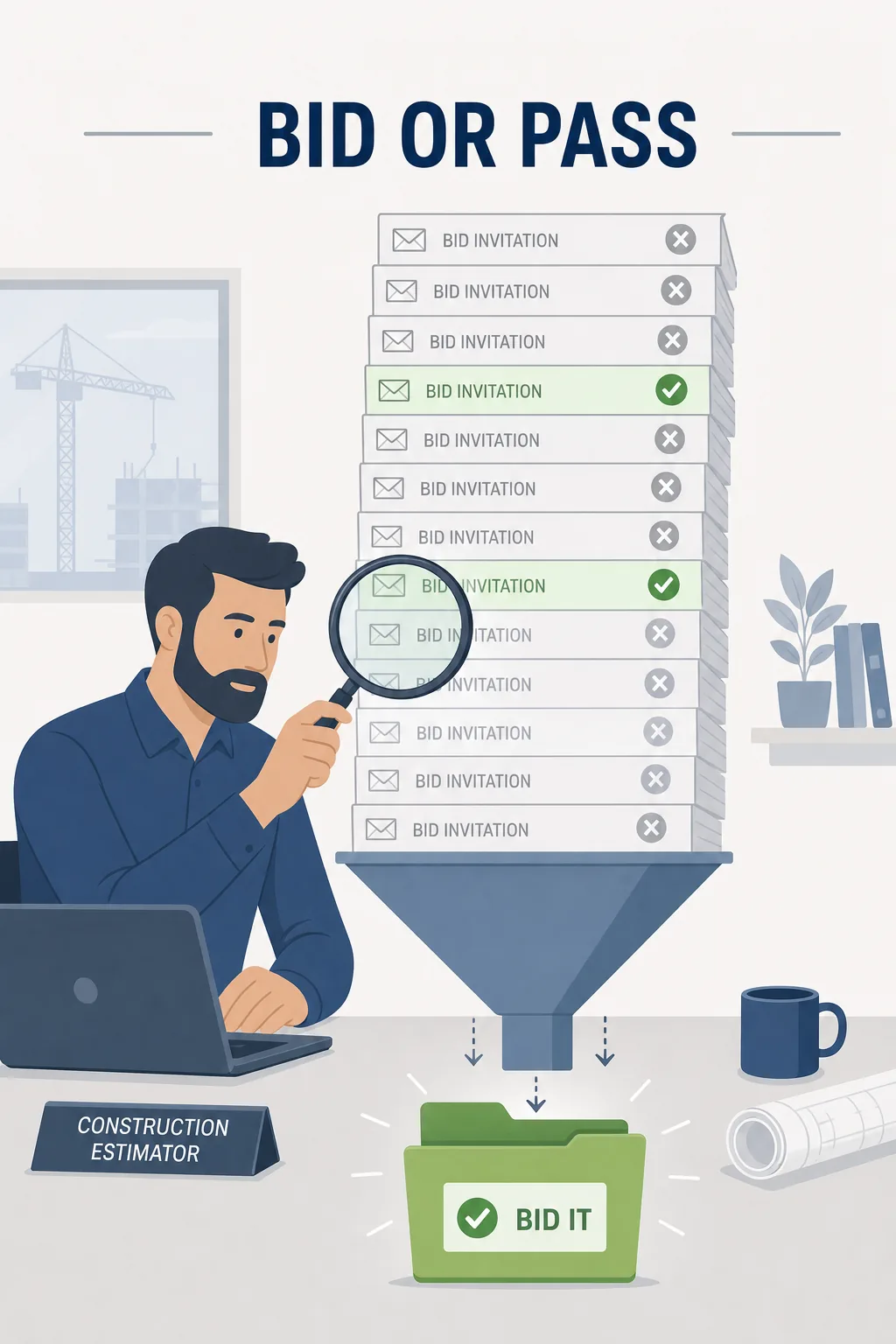
A good estimate should be fast enough to keep a bid moving, but careful enough to protect margin. For small jobs, an estimate may take a few hours or one to two business days. For larger construction projects, especially commercial flooring, drywall, ceilings, or painting, the timeline can stretch from several days to two weeks or more.
Here’s the thing: the real question isn’t only how long should an estimate take. It’s how long an accurate estimate should take when drawings, site conditions, square foot quantities, material prices, labor, waste, exclusions, and bid deadlines all matter.
How Long Should an Estimate Take?
For simple work with clear measurements, how long should an estimate take? Usually, one to three business days is fair. If the project has complete drawings, a limited scope, and clear material selections, a contractor or estimator can often prepare a useful quote quickly.
For mid-size construction projects, a more realistic range is three to ten business days. That gives the estimator time to review plans, perform a material takeoff, check quantities, price labor, and confirm vendor numbers. For complex commercial work, especially when multiple trades or addenda are involved, one to three weeks may be normal.
| Estimate Type | Typical Timeframe | Why It Takes That Long |
| Small repair or single-room scope | Same day to 2 business days | Limited scope and fewer measurements |
| Flooring or painting by square foot | 1–3 business days | Area-based takeoff and material pricing |
| Drywall, ceiling, or framing estimate | 3–7 business days | Assemblies, heights, openings, and finish levels |
| Commercial construction estimate | 5–15 business days | Plans, specs, RFIs, alternates, labor, and exclusions |
| Permit-ready GC estimate | Several weeks or more | Design, subcontractor pricing, approvals, and permitting |
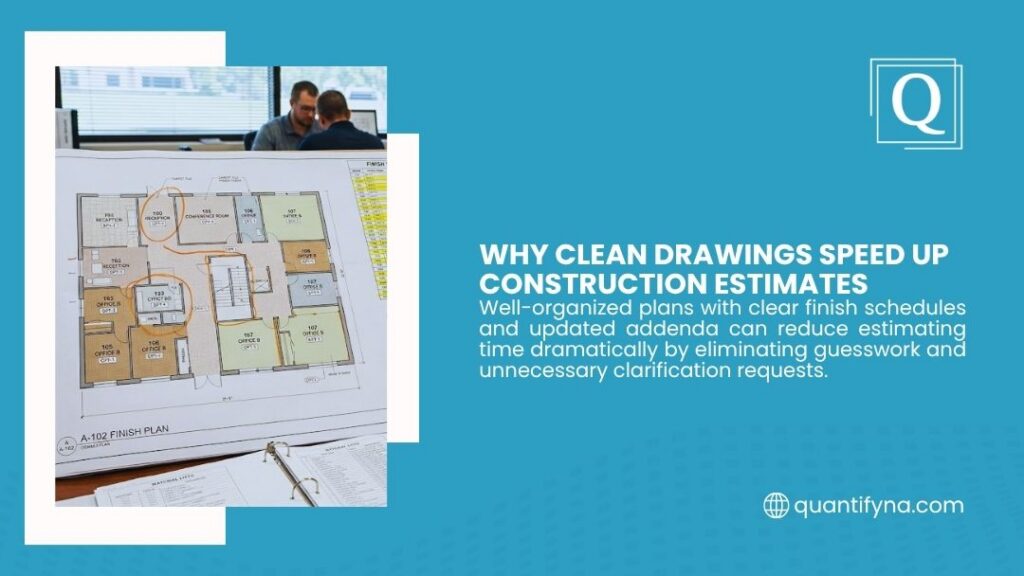
The time depends less on the calendar and more on the condition of the information. Clean drawings, clear finish schedules, and a defined scope help an estimator move fast. Missing details, late addenda, unclear alternates, or a required site visit can add days.
Quantify North America’s own messaging speaks directly to this problem. The company says estimating is difficult for contractors because of tight deadlines, addenda, lack of training resources, staffing issues, and inconsistent sales opportunities; its solution is fast and accurate takeoffs for flooring, drywall, and painting contractors.
For contractors, the better rule is this: the estimate should take long enough to be checked, but not so long that the bid window closes.
How Long Does an Estimate Take by Project Type?
When people search for how long an estimate takes, they may mean a home repair, a commercial bid, a flooring takeoff, or even a car repair estimate. The answer changes fast once the scope changes.
A basic square foot flooring quote can move quickly when the plans are clean. A detailed commercial flooring takeoff takes longer because the estimator must separate finishes by room, floor, phase, material type, waste factor, transitions, base, tile patterns, and sometimes vertical wall finishes. For that type of bid, a contractor may benefit from a dedicated flooring estimating service rather than tying up an in-house salesperson for days.
Drywall is different. A drywall estimate may involve board counts, linear feet of framing, ceiling grid, finish levels, insulation, openings, shaft walls, assemblies, labor production rates, and waste. That is why commercial teams often rely on a structured drywall takeoff process before they price the work.
Painting can look simple from the outside, but large commercial painting bids often need wall area, ceiling area, exposed structure, coatings, primers, surface prep, door frames, specialty finishes, and production rates. A clear understanding of the painting estimating steps can help contractors avoid vague numbers.
Auto estimates are a separate search intent. If someone asks how long does a car estimate take or how long does a collision estimate take, the answer can be much shorter. One auto body source says minor cosmetic damage may take 15–30 minutes, while severe or non-drivable vehicle damage may need 24–48 hours or more. A car estimate often starts with visible damage. A construction estimate starts with plans, scope, takeoff, labor, material pricing, exclusions, and bid risk.
So yes, how long does a car repair estimate take can be measured in minutes or days. Construction estimates are usually more document-heavy.
What Actually Happens Before a Quote Is Ready?
A proper construction estimate is not a guess dressed up in a spreadsheet. It starts with documents.
The estimator reviews drawings, specifications, addenda, finish schedules, alternates, phasing notes, and scope responsibilities. Then comes the takeoff: counting, measuring, and separating quantities. After that, the estimator applies labor, material, equipment, overhead, profit, contingency, exclusions, and clarifications.
Procore describes construction estimating as the process of calculating direct costs, such as material and wages, along with indirect costs, such as equipment depreciation and office labor. Its estimating workflow includes tender package review, site visit, material takeoff, supplier pricing, labor evaluation, insurance, bonding, overhead, profit, and contingency.
That’s why how long should an estimate take can’t be answered with one number. A fast estimate can still be accurate if the scope is simple. A slow estimate can still be weak if the estimator missed exclusions, alternates, or site conditions.
“Developing reliable cost estimates is crucial for realistic program planning, budgeting, and management.” That line comes from the U.S. Government Accountability Office’s Cost Estimating and Assessment Guide, and it explains why serious estimates need method, not guesswork.
How QuantifyNA Helps Contractors Move From Plans to Bid-Ready Numbers
For contractors, the estimating process usually breaks down at the same pressure points: too many bids, not enough estimator time, unclear documents, and last-minute changes. Quantify North America is built around that gap.
The process starts when a contractor submits plans, drawings, specifications, finish schedules, and bid requirements. From there, the scope is reviewed, quantities are measured, drawings are marked up, and the takeoff is organized in a way the contractor can use. The output may include detailed quantities, color-coded plans, original software files, working folders, and job notes, depending on the service level.
QuantifyNA says the company uses tools such as MeasureSquare, Estimat-All, RFMS Measure, Callidus, PlanSwift, OST, and Edge to mirror the client’s own workflow and give easy-to-understand output.
| QuantifyNA Step | What Happens | Why It Matters to Contractors |
| Submit documents | Contractor sends plans, specs, addenda, and finish details | Reduces back-and-forth before estimating starts |
| Review scope | The estimator checks the project requirements and possible gaps | Helps catch issues before bid day |
| Perform takeoff | Quantities are measured by trade, area, finish, or assembly | Gives the bid a measurable foundation |
| Organize output | Plans, quantities, files, and notes are prepared for review | Makes the estimate easier to check |
| Support bid | Contractor uses the takeoff to price labor, material, and proposal scope | Helps protect margin and submit faster |
This process matters because a contractor does not just need numbers. They need numbers that connect to the drawings, explain the scope, and support the bid.
Why Some Estimates Take Longer Than Expected
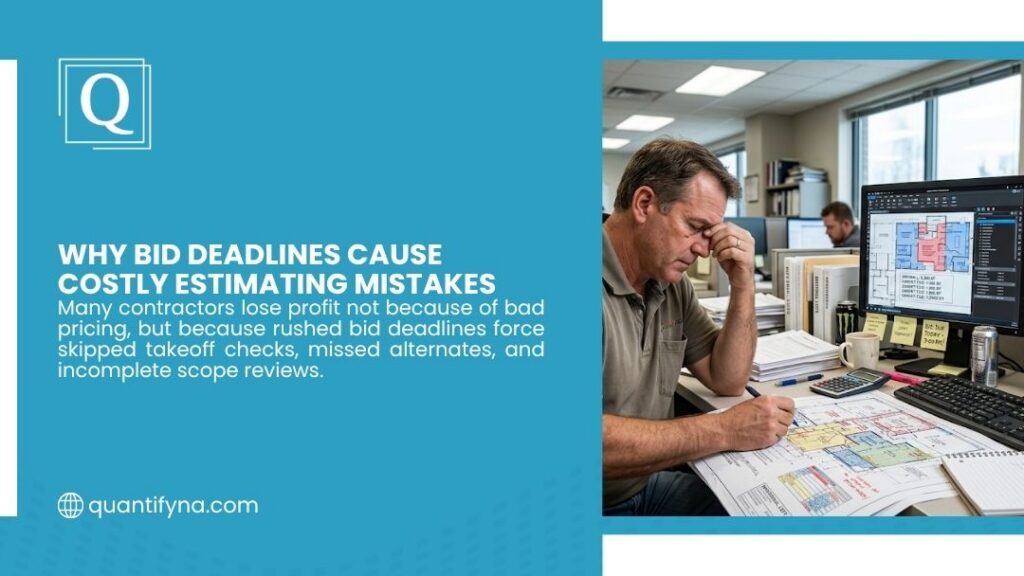
But here’s the problem: an estimator may be ready to work, yet the estimate still stalls. Missing drawings slow things down. So do unclear finish schedules, late addenda, conflicting specs, unapproved substitutions, incomplete site photos, and delayed vendor quotes. If the project needs a site visit, the timeline depends on access. If the job has specialty materials, custom finishes, or long lead-time products, pricing may not come back the same day.
A project priced by square foot may look simple, but the details matter. Flooring needs waste and layout logic. Drywall needs heights and assemblies. Painting needs surface type and coats. A one-line price per square foot can work for early budgeting, but it can hurt the contractor when the bid becomes a contract.
That is where a clear construction takeoff helps. It turns drawings into measurable quantities before the contractor commits to price.
A delay is not always a failure. Sometimes it is the estimator protecting the contractor from a bad number. The problem starts when the delay comes from a messy process instead of careful review.
How Long Should You Wait for a Quote?
For a small job, waiting more than three business days without a reply is usually a sign to follow up. For a mid-size remodel or specialty trade estimate, one week is a fair checkpoint. For a large commercial estimate, two weeks may be normal, especially if the contractor is waiting on supplier pricing or revised documents. If you’re asking how long should you wait for a quote, use the project size as your guide.
| Project Situation | Reasonable Follow-Up Point | What to Ask |
| Small repair or simple trade scope | 2–3 business days | “Do you have enough info to price this?” |
| Flooring, painting, or drywall quote | 3–5 business days | “Is anything missing from the drawings or scope?” |
| Commercial bid package | 5–10 business days | “Are you waiting on pricing, RFIs, or addenda?” |
| Major renovation or multi-trade work | 1–2 weeks | “Can you confirm when the proposal will be ready?” |
A follow-up should not feel pushy. It should help both sides. Often, the delay comes from one missing finish selection, one unclear scope line, or one vendor price.
For contractors, the same idea applies internally. If an estimate is sitting too long, check whether the hold-up is document quality, vendor pricing, staff capacity, or scope uncertainty. Once you know the reason, the fix becomes easier.
Construction Estimate Timeline by Trade
A flooring estimator can often move faster than a drywall estimator when the finish plan is complete, and room areas are clear. A drywall estimator may need more time because quantities depend on board type, partition height, framing, ceiling conditions, finish level, and assemblies. A painting estimator may be fast for repaint work but slower for commercial coatings or exposed structure.
| Trade | Fast Estimate | Detailed Estimate | Common Delay |
| Flooring | 24–48 hours | 3–7 business days | Finish schedule gaps, pattern layout, and alternates |
| Drywall and ceilings | 2–4 business days | 5–10 business days | Wall types, heights, framing, and ceiling plans |
| Painting | 24–72 hours | 3–7 business days | Surface prep, coatings, colors, exposed structure |
| Multi-trade commercial bid | 5–10 business days | 2–3 weeks | Addenda, RFIs, vendor pricing, scope gaps |
For commercial contractors, the issue is rarely one estimate. It’s the stack of estimates. When three bid invites arrive at once, the internal team can fall behind. That is why outsourced construction estimating support can help a contractor bid more work without adding full-time staff.
Budget Estimate vs Detailed Estimate vs Full-Service Estimate
Not every estimate needs the same level of effort. A budget estimate is useful when the contractor or client needs an early number. A detailed estimate is better when the project is moving toward a bid. A full-service estimate makes more sense when the contractor needs deeper review, organized files, and support that fits into the bid process.
QuantifyNA’s flooring and painting show service options move from basic quantity review to more detailed packages with original software files, working documents, job highlights, and added support.
| Estimate Level | Best For | Timeline Expectation | What the Contractor Gains |
| Basic Budget | Early pricing, quick checks, simple scopes | Fastest | A starting point for pricing and planning |
| Detailed | Active bids, trade-specific estimates, document-based takeoffs | Moderate | More complete quantities and clearer review files |
| Full Service | Higher-value bids, complex projects, overloaded teams | Longer but stronger | Deeper support, better organization, and more confidence before submission |
This distinction is important because many people ask how long should an estimate take without saying what type of estimate they need. A budget number and a full bid package are not the same product. The timeline should match the risk.
How Long Does It Take to Get a Quote from a Contractor?
If the contractor has all the documents, how long does it take to get a quote? For straightforward trade work, a few days is reasonable. For large commercial work, the contractor may need a week or more because a bid is more than a price.
A reliable quote should show what is included, what is excluded, what documents were used, what alternates were priced, and what assumptions were made. That protects both the contractor and the client.
A rushed quote may leave out scope. A vague quote may cause a dispute later. A clear quote gives the client a number they can trust and gives the contractor a defensible position if the scope changes.
When a Fast Estimate Is a Red Flag
Speed is useful. Careless speed is expensive. If a contractor gives a detailed commercial number in minutes without reviewing drawings, specs, site conditions, or quantities, that is not efficiency. That is risk. It may be a ballpark price, but it should not be treated as a bid-ready estimate.
The danger is simple. Underestimate the work, and the job can eat into profit. Overestimate the work, and the bid may lose before it gets reviewed. Procore notes that underestimating can force contractors to cut into profit margin, while overestimating can make the tender too high to be selected.
A good estimate should include enough detail to answer three questions: What is counted? What is priced? What is excluded? If those answers are missing, the estimate may be fast, but it is not ready.
How Contractors Can Speed Up Estimates Without Losing Accuracy
The best way to shorten the estimate time is not to rush the estimator. It is to remove friction. Send complete drawings. Include specifications. Note addenda. Share finish schedules. Confirm bid due dates. Clarify whether the estimate is for budgeting, bidding, or final proposal use. If a site visit is needed, schedule it early. If pricing depends on special materials, ask vendors before the last day.
Contractors can also use software and outsource overflow work. QuantifyNA works across estimating needs for flooring, drywall, and painting contractors, which matters when internal teams are already stretched.
For contractors with limited staff, outsourcing can also help prevent bid opportunities from slipping away. A dedicated estimating partner can review plans, create takeoffs, prepare quantity reports, and help the contractor focus on proposal strategy rather than late-night measurement work. Understanding outsourcing construction estimating is a natural next step for teams that need more bid capacity.
The Better Question: What Kind of Estimate Do You Need?
Not every estimate deserves the same timeline. A rough budget can be quick. A definitive estimate takes longer. A takeoff for material quantities may be ready before vendor pricing comes back. A bid proposal may take longer because it needs scope language, exclusions, addenda references, and review.
If the client only needs a planning number, say so. If the contractor needs a bid-ready proposal, say that too. The clearer the purpose, the better the estimate.
For example, a contractor who wants to understand how much an estimate costs is asking a different question than a contractor who needs to submit a full proposal by Friday. One is about the budget. The other is about bid execution.

FAQs About Estimate Timelines
How long should an estimate take for a small job?
A small job estimate can often be prepared the same day or within one to two business days if the scope is clear. If measurements, photos, or material choices are missing, the quote may take longer.
How long does an estimate take for construction work?
A construction estimate may take three to ten business days for many trade scopes. Larger commercial projects can take one to three weeks, especially when the estimate requires drawings, takeoffs, vendor pricing, labor review, exclusions, and addenda checks.
How long do estimates take for flooring, drywall, or painting?
Flooring and painting estimates may take one to seven business days, depending on size and detail. Drywall and ceiling estimates often take longer because wall types, heights, assemblies, framing, openings, and finish levels must be reviewed.
How long should you wait for a quote before following up?
For a simple quote, follow up after two or three business days. For a commercial bid or detailed trade estimate, follow up after five to ten business days unless the contractor has already given you a proposal date.
How long does it take to get a quote if a site visit is required?
A site visit can add a few days because the contractor needs access, travel time, field notes, and sometimes photos or measurements. The estimate usually moves faster when drawings, photos, and site details are shared before the visit.
Why does a contractor estimate take longer than expected?
The most common reasons are missing drawings, unclear scope, late addenda, delayed vendor pricing, incomplete finish schedules, and estimator workload. In commercial construction, one small clarification can affect several parts of the bid.
How can contractors make estimating faster?
Contractors can speed up estimates by sending complete documents, confirming the bid due date, sharing addenda early, clarifying scope, and using professional takeoff support. For busy teams, outsourced estimating can help protect bid capacity without hiring a full-time estimator.
How Long Should an Estimate Take When Accuracy Matters?
When accuracy matters, how long should an estimate take depends on scope, documents, trade, deadline, and risk. A small quote can take a day. A commercial takeoff can take several days. A complex bid can take weeks if the documents keep changing.
Still, contractors should not accept delay as normal just because estimating is detailed work. The right process can make estimates faster and cleaner.
A strong estimate has clear quantities, traceable assumptions, current pricing, and a scope that matches the drawings. A stronger estimate also gives the contractor confidence to bid without second-guessing every square foot.
The real goal is not to make every estimate instant. The goal is to make every estimate useful. Fast enough to meet the bid date. Detailed enough to protect the contractor. Clear enough to support the proposal.
For construction companies that need faster takeoffs, cleaner quantities, and more bid capacity, contact QuantifyNA to discuss estimating support for flooring, drywall, ceilings, painting, and commercial finish work.