
Article Summary
A pre-bid RFI is a written request for clarification submitted during the bid period, before bids are due. Subcontractors should send it through the contact and process named in the bid instructions. The response may be issued by addendum, an official Q&A log, or another channel specified in the solicitation; the instructions determine which communications are authoritative and whether answers are shared with all bidders. A response is not guaranteed, so track the deadline and handle unanswered questions as the bid documents allow.
| Question | Short Answer |
|---|---|
| What is it? | A written request to clarify project documents during bidding. |
| Who sends it? | A subcontractor, supplier, or contractor, following the route set in the bid instructions. |
| When? | Before the question cutoff stated in the bid instructions. |
| What comes back? | An official response through the stated process, or no response; follow the bid instructions for addenda, acknowledgments, and assumptions. |
What a Pre-Bid RFI Means in Construction
RFI stands for Request for Information. In construction, it is a request to clarify a conflict, omission, or ambiguity in project documents. An RFI asks for information; it does not guarantee a response or, by itself, authorize a change to price, scope, or schedule. The project’s procurement documents set the proper contact and response process.
A pre-bid question is raised while the project is still out to bid. If the response changes or clarifies scope, bidders may need to revise their pricing; the effect depends on the response and bid documents. Route the question to the contact named in the solicitation. On some projects, that is the general contractor, who may consolidate trade questions before forwarding them to the design team or owner.
Pre-Bid RFI vs Post-Award RFI
| Factor | Pre-Bid RFI | Post-Award RFI |
|---|---|---|
| Timing | Before bid submission | After contract award, subject to the contract process |
| Who receives it | The person or channel specified in the bid instructions | The party or channel specified by the contract and project procedures |
| How the answer is issued | As specified in the solicitation; an addendum is common for changes or clarifications shared with bidders | Through the contract’s project communication and change procedures |
| Cost impact | May affect bid pricing if the official response changes or clarifies scope | Any price or time effect follows the contract’s change process |
| Schedule impact | Depends on timing and whether the response changes the bid scope | Depends on the issue and contract process |
A pre-bid question can help resolve scope uncertainty before pricing is submitted, but it still takes time to prepare and may not receive an answer. Keep it distinct from substitution or product-approval requests, which may have their own procedure. Procurement terms such as RFP and RFQ can vary by owner and project, so use the definitions in the solicitation.
Who Submits RFIs During the Bid Period
Trade subcontractors, suppliers, and general contractors may submit pre-bid questions, depending on the bid instructions. Drywall, flooring, ceiling, and painting estimators may flag conflicts between schedules, drawings, and specifications while reviewing their scopes. Requests for approved equals or product substitutions may follow a separate process; check the solicitation before treating one as an RFI.
Check the instructions to bidders for the required contact and communication channel. For example, Procore’s instructions for submitting a pre-bid question describe that platform’s process; other portals and bid packages may work differently. Some solicitations restrict direct contact with the architect or owner; violating those rules may affect a bid, depending on the project requirements. The same care matters when you find and vet trade subcontractors for your own scope.
When to Send a Pre-Bid RFI
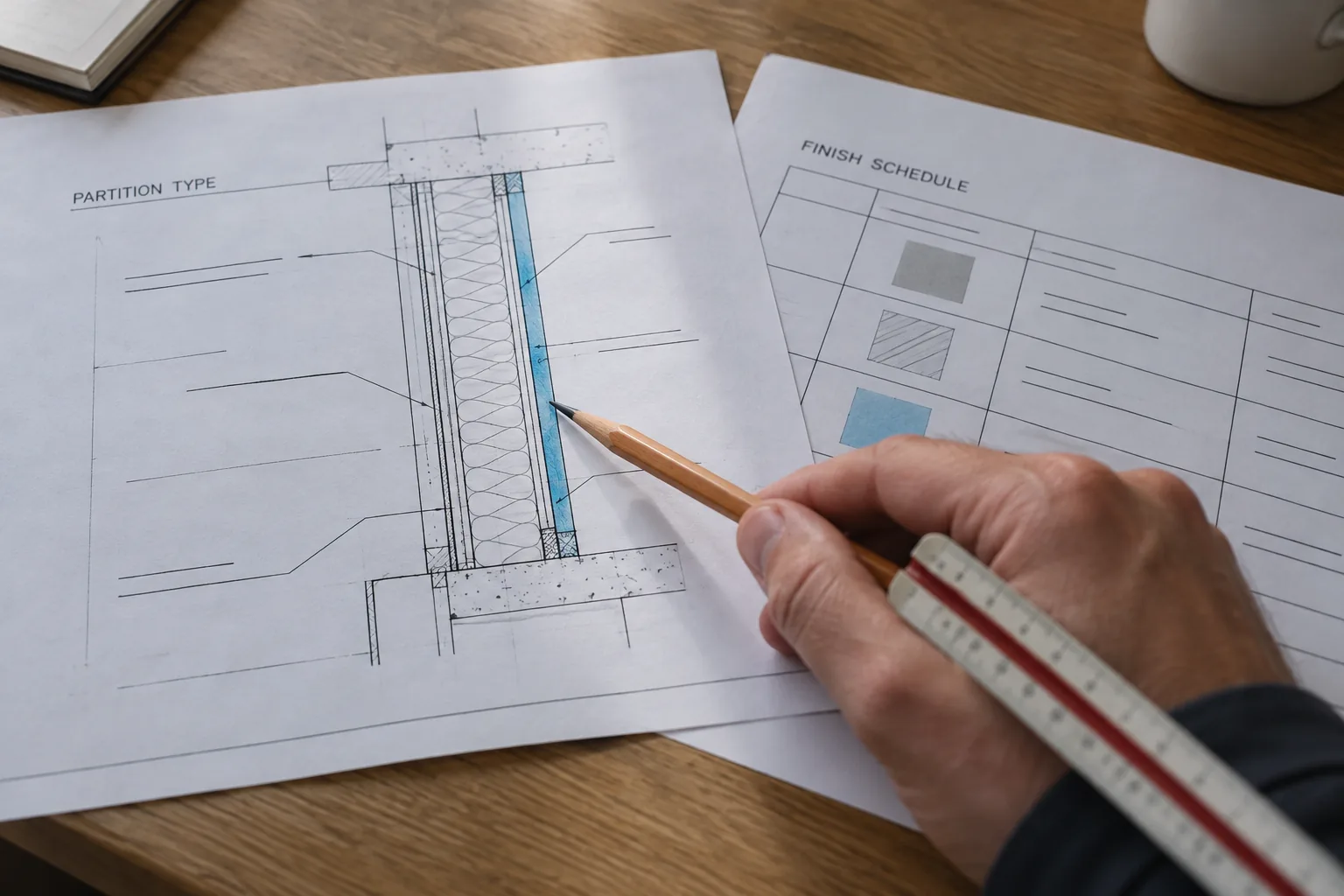
| Trigger | Why It Matters |
|---|---|
| Drawing and spec conflict | Two different products or assemblies, two different prices |
| Missing or partial finish schedule | Quantities cannot be assigned to rooms with confidence |
| No transition detail at flooring changes | Trim, reducers, and prep scope are unpriced |
| Unclear wall type or fire rating | Layer count, board type, and labor hours all shift |
| Unclear responsibility for moisture testing or floor prep | Confirm which documents define the work and which party carries it |
| Ambiguous split between trades | Two bidders carry it, or neither does |
A takeoff can help identify scope gaps early enough to ask about them. A careful drywall takeoff can surface inconsistencies in quantities, wall types, and finish schedules before bid submission.
Before submitting, check Division 01, the finish legend, and any issued addenda for an existing answer. Focus on unresolved document conflicts or omissions that affect scope, quantity, product, or pricing; use the project’s designated process for questions about means and methods.
How a Subcontractor Submits a Pre-Bid RFI
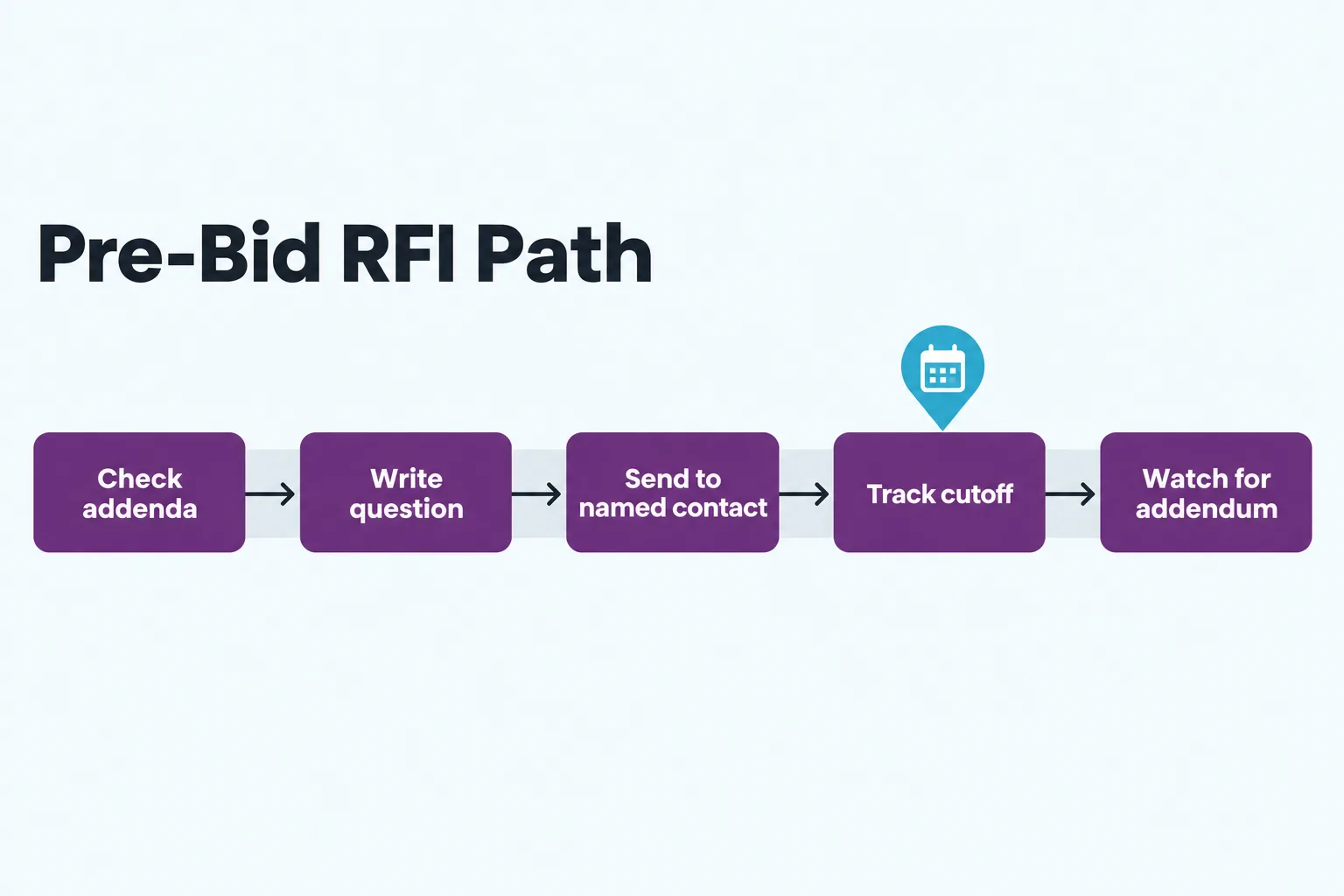
| Step | Action | Common Mistake |
|---|---|---|
| 1 | Read the instructions to bidders for the contact, format, and cutoff date | Assuming that any channel works |
| 2 | Use the portal, planroom, email address, or other channel specified in the bid instructions. Some platforms provide their own question-submission workflow. | Using a channel that is not authorized by the solicitation |
| 3 | Include the project name, bid package, and relevant drawing or specification references. | Sending an incomplete question that is hard to route |
| 4 | Submit before the stated cutoff and allow time for the response process. | Assuming a late question will be answered |
| 5 | Check the official channel for responses and addenda, and review them before submitting. | Pricing from superseded documents |
| 6 | Acknowledge addenda exactly as the bid form or instructions require. | Missing a required acknowledgment |
What to Put in a Pre-Bid RFI (Template and Example)
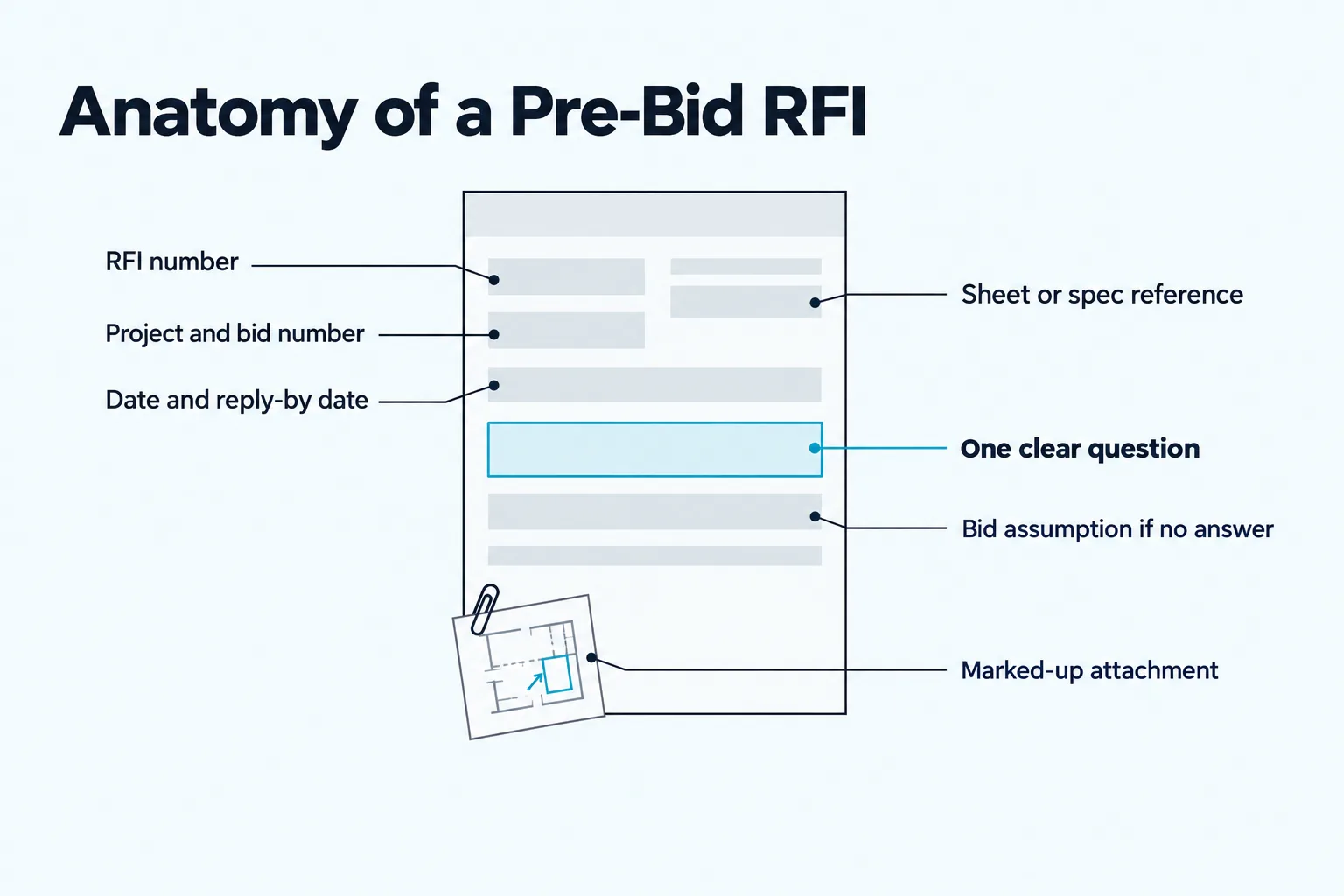
A concise pre-bid RFI should identify the project, point to the relevant documents, and ask one clear question. The AIA G716 Request for Information form is one example of a structured RFI form; use the project’s required form if one is provided.
| Field | What Goes In It |
|---|---|
| RFI number | Sequential, one question per RFI |
| Project name and bid number | Exactly as written in the invitation |
| Date submitted | With the response-needed-by date |
| Reference | Sheet number, detail callout, or spec section |
| Question | One issue, phrased so a yes or no is possible |
| Bid treatment if no answer | The assumption or qualification, if permitted by the bid instructions |
| Attachments | Marked-up sheet clip or product data |
If the bid instructions permit qualifications, state any pricing assumption clearly and identify the unanswered RFI. A qualification does not guarantee acceptance or protect a bid from being found nonresponsive; follow the solicitation and seek clarification through the stated channel.
Worked example: sheet A-601 identifies resilient flooring in a corridor, while Section 09 65 00 appears to describe a different sheet product or seam treatment. Cite both references and ask which material and installation requirements apply. Do not assume that one document controls unless the contract documents establish that order of precedence. A similar question could flag a conflict between a wall type on A-501 and a rated assembly in the specifications. If the bid instructions allow qualifications, keep them clear in a drywall bid template.
Prequalification and Bid Access
Bid access and prequalification requirements vary by owner, project, and jurisdiction. Some solicitations request financial, bonding, insurance, licensing, safety, or past-performance information; others use different eligibility criteria. For federal contracting, the Federal Acquisition Regulation’s contractor-responsibility rules describe how agencies assess prospective contractors. Do not treat those federal rules as a universal checklist for private or state projects.
| Possible item | Why an owner may request it |
|---|---|
| Financial information | May be used to assess financial capacity where required |
| Bonding or insurance information | May be required by the bid documents or applicable rules |
| Licensing | May establish eligibility under applicable requirements |
| Safety information | May be requested as part of project qualification |
| Relevant project experience | May help evaluate experience with similar work |
What Happens to Your Number After the Answer Comes Back
After an official response or addendum, review the affected scope against the current bid documents. If quantities, products, or installation requirements change, update the takeoff and price before submitting. For a material substitution or scope revision, check whether the bid documents require a separate request or approval; an RFI response alone does not automatically change contract price or time.
A late addendum can compress the time available to review and remeasure a trade scope. When estimating capacity is tight, outsourced construction estimating may provide additional takeoff support; confirm the scope and turnaround with the provider.
Keep an RFI and Addendum Log
Track each question from submission through bid close. Record the RFI number, date sent, document references, response status, addendum number, affected scope, and whether the bid form requires acknowledgment. When an addendum changes the scope, mark the affected sheets or specifications, revise the relevant quantities and pricing, and confirm that the current bid package is being used. This log helps the estimator verify coverage; it does not replace the project’s official bid documents.
Frequently asked questions
What should a subcontractor include in a pre-bid RFI?
Is a pre-bid RFI the same as a substitution request?
Who submits RFIs in construction?
Is a verbal answer from the general contractor binding?
What if the bid deadline passes with no response?
Get Bid-Ready Quantities Before the Question Deadline
A takeoff can help surface quantity and scope questions while there is still time to submit them. Quantify North America provides construction takeoff and estimating support, including for flooring, drywall, and painting scopes. If you need help measuring a bid package, talk to our team about your next bid.