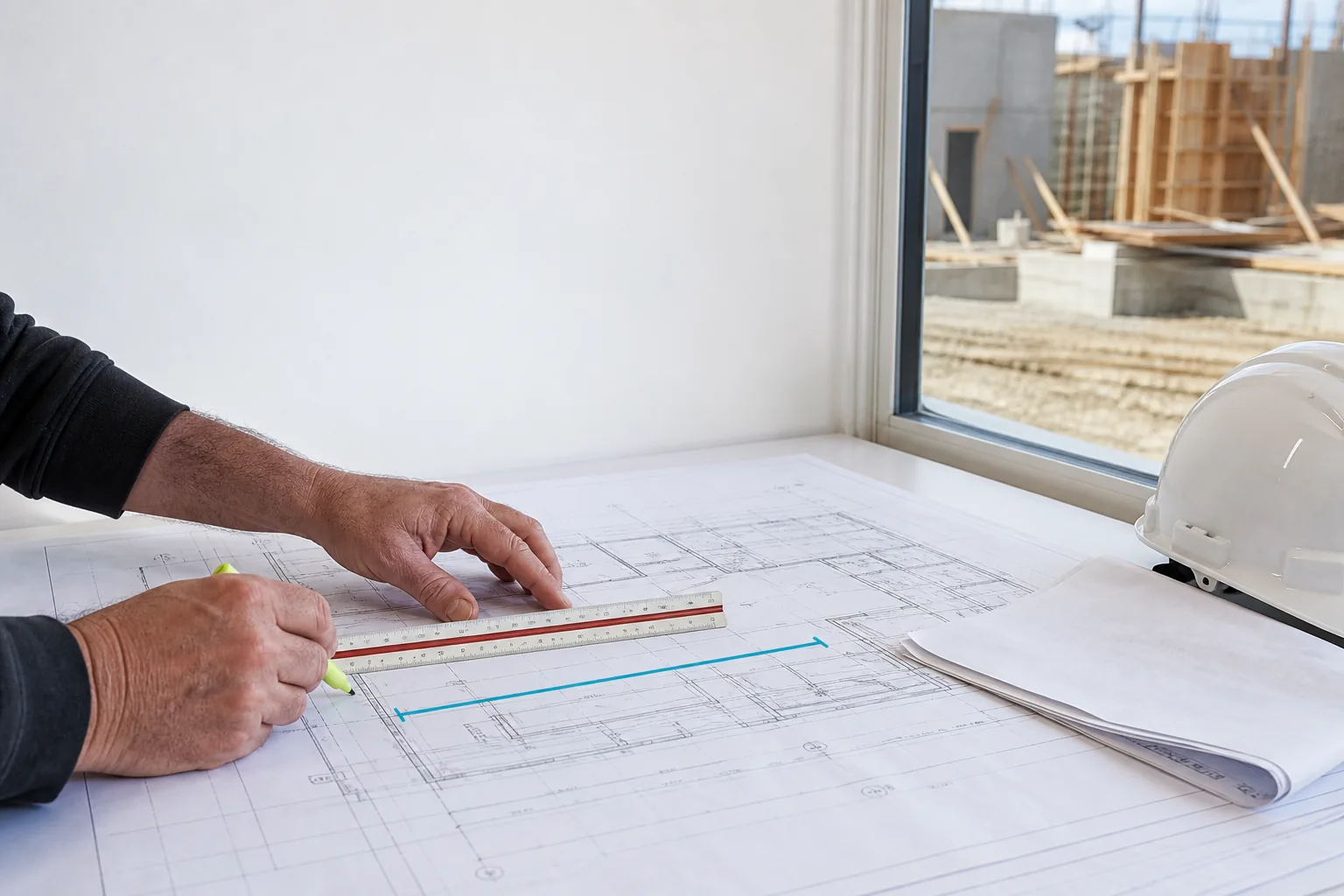
A construction bid looks simple on the surface: scope of work, quantities, material and labor costs, overhead, and a profit margin on top. Yet the gap between the number on paper and the final job cost often decides whether a contractor grows or bleeds cash. Bid accuracy improvement is not just about sharper math; it is about the way you collect information, manage risk, and use data across your entire bidding process in the United States.
This guide shows US contractors how to improve bid accuracy, reduce estimating risk, and protect profit margins using better data, smarter processes, and modern estimating tools. With practical insight into trades like flooring, drywall, ceilings, and painting, it explains how small scope and quantity errors turn into big losses, and how to prevent them.
What Bid Accuracy Improvement Really Means In Construction
When contractors talk about bid accuracy, they usually mix two ideas: how close the construction bid comes to the final cost, and whether the job still delivers the planned profit margin once the dust settles. Bid accuracy improvement means tightening that gap consistently, not just on the odd well-behaved project.
Research on infrastructure and building projects shows how fragile this is. An industry analysis of global construction performance found that close to 90 percent of large projects run over budget, and the biggest “megaprojects” can exceed projected costs by 30 percent or more, often accompanied by significant schedule delays.
Academic work on the effects of inaccurate estimates ties that overrun pattern to disputes, claims, and strained stakeholder relationships. The message is simple: without deliberate bid accuracy improvement, most projects drift.
In practice, an accurate bid does three things. It reflects the real scope of work as designed and specified, it uses realistic material and labor assumptions for the location and timeframe, and it factors in risk in a way that protects margin without knocking the bid out of contention. Bid accuracy improvement, especially in the US market, means you move from ad hoc spreadsheets and habits to a repeatable system grounded in historical data and clear project management routines.

Why Owners And GCs Care About Bid Accuracy, Not Just Low Price
A low number alone does not impress an experienced owner or general contractor. They care about reliability. Studies of project failure highlight inaccurate estimates as a recurring cause of cost disputes, claims, and even abandonment of work. When a contractor submits an accurate bid, the GC sees fewer surprise change orders, fewer cash calls mid-project, and fewer arguments over what was “in” or “out” of the original contract.
Bid accuracy improvement also affects your bid-hit ratio over time. Lenders and consultants who review contractor performance often point out that consistent, believable bids lead to repeat invitations and negotiated work, while a pattern of low-ball bids that explode on site erodes trust.
Industry benchmarks often show that many U.S. contractors average win rates around 20–30% on competitive bids, roughly one win for every four to five submissions, though actual ratios vary widely by project type, market conditions, and delivery model. Reliable, accurate bids support that target far better than aggressive undercutting.
The High Cost Of Inaccurate Bids In The USA
The industry’s track record on overruns makes the cost of bad estimates very clear. One review found that around 86% of projects exceeded budget, with an average cost overrun of 28%. Research on large-scale construction projects shows that roughly 98% of mega-projects blow past their original budgets, and cost overruns in some infrastructure categories can reach around 70% above initial estimates.
Those numbers come from large schemes, but the pattern shows up in everyday US building work as well. Academic and industry studies link overruns to inaccurate cost estimates, weak scope definition, and poor cost control. For a contractor who lives on single-digit profit margins, that gap between estimate and reality hits hard.
You can frame the impact of bid accuracy in three simple buckets.
| Impact Area | What Inaccurate Bids Do In Practice | Typical Result For A Contractor |
| Overbidding | Adds untested contingency, outdated unit rates, or “safety” markups with no data behind them. | Fewer awarded jobs, higher estimated cost per win, and weaker relationships with key GCs or owners. |
| Underbidding | Misses scope items, underestimates labor productivity, or ignores escalation and risk. | Eroded profit margin, cash strain, more change-order fights, and potential losses on “won” projects. |
| Reputation And Pipeline | Creates a pattern of bids that look appealing upfront but lead to overruns or claims. | Lower trust, fewer negotiated opportunities, and more pressure to compete on price alone. |
Core Drivers Of Poor Bid Accuracy
Bid accuracy improvement begins with a clear view of the forces that drag numbers away from reality. Large reviews of cost overrun factors point toward scope clarity, quantity takeoff quality, price volatility, risk allocation, and management of historical data as recurring themes. On the ground in the USA, those themes show up in very specific ways.
An unclear or incomplete scope of work means estimators guess at details. Inadequate quantity takeoffs create systematic undercounts or double counts for material and labor. Weak labor productivity data leads to crew hours that look fine on a worksheet but fail once the job runs.
Outdated pricing ignores real-time changes in local markets for materials, freight, and subcontractor capacity. Fragmented processes, with separate spreadsheets on laptops and paper notes in trucks instead of a cloud-based system, ensure lessons never reach the next bid.
Scope Of Work And Design Detail
Scope drives everything. Studies of estimating errors often point to vague or incomplete design information as a root cause of cost growth. In US commercial work, that can mean missing details for stairwells and transition strips in flooring, unclear bulkhead and soffit details in drywall ceilings, or unspecified coating systems in painting.
Bid accuracy improvement at this stage means interrogating the scope of work rather than taking drawings at face value. Contracts that rely on incomplete drawings, heavy use of allowances, or “performance specs” instead of detailed product descriptions need a different level of contingency and clarification. For trade contractors, a disciplined review of finish schedules and elevations often reveals square footage and lineal footage that never made it into the first rough estimate.
If your team wants a deeper breakdown of how scope links to quantities for finishes, a resource such as a dedicated construction estimating guide can help introduce structure to that early review rather than relying on instinct.
Quantity Takeoff Completeness And Methods
Cost estimate accuracy lives or dies on quantity. Research that compares estimated vs actual costs often uses quantity takeoff completeness as a key explanatory factor. Many smaller contractors still rely on manual scale and highlighters for takeoffs, which increases the risk of missing areas, misreading scales, or counting the same element more than once.
Digital construction takeoff tools, when used with discipline, reduce many of those errors. They allow you to trace linear footage, surface areas, and counts in a consistent way, log assumptions, and test alternatives.
Outsourced estimators who specialise in trades such as flooring, drywall, ceilings, and painting often bring their own takeoff systems and rule sets. That helps standardise how walls, ceilings, substrates, pattern layouts, and waste factors feed into an accurate bid.
Labor Productivity, Crews, And Indirect Costs
Estimators usually know their crew’s hourly rates. Fewer teams maintain structured records of actual production. Research into project performance and cost estimation points out that poor productivity assumptions and weak schedule planning feed both cost overruns and delay.
Bid accuracy improvement around labor comes from tracking how many square feet of drywall a crew hangs and finishes per day at varying heights, how long a flooring crew needs to move between rooms, or how much prep time a painting team spends on patching before they start to coat. The contractors who feed that historical data back into estimating software, instead of relying on rules of thumb, see smaller gaps between bid and actual labor.
Indirect costs matter as well. Mobilisation, supervision, safety, and coordination hours often sit outside simple production rates. If those elements do not appear in the estimate as lines, they still show up in the project ledger. Accurate bid values need to capture those inevitable hours in a deliberate way.
Market Volatility, Supplier Quotes, And Subcontractor Bids
Construction pricing in the US has outpaced general inflation for years. Materials, freight, and labor availability fluctuate by region and season.
Pulling unit rates from old spreadsheets creates risk. So does recycling subcontractor quotes from past jobs.
Better accuracy comes from routines: current supplier pricing, leveled subcontractor bids, and transparent allowances for volatile items. Research shows that weak procurement practices can contribute materially to cost growth and schedule issues.
Risk, Contingency, And Contract Structure
Cost overrun research often lists risk allocation and unclear contract structures among major contributors to budget drift. The delivery method, lump sum, guaranteed maximum price, unit price, or design-build, shifts who holds risk for scope changes, quantity growth, or price escalation.
Bid accuracy improvement requires explicit contingency strategies linked to that structure. A contractor who bids a lump sum on a partially designed commercial interior needs different allowances than a subcontractor on a unit-rate contract with measured quantities.
Risk registers, even simple ones, allow estimators to log threats such as uncertain slab flatness under a flooring package or untested existing substrates under a painting scope and then assign a realistic cost response.

A Practical Framework For Bid Accuracy Improvement
Contractors who reduce variance follow systems, not instincts. A reliable improvement framework includes four elements:
Step 1: Diagnose Where Your Bids Go Wrong
Start with your own record. Studies of estimate accuracy and project success recommend comparison of estimated and actual costs by category as the first step toward an improvement program. Select a sample of recent projects in the USA, preferably a mix of work where you met targets and where you did not. Compare estimated versus actual values for labor, materials, equipment, and overhead, and then calculate variance in percentage terms.
Patterns appear fast. You may see regular underestimates on drywall finishing labor above a certain wall height, surprisingly high waste on some flooring materials, or consistent underpricing of nighttime painting shifts in occupied buildings. That diagnosis gives concrete targets for bid accuracy improvement. It also feeds the next step: structured templates.
Step 2: Standardise Templates, Checklists, And Assumptions
Once you know your weak spots, you can adjust your estimating process so you do not miss the same items next time. Industry guidance on estimating suggests that standard templates reduce omissions and allow faster review.
For flooring, that may mean a template that always includes substrate prep, moisture mitigation when specified, transition strips, and base. For drywall, a standard layout that lists framing, board, insulation, taping, corner beads, backing, and fire stopping in separate lines reduces guesswork. Painting templates that force you to state coat counts, primer type, and access method for each surface keep the scope clear.
Step 3: Digitise Takeoffs And Estimates With Cloud Based Tools
Most leading commentary on construction estimating now assumes the use of digital tools. Software reduces manual error, centralizes data, and enables faster comparisons, but only when assemblies and rates are calibrated to reality. Many contractors blend in-house tools with external estimating support to manage workload and complexity.
Cloud-based estimating software and takeoff tools support bid accuracy improvement in several ways. They store assemblies and unit prices, so estimators do not retype formulas. They push updates to material and labor rates across projects. They keep drawings, scope notes, and historical data in one place rather than scattered through inboxes.
For many small and mid-sized US contractors, the realistic choice is a hybrid. Some maintain in-house estimating software and use external specialty estimators for overflow, hard deadlines, or complex scopes. Others opt to rely more heavily on outsourced construction estimating services that already run proven digital workflows. In both cases, the goal stays the same: use digital systems to reduce noise in the bidding process and save time without losing control.
Step 4: Close The Loop With Job-Cost Feedback
A serious bid accuracy improvement effort always loops back to real numbers. Research on cost estimation and project performance shows that organisations that close this loop improve both schedule and budget outcomes.
That means each completed project feeds back into the estimating database. Actual labor hours per unit of work, actual material consumption including waste, frequency and value of change orders, and any claims or disputes go into a structured record. Estimators then refine rates and factors. Over time, the construction bid for a familiar project type will rest on strong historical data rather than hopeful assumptions.
Cloud-based project management and accounting systems make this easier, but they still need someone to own the process. A project manager, controller, or senior estimator must regularly review job cost reports and push adjustments into the estimating system.
Using Data And KPIs To Measure Bid Accuracy Improvement
Contractors often talk about “getting better at estimating,” but without metrics, the statement does not mean much. Studies and industry recommend a small set of KPIs to track how well cost estimates support project success and business growth.
The table below shows example measures that tie directly to bid accuracy improvement.
| KPI | What It Measures | How It Relates To Bid Accuracy Improvement |
| Bid-Hit Ratio | Number of successful bids divided by total bids. | Shows whether your bidding process targets the right projects and whether your prices look believable. Sudden drops can indicate chronic overbidding. |
| Estimate-To-Actual Cost Variance | Percentage difference between estimated and final cost, by trade and cost code. | Direct measure of bid accuracy. Lower, stable variance after changes means your process improves. |
| Margin Slippage | The difference between the planned and the achieved profit margin. | Captures hidden costs, scope gaps, and change-order performance, even when revenue grows. |
| Estimating Cycle Time | Time from bid invitation to final construction bid submission. | Indicates whether process and software choices help you save time without sacrificing accuracy. |
Setting Realistic Accuracy Targets By Project Type
Not every estimate deserves the same level of precision. Early-stage pricing based on limited drawings naturally carries wider risk than a fully documented bid near contract award. That’s why professional estimating practice works within accuracy ranges rather than pretending all numbers should land in the same window.
Concept-level estimates may reasonably fall far from the final cost, while late-stage bids are expected to perform much more tightly. Bid accuracy improvement for contractors means pulling each estimate type closer to the realistic edge of its own range. The real measure of progress isn’t perfection, but whether cost variance on similar projects shrinks as takeoffs, data quality, and risk planning improve.
Tracking Profit Margin Protection
Profit margin is where estimating accuracy proves itself. A project can match the estimated cost and still disappoint if the markup assumptions were weak or scope protection failed. That’s why many contractors compare planned margin at bid time with actual margin at closeout.

When margins consistently erode, the cause is usually incomplete cost capture or ineffective change-order control. Better scope definition and more deliberate risk allowances reduce surprise work and make scope growth easier to justify. When margins stabilize across similar jobs, it signals that estimating, project management, and contract strategy are working together instead of against each other.
Trade-Specific Bid Accuracy Improvement For Finishing Trades
Flooring, drywall, ceilings, and painting demand more precision than broad estimating advice usually covers. In these trades, small quantity mistakes or misread details can erase profit quickly. Accurate bids depend on disciplined takeoffs, realistic labor assumptions, and a clear link between contract scope and site conditions.
Flooring estimates are heavily influenced by layout complexity, waste factors, and substrate condition. Pattern work, diagonal layouts, and irregular rooms increase both material usage and labor time. Substrate preparation is often underpriced or buried in vague notes, yet crews still perform the work. When prep allowances aren’t explicit, margin quietly absorbs the cost.
Drywall and ceiling bids are shaped by geometry. Wall height changes access needs and productivity, while soffits, bulkheads, and specialty ceilings add framing and accessories that basic takeoffs miss. Fire-rated and acoustic assemblies further complicate material and labor planning. Accuracy improves when estimates break work into assemblies and adjust production rates for actual conditions instead of relying on blended averages.
Painting looks simple on bid forms but hides risk in surface preparation, coating systems, and access constraints. Prep time, coverage rates, specialty coatings, and work in occupied spaces all affect labor and supervision. A clear definition of coating systems by substrate and realistic labor planning for restricted environments prevents underpricing that only becomes visible once crews are on site.
Raising the Standard in Bid Accuracy
Contractors who improve bid accuracy don’t eliminate risk; they control it. Over time, disciplined estimating, real job-cost feedback, and structured takeoffs replace guesswork with confidence. Margins stabilize, forecasts tighten, and bids stop being hopeful numbers and start reflecting how the work will actually run.
In a US market where price pressure never lets up, that control becomes a competitive advantage. Accurate bids protect profit, reduce friction on site, and build long-term trust with owners and GCs.
If you’re ready to move past reactive estimating and bring consistency to your bids, Quantify North America can help. From trade-specific takeoffs to full construction estimating support, Quantify NA works inside your process to deliver numbers you can stand behind. Contact us and turn your next bid into a calculated decision, not a gamble.